
I received my Ph.D. from the Dept. of History at Harvard in 2018. My first book, “The Disinherited: Christianity and Conversion in Colonial India, 1813-1907” is forthcoming from Harvard University Press. The book-project is an intellectual and political history of the creation of the Indian political self – a self that emerged through an often-oppositional relationship with evangelical Christianity and the apologetic debates arising out of such engagements.
My research was funded by the award of the 2013 SSRC-IDRF dissertation research fellowship which enabled me to conduct research at multiple archives in the UK, in India and in Bangladesh. My dissertation received the Harold K. Gross award , which is granted annually by the faculty of the History Department at Harvard to the graduate student whose dissertation ‘gave greatest promise of a distinguished career of historical research.”
My second book, under contract with Juggernaut Press, India, is an intellectual history of the life and times of the pioneering Indian social reformer Raja Rammohan Roy.
My research interests include the religion and politics in India, the history of gender, hunger and food politics, and the history of borders and immigration in colonial South Asia. Prior to my appointment at UW–Madison, I was College fellow at the Department of South Asian Studies at Harvard in 2018 and Assistant Professor of History at Clemson University in 2018-19.
Education
Ph.D.; in History: Harvard University, 2018
A.M.; in History: Harvard University, 2013
M.A.; in English: Jadavpur University, 2006
B.A.; (Hons) in English: Jadavpur University, 2004
Books
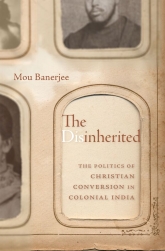
The Disinherited: The Politics of Christian Conversion in Colonial India
Mou Banerjee. The Disinherited: The Politics of Christian Conversion in Colonial India. Harvard University Press, 2025.
An illuminating history of religious and political controversy in nineteenth-century Bengal, where Protestant missionary activity spurred a Christian conversion “panic” that indelibly shaped the trajectory of Hindu and Muslim politics. In 1813, the British Crown adopted a policy officially permitting Protestant missionaries to evangelize among the empire’s Indian subjects. The ramifications proved enormous and long-lasting. While the number of conversions was small—Christian converts never represented more than 1.5 percent of India’s population during the nineteenth century—Bengal’s majority faith communities responded in ways that sharply politicized religious identity, leading to the permanent ejection of religious minorities from Indian ideals of nationhood. Mou Banerjee details what happened as Hindus and Muslims grew increasingly suspicious of converts, missionaries, and evangelically minded British authorities. Fearing that converts would subvert resistance to British imperialism, Hindu and Muslim critics used their influence to define the new Christians as a threatening “other” outside the bounds of authentic Indian selfhood. The meaning of conversion was passionately debated in the burgeoning sphere of print media, and individual converts were accused of betrayal and ostracized by their neighbors. Yet, Banerjee argues, the effects of the panic extended far beyond the lives of those who suffered directly. As Christian converts were erased from the Indian political community, that community itself was reconfigured as one consecrated in faith. While India’s emerging nationalist narratives would have been impossible in the absence of secular Enlightenment thought, the evolution of cohesive communal identity was also deeply entwined with suspicion toward religious minorities. Recovering the perspectives of Indian Christian converts as well as their detractors, The Disinherited is an eloquent account of religious marginalization that helps to explain the shape of Indian nationalist politics in today’s era of Hindu majoritarianism.
Selected Publications
- “The Tale of the Tailor: Munshi Mohammad Meherullah and Muslim- Christian Apologetics in Bengal, 1885–1907.” South Asian Studies (2017), 33:2, 122-136.
- “They all belong to the school of Adam Smith”: The dissemination of Adam Smith’s ideas in Calcutta in the nineteenth century. Cambridge: Harvard University; 2015
- “Christ in the Paintings of Jamini Ray.” Literature and Criticism. 2008;6 (1)
- “Milton: Parrhesiastes/Prophet.” The Atlantic Critical Review. 2008;7 (3)
Advisor To
- Amrita Chowdhury (Asian Languages & Cultures)
- Shatrunjay Mall
- Sagarika Naik
- Srotaswini Bhowmick
History Courses
- History 142 – History of South Asia to the Present – Syllabus 2025 (pdf)
- History 200 – Historical Studies: Gandhi, King, Mandela: Non-Violence in the World – Syllabus 2022 (pdf)
- History 200 – Historical Studies: A Global History of Non-Violence – Syllabus 2020 (pdf)
- History 450 – The Making of Modern South Asia
- History 600 – Advanced Seminar in History: Gandhi, King, Mandela: Non-Violence in the World – Syllabus 2021 (pdf)
- History 600 – Advanced Seminar in History: A Global History of Non-Violence – Syllabus 2020 (pdf)
- History 680/690 – Thesis Colloquium – Syllabus 2025 (pdf)
- History 790 – Empire and Colonialism in South Asia – Syllabus 2022 (pdf)