Faculty Bookshelf
Submit a book to the faculty bookshelf
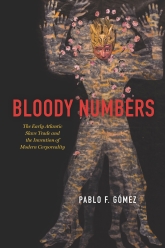
Bloody Numbers: The Early Atlantic Slave and the Invention of the Modern Corporeality
Pablo F. Gómez. Bloody Numbers: The Early Atlantic Slave and the Invention of the Modern Corporeality. University of Chicago Press, 2026.
Bloody Numbers is a provocative account of the violent world of the sixteenth and early seventeenth-century South Atlantic slave-trading societies, where traders, officials, notaries, and ship captains began thinking about human bodies as aggregate populations understood through numbers: measurements, averages, and calculations of risk and value assessed through the tabulation of heights, weights, tumors, scars, and other characteristics. Pablo F. Gómez explores how figures within the Spanish, Portuguese, and African slave trades used this model for understanding human bodies to generalize about behavior and disease in ways that foreshadowed the work of modern epidemiologists and public health officials—though they employed their probabilities with the brutal aim of protecting their financial interests rather than caring for enslaved people. The ruthlessness inherent in these practices became ingrained in the modern corporeal mathematics that emerged from the early slave trade and diffused through its vast political, financial, logistical, and intellectual networks. A pathbreaking work, Bloody Numbers reveals the historical actions that rendered populations quantifiable. In doing so, Gómez shows that confronting these origins is essential to understanding the violent political, legal, economic, and scientific practices that ascribe numbers to our own bodies.

Coding Capitalism: Computers and the Remaking of the Postwar US Economy
Devin Kennedy. Coding Capitalism: Computers and the Remaking of the Postwar US Economy. Columbia University Press, 2026.
Long before Google, Amazon, or Microsoft, computer technology shaped how people worked, how markets operated, and how businesses became big. After World War II, military officials and their partners in industry looked to the newly invented electronic computer as they sought to cut costs, speed up labor, manage supply chains, and—they hoped—bring stability to the postwar economy. Their efforts would shape early computer science and the first applications of computer technology in manufacturing and business, with profound consequences for workers and managers alike. By the 1960s, practices originally developed to improve industrial efficiency were being used by Wall Street, influencing how markets worked and even how traders thought. Digital technology became central to finance, tying together far-flung trading floors and automating decision making—with alarming consequences, including the 1987 Black Monday crash. Devin Kennedy offers a new history of the digital economy, showing how the computer emerged from—and transformed—capitalism in the United States. He traces how computer science and technology were made by industry, which molded computation to manage factories, financial markets, and entire firms. Drawing on the archives of businesses, computer researchers, regulators, and financial institutions, Coding Capitalism retells the story of the postwar economy and the computer, revealing how midcentury business laid the foundations of the digital world. Bridging business and economic history with the history of science and technology, this book uncovers the prehistory of big tech and demonstrates how capitalism has shaped computing since its invention.
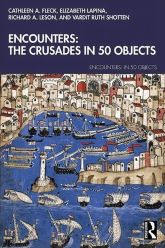
Encounters: The Crusades in 50 Objects
Cathleen A. Fleck, Elizabeth Lapina, Richard A. Leson, and Vardit Ruth Shotten. Encounters: The Crusades in 50 Objects. Routledge, 2026.
From the late eleventh to the late thirteenth century, during the existence of the Kingdom of Jerusalem and other crusader states, Latin Christians did not only frequently encounter Muslims on the battlefield, but also engaged in unprecedented commercial and cultural exchanges with the Muslim, Eastern Christian, and Jewish inhabitants of the Middle East. Through a focused analysis of fifty objects, this volume examines what material culture can tell us about interpersonal, interfaith, cross-cultural, and trans-regional encounters during this period. This richly illustrated volume explores a variety of Latin Christian, Eastern Christian, Muslim, and Jewish objects, including sculpture, glassware, metalware, manuscripts, textiles, painting, coins, and seals. Addressing the themes of Belief, Conflict, Exchange, Power, and Memory, the essays examine the conception of these objects and the uses to which they were put throughout their history. As a result, there emerges a picture of the Middle East as a place of profound cultural diversity and of multiplicity of encounters between different communities. The book stands as a valuable resource for students and scholars of the medieval crusades, the medieval Middle East and Europe, as well as all those interested in archaeology, art history, global history, and religious studies more broadly.

Reinventing Protestant Germany: Religious Nationalists and the Contest for Post-Nazi Democracy
Brandon Bloch. Reinventing Protestant Germany: Religious Nationalists and the Contest for Post-Nazi Democracy. Harvard University Press, 2025.
A revealing account of how German Protestant leaders embraced democratic ideals after WWII, while firmly and consequentially refusing to account for their earlier complicity with Nazism. Germany’s Protestant churches, longtime strongholds of nationalism and militarism, largely backed the Nazi dictatorship that took power in 1933. For many Protestant leaders, pastors, and activists, national and religious revival were one and the same. Even those who opposed the regime tended toward antidemocratic attitudes. By the 1950s, however, Church leaders in West Germany had repositioned themselves as prominent advocates for constitutional democracy and human rights.

Wages for Housework: The Story of a Movement, an Idea, a Promise
Emily Callaci. Wages for Housework: The Story of a Movement, an Idea, a Promise. Penguin UK/Seal USA, 2025.
What would women do with their lives if they had more time? The riveting, untold story of a revolutionary campaign to change the way work is valued ‘The women of the world are serving notice. We want wages for every dirty toilet, every indecent assault, every painful childbirth, every cup of coffee and every smile. And if we don’t get what we want, we will simply refuse to work any longer!’ Across the globe in the 1970s, a network of feminists distilled their struggles into a single demand: Wages for Housework! Today, it remains a provocative idea, and an unfulfilled promise. Here historian Emily Callaci tells the story of this campaign by exploring the lives and ideas of its key creators, tracing their wildly creative political vision over the past five decades: from the early 1970s, when Selma James, a working-class political organizer, and Mariarosa Dalla Costa, a scholar-activist, started laying the foundations of Wages for Housework in London and Italy; through philosopher Silvia Federici reframing the campaign in the context of New York City’s fiscal crisis; to Wilmette Brown, lesbian poet and anti-war activist, and Margaret Prescod, community organizer, who brought the insights of Black feminism to the movement. Drawing on new archival research and extensive interviews, Callaci takes us deep inside the heart of the movement as it reached across Europe, America, Africa and the Caribbean. For these women, the wage was more than a demand for money: it was a starting point for remaking the world as we know it, imagining potential futures under capitalism – and beyond. Then as now, Wages for Housework poses profound questions. What would it be like to live in a society that prioritizes care rather than production? How would this change our relationship with the natural world? And what would women do with their lives if they had more time?
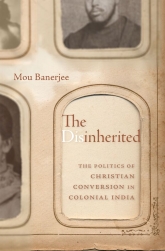
The Disinherited: The Politics of Christian Conversion in Colonial India
Mou Banerjee. The Disinherited: The Politics of Christian Conversion in Colonial India. Harvard University Press, 2025.
An illuminating history of religious and political controversy in nineteenth-century Bengal, where Protestant missionary activity spurred a Christian conversion “panic” that indelibly shaped the trajectory of Hindu and Muslim politics. In 1813, the British Crown adopted a policy officially permitting Protestant missionaries to evangelize among the empire’s Indian subjects. The ramifications proved enormous and long-lasting. While the number of conversions was small—Christian converts never represented more than 1.5 percent of India’s population during the nineteenth century—Bengal’s majority faith communities responded in ways that sharply politicized religious identity, leading to the permanent ejection of religious minorities from Indian ideals of nationhood. Mou Banerjee details what happened as Hindus and Muslims grew increasingly suspicious of converts, missionaries, and evangelically minded British authorities. Fearing that converts would subvert resistance to British imperialism, Hindu and Muslim critics used their influence to define the new Christians as a threatening “other” outside the bounds of authentic Indian selfhood. The meaning of conversion was passionately debated in the burgeoning sphere of print media, and individual converts were accused of betrayal and ostracized by their neighbors. Yet, Banerjee argues, the effects of the panic extended far beyond the lives of those who suffered directly. As Christian converts were erased from the Indian political community, that community itself was reconfigured as one consecrated in faith. While India’s emerging nationalist narratives would have been impossible in the absence of secular Enlightenment thought, the evolution of cohesive communal identity was also deeply entwined with suspicion toward religious minorities. Recovering the perspectives of Indian Christian converts as well as their detractors, The Disinherited is an eloquent account of religious marginalization that helps to explain the shape of Indian nationalist politics in today’s era of Hindu majoritarianism.

Mutiny on the Black Prince: Slavery, Piracy, and the Limits of Liberty in the Revolutionary Atlantic World
James Sweet. Mutiny on the Black Prince: Slavery, Piracy, and the Limits of Liberty in the Revolutionary Atlantic World. Oxford University Press, 2025.
The dramatic story of a mutiny aboard an eighteenth-century British ship and how its owners effectively rallied the power of the British Crown to protect their investment and expand their wealth and political power across multiple generations. In 1768, the British slave ship Black Prince, departed the port of Bristol, bound for West Africa. It never arrived. Before reaching Old Calabar, the crew mutinied, murdering the captain and his officers. The mutineers renamed the ship Liberty, elected new officers, and set out for Brazil. By the time the ship arrived there, the crew had disintegrated into a violent mob and fired into the port city. After the Black Prince wrecked off the coast of Hispaniola, the rebels fled to outposts around the Atlantic world. An eight-year manhunt ensued. This book follows the crew’s turn to piracy and the merchant-owners’ response to the uprising. At the very moment that the American Revolution unfolded in North America, the Black Prince’s owners conducted a “shadow” revolution, mobilizing the power of the British Crown to seek justice and restitution on their behalf. These private merchants used state surveillance, policing, extradition, capital punishment, international diplomacy, and even warfare in order to protect their wealth. During an era of professed liberty and freedom, the privatization of state power was already emerging, replacing monarchies with corporate oligarchies, presaging a new kind of political power in the Atlantic world. The eighteenth-century Bristol slave merchants and subsequent generations of their families accrued great fortunes from the trade and invested it in early British banks, railroads, insurance companies, industrial manufacturing, and even the Anglican Church. Mutiny on the Black Prince narrates the dramatic story of the events onboard and the merchant owners’ efforts to capture the rebels from around the Atlantic world, as well as the way that British slavery shaped the industrializing Atlantic economy and the evolution of the modern corporate state.

Depicting the Holy War: Crusader Imagery in Medieval French and English Murals
Elizabeth Lapina. Depicting the Holy War: Crusader Imagery in Medieval French and English Murals. Penn State University Press, 2025.
Depicting the Holy War examines the impact that crusades in the Middle East had on societies in western Europe through the analysis of a heretofore largely ignored type of source: mural paintings. In this book, Elizabeth Lapina analyzes five programs of mural paintings from the early twelfth to the late thirteenth century in what is today France and England—in Hardham, Berzé-la-Ville, Poncé-sur-le-Loir, Cressac, and Tour Ferrande. These images provide rare sources of information about attitudes toward crusades in locations that have produced next to no written evidence about the subject, such as rural parishes. Four of the murals are found in ecclesiastical structures, themselves sacred and made more so as the location of the celebration of mass. This sacralization of violence, Lapina argues, led to changing attitudes toward the enemy and depictions of battles as “holy wars” between the forces of good and evil. The mural paintings come from England, Normandy, Aquitaine, Provence, and Burgundy, areas that supplied both numerous crusaders and ideas related to crusades. Taken together, the murals show a trend toward an acceptance and celebration of increasingly varied types of violence across the period. This pathbreaking study employs new methods to open a window onto perceptions and representations of crusades in strata of society about which we know relatively little. It will be indispensable to historians and art historians who study crusades, warfare, and violence in medieval England and France.

Banished Citizens: A History of the Mexican American Women Who Endured Repatriation
Marla A. Ramírez. Banished Citizens: A History of the Mexican American Women Who Endured Repatriation. Harvard University Press, 2025.
A moving portrait of a grim period in American immigration history, when approximately one million ethnic Mexicans—mostly women and children who were US citizens—were forced to relocate across the southern border. From 1921 to 1944, approximately one million ethnic Mexicans living in the United States were removed across the border to Mexico. What officials called “repatriation” was in fact banishment: 60 percent of those expelled were US citizens, mainly working-class women and children whose husbands and fathers were Mexican immigrants. Drawing on oral histories, transnational archival sources, and private collections, Marla A. Ramírez illuminates the lasting effects of coerced mass removal on three generations of ethnic Mexicans.

Cold War on Five Continents: A Global History of Empire and Espionage
Alfred W. McCoy. Cold War on Five Continents: A Global History of Empire and Espionage. Haymarket Books, 2025.
A provocative analysis of the deadly conflicts that devastated countries and communities far from Moscow and Washington. Transforming battlegrounds in Africa, Asia, and Latin America into veritable wastelands, surrogate wars in the Cold War era left behind a legacy of collective trauma and social conflict that have persisted into the present. In this ambitious work, Alfred W. McCoy uses a bottom-up, outside-in approach to offer a new perspective on the longest, most consequential conflict in modern world history. McCoy offers an intimate portrait of covert operatives and young antiwar protesters, humanizing the history of the Cold War—a history that has too often been told in terms of economic growth, nuclear arsenals, or diplomatic ententes. By showing how otherwise ordinary individuals helped end a global conflict that threatened nuclear holocaust, McCoy offers important lessons for a younger generation facing climate change even as the great powers devote humanity’s scarce resources to a “new cold war.”

Sailing Away from Byzantium toward East Roman History
Leonora Neville. Sailing Away from Byzantium Toward East Roman History. Cambridge University Press, 2025.
Although the first thing one learns about the ‘Byzantine Empire’ is that it was really the eastern Roman empire, scholars have preferred to call it ‘Byzantine’ in a repudiation of the self-conception and emic vocabulary of the inhabitants of that polity. The terminology of ‘Byzantium’ artificially severs the ‘medieval’ eastern Roman empire from its ‘classical’ roots allowing for the fundamentally Eurocentric schematization of history into ‘ancient,’ ‘medieval,’ and ‘Renaissance’ periods. ‘Byzantine’ is not a benign term of art but has served a variety of political and historiographical agendas including maintaining nationalist visions of ethnic continuity, creating precedents for communism, enabling politics of nostalgia for Orthodox dominion, and constructing visions of western European superiority and masculinity that justify colonialism. By exploring these intellectual legacies of ‘Byzantium,’ and the benefits of conceptualizing Roman history as an unsevered whole, this Element exhorts scholars to let go of the ‘Byzantine’ misnomer.
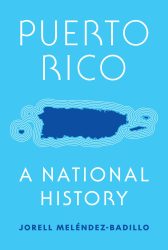
Puerto Rico: A National History
Jorell Meléndez-Badillo. Puerto Rico: A National History. Princeton University Press, 2024.
Puerto Rico is a Spanish-speaking territory of the United States with a history shaped by conquest and resistance. For centuries, Puerto Ricans have crafted and negotiated complex ideas about nationhood. Jorell Meléndez-Badillo provides a new history of Puerto Rico that gives voice to the archipelago’s people while offering a lens through which to understand the political, economic, and social challenges confronting them today. In this masterful work of scholarship, Meléndez-Badillo sheds light on the vibrant cultures of the archipelago in the centuries before the arrival of Columbus, and captures the full sweep of Puerto Rico’s turbulent history in the centuries that followed, from the first indigenous insurrection against colonial rule in 1511—led by the powerful chieftain Agüeybaná II—to the establishment of the Commonwealth in 1952. He deftly portrays the contemporary period and the intertwined though unequal histories of the archipelago and the continental United States. Puerto Rico is an engaging, sometimes personal, and consistently surprising history of colonialism, revolt, and the creation of a national identity, offering new perspectives not only on Puerto Rico and the Caribbean but on the United States and the Atlantic world more broadly. Available in Spanish from our partners at Grupo Planeta

Looking Through the Speculum: Examining the Women’s Health Movement
Judith A. Houck. Looking Through the Speculum: Examining the Women’s Health Movement. University of Chicago Press, 2024.
Highlights local history to tell a national story about the evolution of the women’s health movement, illuminating the struggles and successes of bringing feminist dreams into clinical spaces. The women’s health movement in the United States, beginning in 1969 and taking hold in the 1970s, was a broad-based movement seeking to increase women’s bodily knowledge, reproductive control, and well-being. It was a political movement that insisted that bodily autonomy provided the key to women’s liberation. It was also an institution-building movement that sought to transform women’s relationships with medicine; it was dedicated to increasing women’s access to affordable health care without the barriers of homophobia, racism, and sexism. But the movement did not only focus on women’s bodies. It also encouraged activists to reimagine their relationships with one another, to develop their relationships in the name of personal and political change, and, eventually, to discover and confront the limitations of the bonds of womanhood. This book examines historically the emergence, development, travails, and triumphs of the women’s health movement in the United States. By bringing medical history and the history of women’s bodies into our emerging understandings of second-wave feminism, the author sheds light on the understudied efforts to shape health care and reproductive control beyond the hospital and the doctor’s office—in the home, the women’s center, the church basement, the bookshop, and the clinic. Lesbians, straight women, and women of color all play crucial roles in this history. At its center are the politics, institutions, and relationships created by and within the women’s health movement, depicted primarily from the perspective of the activists who shaped its priorities, fought its battles, and grappled with its shortcomings.
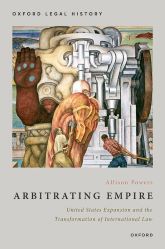
Arbitrating Empire: United States Expansion and the Transformation of International Law
Allison Powers Useche. Arbitrating Empire: United States Expansion and the Transformation of International Law. Oxford University Press, 2024.
Traces how ordinary people used international law to hold the United States accountable for state violence during the first decades of the twentieth century Shows how key transformations in the legal architecture of the early twentieth-century United States Empire were the product of efforts to insulate the US government from international scrutiny Rethinks histories of the Monroe and Calvo Doctrines in the Americas Offers a new way of understanding formations of modern international law through attention to erasure in legal archives

The Crusades and Nature: Natural and Supernatural Environments in the Middle Ages
Jessalynn Bird (Co-editor), and Elizabeth Lapina (Co-editor). The Crusades and Nature: Natural and Supernatural Environments in the Middle Ages. Palgrave Macmillan, 2024.
The Crusades and Nature: Natural and Supernatural Environments in the Middle Ages explores the intersection of crusader studies and studies of nature. The volume addresses encounters with, responses to and representations of a broad variety of phenomena: celestial objects and events; familiar and unfamiliar fauna and flora; seascapes and landscapes; the elements and the seasons; etc. It introduces readers to crusaders’ actual, but also largely or entirely imaginary encounters with natural phenomena, as well as literary references to nature in crusader sources more generally (such as, for example, animal metaphors). Finally, this project investigates the relationships between the natural and the supernatural and between nature and human-made environments. The volume will define “crusades” broadly, to include not only crusades to the East, but also crusades to frontier regions such as the Baltic and Iberian peninsula and extends to representations of crusades and nature in later medieval and early modern sources.

Uneasy Allies: Sino-American Relations at the Grassroots, 1937–1949
Zach Fredman (Co-editor), and Judd Kinzley (Co-editor). Uneasy Allies: Sino-American Relations at the Grassroots, 1937–1949. Cambridge University Press, 2024.
This timely collection of essays examines Sino-American relations during the Second World War, the Chinese Civil War and the opening of the Cold War. Drawing on new sources uncovered in China, Taiwan, the UK and the US, the authors demonstrate how ‘grassroots’ engagements – not just elite diplomacy – established the trans-Pacific networks that both shaped the postwar order in Asia, and continue to influence Sino-US relations today. In these crucial years, servicemen, scientists, students, businesspeople, activists, bureaucrats and many others travelled between the US and China. In every chapter, this innovative volume’s approach uncovers their stories using both Chinese and English language sources. By examining interactions among various Chinese and American actors in the dynamic wartime environment, Uneasy Allies reveals a new perspective on the foundations of American power, the brittle nature of the Sino-American relationship, and the early formation of the institutions that shaped the Cold War Pacific.
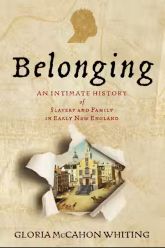
Belonging: An Intimate History of Slavery and Family in Early New England
Gloria Whiting. Belonging: An Intimate History of Slavery and Family in Early New England. Penn Press, 2024.
*Winner of the 2025 John Winthrop Prize from the Colonial Society of Massachusetts for the best book on the seventeenth century published in 2024. *Winner of the 2025 Frances Richardson Keller-Sierra Prize from the Western Association of Women Historians for the best single-authored historical monograph published in 2024. Explores how Black New Englanders maintained a sense of belonging among their kin in the face of slavery. As winter turned to spring in the year 1699, Sebastian and Jane embarked on a campaign of persuasion. The two wished to marry, and they sought the backing of their community in Boston. Nothing, however, could induce Jane’s enslaver to consent. Only after her death did Sebastian and Jane manage to wed, forming a long-lasting union even though husband and wife were not always able to live in the same household. New England is often considered a cradle of liberty in American history, but this snippet of Jane and Sebastian’s story reminds us that it was also a cradle of slavery. From the earliest years of colonization, New Englanders bought and sold people, most of whom were of African descent. In Belonging, Gloria McCahon Whiting tells the region’s early history from the perspective of the people, like Jane and Sebastian, who belonged to others and who struggled to maintain a sense of belonging among their kin. Through a series of meticulously reconstructed family narratives, Whiting traces the contours of enslaved people’s intimate lives in early New England, where they often lived with those who bound them but apart from kin. Enslaved spouses rarely were able to cohabit; fathers and their offspring routinely were separated by inheritance practices; children could be removed from their mothers at an enslaver’s whim; and people in bondage had only partial control of their movement through the region, which made more difficult the task of maintaining distant relationships. But Belonging does more than lay bare the obstacles to family stability for those in bondage. Whiting also charts Afro-New Englanders’ persistent demands for intimacy throughout the century and a half stretching from New England’s founding to the American Revolution. And she shows how the work of making and maintaining relationships influenced the region’s law, religion, society, and politics. Ultimately, the actions taken by people in bondage to fortify their families played a pivotal role in bringing about the collapse of slavery in New England’s most populous state, Massachusetts.
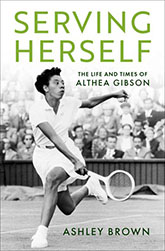
Serving Herself: The Life and Times of Althea Gibson
Ashley Brown. Serving Herself: The Life and Times of Althea Gibson. Oxford University Press, 2023.
A compelling narrative of the trials and triumphs of tennis champion Althea Gibson, a key figure in the integration of American sports and, for a time, one of the most famous women in the world. From her start playing paddle tennis on the streets of Harlem as a young teenager to her eleven Grand Slam tennis wins to her professional golf career, Althea Gibson became the most famous black sportswoman of the mid-twentieth century. In her unprecedented athletic career, she was the first African American to win titles at the French Open, Wimbledon, and the US Open. In this comprehensive biography, Ashley Brown narrates the public career and private struggles of Althea Gibson (1927-2003). Based on extensive archival work and oral histories, Serving Herself sets Gibson’s life and choices against the backdrop of the Great Migration, Jim Crow racism, the integration of American sports, the civil rights movement, the Cold War, and second wave feminism. Throughout her life Gibson continuously negotiated the expectations of her supporters and adversaries, including her patrons in the black-led American Tennis Association, the white-led United States Lawn Tennis Association, and the media, particularly the Black press and community’s expectations that she selflessly serve as a representative of her race. An incredibly talented, ultra-competitive, and not always likeable athlete, Gibson wanted to be treated as an individual first and foremost, not as a member of a specific race or gender. She was reluctant to speak openly about the indignities and prejudices she navigated as an African American woman, though she faced numerous institutional and societal barriers in achieving her goals. She frequently bucked conventional norms of femininity and put her career ahead of romantic relationships, making her personal life the subject of constant scrutiny and rumors. Despite her major wins and international recognition, including a ticker tape parade in New York City and the covers of Sports Illustrated and Time, Gibson endeavored to find commercial sponsorship and permanent economic stability. Committed to self-sufficiency, she pivoted from the elite amateur tennis circuit to State Department-sponsored goodwill tours, attempts to find success as a singer and Hollywood actress, the professional golf circuit, a tour with the Harlem Globetrotters and her own professional tennis tour, coaching, teaching children at tennis clinics, and a stint as New Jersey Athletics Commissioner. As she struggled to support herself in old age, she was left with disappointment, recounting her past achievements decades before female tennis players were able to garner substantial earnings. A compelling life and times portrait, Serving Herself offers a revealing look at the rise and fall of a fiercely independent trailblazer who satisfied her own needs and simultaneously set a pathbreaking course for Black athletes.

Citizens of a Stolen Land: A Ho-Chunk History of the Nineteenth-Century United States
Stephen Kantrowitz. Citizens of a Stolen Land: A Ho-Chunk History of the Nineteenth-Century United States. The University of North Carolina Press, 2023.
This concise and revealing history reconsiders the Civil War era by centering one Native American tribe’s encounter with citizenship. In 1837, eleven years before Wisconsin’s admission as a state, representatives of the Ho-Chunk people yielded under immense duress and signed a treaty that ceded their remaining ancestral lands to the U.S. government. Over the four decades that followed, as “free soil” settlement repeatedly demanded their further expulsion, many Ho-Chunk people lived under the U.S. government’s policies of “civilization,” allotment, and citizenship. Others lived as outlaws, evading military campaigns to expel them and adapting their ways of life to new circumstances. After the Civil War, as Reconstruction’s vision of nonracial, national, birthright citizenship excluded most Native Americans, the Ho-Chunk who remained in their Wisconsin homeland understood and exploited this contradiction. Professing eagerness to participate in the postwar nation, they gained the right to remain in Wisconsin as landowners and voters while retaining their language, culture, and identity as a people. This history of Ho-Chunk sovereignty and citizenship offer a bracing new perspective on citizenship’s perils and promises, the way the broader nineteenth-century conflict between “free soil” and slaveholding expansion shaped Indigenous life, and the continuing impact of Native people’s struggles and claims on U.S. politics and society.

A Global History of Crime and Punishment Volume 2: A Global History of Crime and Punishment in the Medieval Age
Karl Shoemaker (Editor). A Global History of Crime and Punishment Volume 2: A Global History of Crime and Punishment in the Medieval Age. Bloomsbury Publishing Inc, 2023.
What constituted a crime 2,500 years ago, and how was criminal activity dealt with? How has our definition of justice evolved over time alongside developments in law, society, religion and class structures? 36 experts address these pressing questions in a six-volume reference set that spans 2,500 years of human history. Integrating perspectives from history, cultural studies, philosophy and classics, this globally-focused work traces developments in the ever-changing criminal and justice worlds against a variety of social, legal and cultural contexts. Individual volume editors ensure the cohesion of the whole, and to make it as easy as possible to use, chapter titles are identical across each of the volumes. This gives the choice of reading about a specific period in one of the volumes, or following a theme across history by reading the relevant chapter in each of the six. The six volumes cover: 1. Antiquity (500 BCE – 800 CE); 2. Medieval Age (800 – 1450); 3. Renaissance (1450 – 1650) ; 4. Age of Enlightenment (1650 – 1800); 5. Age of Empire (1800 – 1920); 6. Modern Age (1920 – 2000+). Themes include crime, types of criminal, law enforcement, sanctions and representations of crime and punishment. The page extent is approximately 1,728 pp. with c. 300 illustrations. Each volume opens with notes on contributors, a series preface and an introduction, and concludes with notes, bibliography and an index. Table of Contents Volume 1: A Global History of Crime and Punishment in Antiquity Edited by Adriaan Lanni, Harvard Law School, USA Volume 2: A Global History of Crime and Punishment in the Medieval Age Edited by Karl Shoemaker, University of Wisconsin–Madison, USA Volume 3: A Global History of Crime and Punishment in the Renaissance Edited by Laura Stokes, Stanford University, USA Volume 4: A Global History of Crime and Punishment in the Age of Enlightenment Edited by Xavier Rousseaux, Université Catholique de Louvain, Belgium Volume 5: A Global History of Crime and Punishment in the Age of Empire Edited by Mark Finnane, Griffith University, Australia Volume 6: A Global History of Crime and Punishment in the Modern Age Edited by Paul Lawrence, The Open University, UK

Pan-Asianism and the Legacy of the Chinese Revolution
Viren Murthy. Pan-Asianism and the Legacy of the Chinese Revolution. The University of Chicago Press, 2023.
Recent proposals to revive the ancient Silk Road for the contemporary era and ongoing Western interest in China’s growth and development have led to increased attention to the concept of pan-Asianism. Most of that discussion, however, lacks any historical grounding in the thought of influential twentieth-century pan-Asianists. In this book, Viren Murthy offers an intellectual history of the writings of theorists, intellectuals, and activists—spanning leftist, conservative, and right-wing thinkers—who proposed new ways of thinking about Asia in their own historical and political contexts. Tracing pan-Asianist discourse across the twentieth century, Murthy reveals a stronger tradition of resistance and alternative visions than the contemporary discourse on pan-Asianism would suggest. At the heart of pan-Asianist thinking, Murthy shows, were the notions of a unity of Asian nations, of weak nations becoming powerful, and of the Third World confronting the “advanced world” on equal terms—an idea that grew to include non-Asian countries into the global community of Asian nations. But pan-Asianists also had larger aims, imagining a future beyond both imperialism and capitalism. The fact that the resurgence of pan-Asianist discourse has emerged alongside the dominance of capitalism, Murthy argues, signals a profound misunderstanding of its roots, history, and potential.

Russian translation of “Soviet Judgment at Nuremberg: A History of the New International Military Tribunal After World War II.” Translated by Robert Abatullin.
Francine Hirsch. Russian Translation of “Soviet Judgment at Nuremberg: A History of the New International Military Tribunal After World War II.” Translated by Robert Abatullin. NLO, 2023.
Organized in the immediate aftermath of World War II to try the former Nazi leaders for war crimes, the Nuremberg trials, known as the International Military Tribunal (IMT), paved the way for global conversations about genocide, justice, and human rights that continue to this day. As Francine Hirsch reveals in this immersive new history of the trials, a central piece of the story has been routinely omitted from standard accounts: the critical role that the Soviet Union played in making Nuremberg happen in the first place. Hirsch’s book reveals how the Soviets shaped the trials–only to be written out of their story as Western allies became bitter Cold War rivals. Soviet Judgment at Nuremberg offers the first full picture of the war trials, illuminating the many ironies brought to bear as the Soviets did their part to bring the Nazis to justice. Everyone knew that Stalin had originally allied with Hitler before the Nazi invasion of the Soviet Union. The Molotov-Ribbentrop Pact of 1939 hung heavy over the courtroom, as did the suspicion among the Western prosecutors and judges that the Soviets had falsified evidence in an attempt to pin one of their own war crimes, the Katyn massacre of Polish officers, on the Nazis. It did not help that key members of the Soviet delegation, including the Soviet judge and chief prosecutor, had played critical roles in Stalin’s infamous show trials of the 1930s. For the lead American prosecutor Robert H. Jackson and his colleagues, Soviet participation in the Nuremberg Trials undermined their overall credibility and possibly even the moral righteousness of the Allied victory. Yet Soviet jurists had been the first to conceive of a legal framework that treated war as an international crime. Without it, the IMT would have had no basis for judgment. The Soviets had borne the brunt of the fighting against Germany–enduring the horrors of the Nazi occupation and experiencing almost unimaginable human losses and devastation. There would be no denying their place on the tribunal, nor their determination to make the most of it. Once the trials were set in motion, however, little went as the Soviets had planned. Soviet Judgment at Nuremberg shows how Stalin’s efforts to direct the Soviet delegation and to steer the trials from afar backfired, and how Soviet war crimes became exposed in open court. Hirsch’s book offers readers both a front-row seat in the courtroom and a behind-the-scenes look at the meetings in which the prosecutors shared secrets and forged alliances. It reveals the shifting relationships among the four countries of the prosecution (the U.S., Great Britain, France, and the USSR), uncovering how and why the Palace of Justice in Nuremberg became a Cold War battleground. In the process Soviet Judgment at Nuremberg offers a new understanding of the trials and a fresh perspective on the post-war movement for human rights.

Russian translation of “Empire of Nations: Ethnographic Knowledge and the Making of the Soviet Union”. Translated by Robert Ibatullin
Francine Hirsch. Russian Translation of “Empire of Nations: Ethnographic Knowledge and the Making of the Soviet Union". Translated by Robert Ibatullin. NLO, 2022.
Published in English in 2005, The Empire of Nations has already earned the status of a classic study of the history of Soviet nationality politics. Francine Hirsch traces the interaction of power and expertise in the process of state building, showing the contribution of ethnographers, anthropologists, geographers, linguists and other specialists in the formation of Soviet ideas about the nation and race, as well as the development of the very principles of the structure of the USSR as a multinational state. In the 1920s and 1930s, specific forms of state policy towards certain peoples depended on experts who had pre-revolutionary training and relied on Western European ideas. Based on extensive archival research, the author shows how, through planning and conducting censuses, mapping, creating museum exhibitions, the general ideas of the Bolsheviks crystallized into political decisions. The European idea of cultural evolutionism, the Marxist theory of stage development and the Leninist idea of the ability of a revolutionary party to accelerate historical development became the basis of the state policy of integrating different peoples and cultures within the framework of the Soviet project. Francine Hirsch is Professor of History at the University of Wisconsin–Madison (USA).
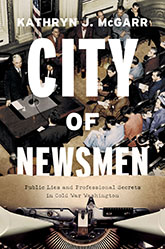
City of Newsmen: Public Lies and Professional Secrets in Cold War Washington
Kathryn McGarr. City of Newsmen: Public Lies and Professional Secrets in Cold War Washington. University of Chicago Press , 2022.
An inside look at how midcentury DC journalists silenced their own skepticism and shaped public perceptions of the Cold War. Americans’ current trust in journalists is at a dismayingly low ebb, particularly on the subject of national and international politics. For some, it might be tempting to look back to the mid-twentieth century, when the nation’s press corps was a seemingly venerable and monolithic institution that conveyed the official line from Washington with nary a glint of anti-patriotic cynicism. As Kathryn McGarr’s City of Newsmen shows, however, the real story of what Cold War–era journalists did and how they did it wasn’t exactly the one you’d find in the morning papers. City of Newsmen explores foreign policy journalism in Washington during and after World War II—a time supposedly defined by the press’s blind patriotism and groupthink. McGarr reveals, though, that DC reporters then were deeply cynical about government sources and their motives, but kept their doubts to themselves for professional, social, and ideological reasons. The alliance and rivalries among these reporters constituted a world of debts and loyalties: shared memories of harrowing wartime experiences, shared frustrations with government censorship and information programs, shared antagonisms, and shared mentors. McGarr ventures into the back hallways and private clubs of the 1940s and 1950s to show how white male reporters suppressed their skepticism to build one of the most powerful and enduring constructed realities in recent US history—the Washington Cold War consensus. Though by the 1960s, this set of reporters was seen as unduly complicit with the government—failing to openly critique the decisions and worldviews that led to disasters like the Vietnam War—McGarr shows how self-aware these reporters were as they negotiated for access, prominence, and, yes, the truth—even as they denied those things to their readers.

The Politics of Time in China and Japan: Back to the Future
Viren Murthy. The Politics of Time in China and Japan: Back to the Future. Routledge, 2022.
Drawing on a wide range of texts and using an interdisciplinary approach, this volume shows how Chinese and Japanese intellectuals mobilized the past to create a better future. It is especially significant today given a world where, amidst tensions within Asia and the rise of China, East Asian intellectuals and governments constantly find new political meanings in their traditions. The essays illuminate how throughout Chinese and Japanese history, thinkers constantly weaved together nationalism, internationalism, and a politics of time. This volume explores a broad range of subjects such as premodern and early modern attempts to conjure a politics of Confucianism, twentieth-century Japanese Marxist interpretations of Buddhism, and Japanese and Chinese endeavors to imagine a new world order. In sum, this book shows us why understanding East Asian pasts are essential to making sense of ideological trends in contemporary China and Japan. For example, without understanding Confucianism and how modern intellectuals in China grappled with this body of thought, we would be unable to make sense of the Chinese government’s current promotion of the Chinese classics. This book will interest students and scholars of political science, history, Asian studies, sociology, and philosophy.

Games and Visual Culture in the Middle Ages and the Renaissance
Vanina Kopp (Co-editor), and Elizabeth Lapina (Co-editor). Games and Visual Culture in the Middle Ages and the Renaissance. Brepols, 2021.
The volume contributes to reconstruction of medieval and early modern gaming culture through analysis of visual and material evidence. During the Middle Ages and the Renaissance, games were not an idle pastime, but were in fact important tools for exploring, transmitting, enhancing, subverting, and challenging social practices and their rules. Their study, through both visual and material sources, offers a unique insight into medieval and early modern gaming culture, shedding light not only on why, where, when, with whom and in what conditions and circumstances people played games, but also on the variety of interpretations that they had of games and play. Representations of games, and of artefacts associated with games, also often served to communicate complex ideas on topics that ranged from war to love, and from politics to theology. This volume offers a particular focus onto the type of games that required little or no physical exertion and that, consequently, all people could enjoy, regardless of age, gender, status, occupation, or religion. The representations and artefacts discussed here by contributors, who come from varied disciplines including history, literary studies, art history, and archaeology, cover a wide geographical and chronological range, from Spain to Scandinavia to the Ottoman Turkey and from the early medieval period to the seventeenth century and beyond. Far from offering the ‘last word’ on the subject, it is hoped that this volume will encourage further studies. Vanina Kopp is Privatdozentin at the University of Münster. She was research group leader on medieval games at the German Historical Institute in Paris, where she wrote her second book Sacred, Serious, Subversive (Habilitation, 2020) on literary games in monastic, courtly, and urban contexts, and she has co-edited two volumes on educational games (Jeux éducatifs et savoirs ludiques in Ludica, 2016-2018). She is also the author of one monograph (Der König und die Bücher, Thorbecke 2016) and co-author of an edited volume on archives and power (Archiv Macht Wissen, Campus 2010). Elizabeth Lapina is Associate Professor of Medieval History and Director of the Medieval Studies Program at the University of Wisconsin – Madison. She is the author of one monograph (Warfare and the Miraculous in the Chronicles of the First Crusade, Penn State, 2015) and is co-editor of two volumes (The Crusades and Visual Culture, Ashgate, 2015 and The Uses of the Bible in Crusader Sources, Brill, 2017). Her articles include ”Gambling and Gaming in the Holy Land: Chess, Dice and Other Games in the Sources of the Crusades,” published in Crusades in 2013. Table of Contents List of Illustrations Introduction — VANINA KOPP AND ELIZABETH LAPINA Rhetoric and Reality in the Visual Culture of Medieval Celtic Board Games: Literary and Archaeological Evidence Combined — KATHERINE FORSYTH AND MARK A. HALL ‘Turne Over the Leef’: Games and Interpretation on Misericords — PAUL HARDWICK Gambling Miners — LENA ASRIH AND JENNIFER GARNER Chess and Cultural Crossings in Boccaccio — AKASH KUMAR Visualizing Chess and Love in Les Eschéz d’Amours — DANIEL E. O’SULLIVAN Game as a Sign of Social Status: Backgammon in the Ottoman Literature and Visual Culture — TÜLÜN DEĞIRMENCI Chess of the Gnostics: The Sufi Version of Snakes and Ladders in Turkey and India — İRVIN CEMIL SCHICK Playthings: Ivory on Ivory — ELINA GERTSMAN The Playing Eye: On the Transfer of Game-related Knowledge through Miniatures in Alfonso X’s Book of Games (1283/84) — MICHAEL A. CONRAD Children’s Toys in Italy, 1350–1550 — ANNEMARIEKE WILLEMSEN The Printed Book and the Visual Culture of Chess in the Late Middle Ages: William Caxton’s 1483 Edition of The Game and Playe of Chess — LOUISE FANG Graffiti as Gaming: Vikings at Play in the Orkney Islands — JULIE MELL Scratching the Surface: Graffiti Games in the Byzantine Empire — WALTER CRIST
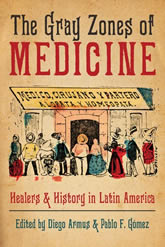
The Gray Zones of Medicine: Healers and History in Latin America
Pablo F. Gómez (Editor), and Diego Armus (Editor). The Gray Zones of Medicine: Healers and History in Latin America. University of Pittsburgh Press, 2021.
Health practitioners working in gray zones, or between official and unofficial medicines, played a fundamental role in shaping Latin America from the colonial period onward. The Gray Zones of Medicine offers a human, relatable, complex examination of the history of health and healing in Latin America across five centuries. Contributors uncover how biographical narratives of individual actors—outside those of hegemonic biomedical knowledge, careers of successful doctors, public health initiatives, and research and medical institutions—can provide a unique window into larger social, cultural, political, and economic historical changes and continuities in the region. They reveal the power of such stories to illuminate intricacies and resilient features of the history of health and disease, and they demonstrate the importance of escaping analytical constraints posed by binary frameworks of legality/illegality, learned/popular, and orthodoxy/heterodoxy when writing about the past. Through an accessible and story-like format, this book unlocks the potential of historical narratives of healings to understand and give nuance to processes too frequently articulated through intellectual medical histories or the lenses of empires, nation-states, and their institutions.

To Govern the Globe: World Orders and Catastrophic Change
Alfred W. McCoy. To Govern the Globe: World Orders and Catastrophic Change. Haymarket Books, 2021.
In a sweep through seven centuries from 1350 to 2050, the work explains how catastrophes– pandemics, wars, and climate crisis–have shaped the destiny of empires and world orders. In a tempestuous narrative that sweeps across five continents and seven centuries, this book explains how a succession of catastrophes—from the devastating Black Death of 1350 through the coming climate crisis of 2050—has produced a relentless succession of rising empires and fading world orders. During the long centuries of Iberian and British imperial rule, the quest for new forms of energy led to the development of the colonial sugar plantation as a uniquely profitable kind of commerce. In a time when issues of race and social justice have arisen with pressing urgency, the book explains how the plantation’s extraordinary profitability relied on a production system that literally worked the slaves to death, creating an insatiable appetite for new captives that made the African slave trade a central feature of modern capitalism for over four centuries. After surveying past centuries roiled by imperial wars, national revolutions, and the struggle for human rights, the closing chapters use those hard-won insights to peer through the present and into the future. By rendering often-opaque environmental science in lucid prose, the book explains how climate change and changing world orders will shape the life opportunities for younger generations, born at the start of this century, during the coming decades that will serve as the signposts of their lives—2030, 2050, 2070, and beyond.
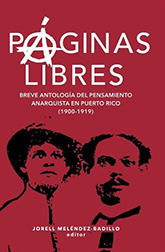
Páginas libres: breve antología del pensamiento anarquista en Puerto Rico
Jorell Meléndez-Badillo (Editor). Páginas Libres: Breve antología Del Pensamiento Anarquista En Puerto Rico. Editora Educación Emergente, 2021.
Páginas libres. Breve antología del pensamiento anarquista en Puerto Rico (1900-1919), compilado y editado con sensible cuidado por Jorell Meléndez-Badillo, suma hilos a una recuperación histórica imprescindible en nuestro país. Con el junte de textos de Venancio Cruz, Luisa Capetillo, Juan Vilar, Juan José López y Ángel María Dieppa esta nueva entrega de la serie Otra Universidad pone en circulación ideas, conexiones, aciertos y silencios de y sobre nuestrxs anarquistas. Así abona la genealogía de esta ignorada propuesta política en nuestro archipiélago y sus filiaciones tanto locales como internacionales. En cada una de estas Páginas libres… se respira la ilustración radical del anarquismo puertorriqueño, su apuesta por el libre pensamiento, su sospecha por las instituciones al uso y su aspiración insobornable por una mejor existencia para todxs. Para Juan Vilar, “La humanidad vive, porque sueña” y ese soñar se concreta en acciones por la vida. Abre este libro, camina a su lado, ponlo en circulación libre y déjate inspirar por sus luminosos sueños. Son posibles.

American Intellectual History: A Very Short Introduction
Jennifer Ratner-Rosenhagen. American Intellectual History: A Very Short Introduction. Oxford University Press, 2021.
Long before the United States was a nation, it was a set of ideas, projected onto the New World by European explorers with centuries of belief and thought in tow. From this foundation of expectation and experience, America and American thought grew in turn, enriched by the bounties of the Enlightenment, the philosophies of liberty and individuality, the tenets of religion, and the doctrines of republicanism and democracy. Crucial to this development were the thinkers who nurtured it, from Thomas Jefferson to Ralph Waldo Emerson, W.E.B. Du Bois to Jane Addams, and Betty Friedan to Richard Rorty. This addition to Oxford’s Very Short Introductions series traces how Americans have addressed the issues and events of their time and place, whether it is the Civil War, the Great Depression, or the culture wars of today. Spanning a variety of disciplines, from religion, philosophy, and political thought, to cultural criticism, social theory, and the arts, Jennifer Ratner-Rosenhagen shows how ideas have been major forces in American history, driving movements such as transcendentalism, Social Darwinism, conservatism, and postmodernism. In engaging and accessible prose, this introduction to American thought considers how notions about freedom and belonging, the market and morality – and even truth – have commanded generations of Americans and been the cause of fierce debate.

Soviet Judgment at Nuremberg A New History of the International Military Tribunal after World War II
Francine Hirsch. Soviet Judgment at Nuremberg A New History of the International Military Tribunal After World War II. Oxford University Press, 2020.
Organized in the immediate aftermath of World War II to try the former Nazi leaders for war crimes, the Nuremberg trials, known as the International Military Tribunal (IMT), paved the way for global conversations about genocide, justice, and human rights that continue to this day. As Francine Hirsch reveals in this immersive new history of the trials, a central piece of the story has been routinely omitted from standard accounts: the critical role that the Soviet Union played in making Nuremberg happen in the first place. Hirsch’s book reveals how the Soviets shaped the trials–only to be written out of their story as Western allies became bitter Cold War rivals. Soviet Judgment at Nuremberg offers the first full picture of the war trials, illuminating the many ironies brought to bear as the Soviets did their part to bring the Nazis to justice. Everyone knew that Stalin had originally allied with Hitler before the Nazi invasion of the Soviet Union. The Molotov-Ribbentrop Pact of 1939 hung heavy over the courtroom, as did the suspicion among the Western prosecutors and judges that the Soviets had falsified evidence in an attempt to pin one of their own war crimes, the Katyn massacre of Polish officers, on the Nazis. It did not help that key members of the Soviet delegation, including the Soviet judge and chief prosecutor, had played critical roles in Stalin’s infamous show trials of the 1930s. For the lead American prosecutor Robert H. Jackson and his colleagues, Soviet participation in the Nuremberg Trials undermined their overall credibility and possibly even the moral righteousness of the Allied victory. Yet Soviet jurists had been the first to conceive of a legal framework that treated war as an international crime. Without it, the IMT would have had no basis for judgment. The Soviets had borne the brunt of the fighting against Germany–enduring the horrors of the Nazi occupation and experiencing almost unimaginable human losses and devastation. There would be no denying their place on the tribunal, nor their determination to make the most of it. Once the trials were set in motion, however, little went as the Soviets had planned. Soviet Judgment at Nuremberg shows how Stalin’s efforts to direct the Soviet delegation and to steer the trials from afar backfired, and how Soviet war crimes became exposed in open court. Hirsch’s book offers readers both a front-row seat in the courtroom and a behind-the-scenes look at the meetings in which the prosecutors shared secrets and forged alliances. It reveals the shifting relationships among the four countries of the prosecution (the U.S., Great Britain, France, and the USSR), uncovering how and why the Palace of Justice in Nuremberg became a Cold War battleground. In the process Soviet Judgment at Nuremberg offers a new understanding of the trials and a fresh perspective on the post-war movement for human rights.

On Civilization’s Edge: A Polish Borderland in the Interwar World
Kathryn Ciancia. On Civilization’s Edge: A Polish Borderland in the Interwar World. Oxford University Press, 2020.
As a resurgent Poland emerged at the end of World War I, an eclectic group of Polish border guards, state officials, military settlers, teachers, academics, urban planners, and health workers descended upon Volhynia, an eastern borderland province that was home to Ukrainians, Poles, and Jews. Its aim was not simply to shore up state power in a place where Poles constituted an ethnic minority, but also to launch an ambitious civilizing mission that would transform a poor Russian imperial backwater into a region that was at once civilized, modern, and Polish. Over the next two decades, these men and women recast imperial hierarchies of global civilization-in which Poles themselves were often viewed as uncivilized-within the borders of their supposedly anti-imperial nation-state. As state institutions remained fragile, long-debated questions of who should be included in the nation re-emerged with new urgency, turning Volhynia’s mainly Yiddish-speaking towns and Ukrainian-speaking villages into vital testing grounds for competing Polish national visions. By the eve of World War II, with Nazi Germany and the Soviet Union growing in strength, schemes to ensure the loyalty of Jews and Ukrainians by offering them a conditional place in the nation were replaced by increasingly aggressive calls for Jewish emigration and the assimilation of non-Polish Slavs. Drawing on research in local and national archives across four countries and utilizing a vast range of written and visual sources that bring Volhynia to life, On Civilization’s Edge offers a highly intimate story of nation-building from the ground up. We eavesdrop on peasant rumors at the Polish-Soviet border, read ethnographic descriptions of isolated marshlands, and scrutinize staged photographs of everyday life. But the book’s central questions transcend the Polish case, inviting us to consider how fears of national weakness and competitions for local power affect the treatment of national minorities, how more inclusive definitions of the nation are themselves based on exclusions, and how the very distinction between empires and nation-states is not always clear-cut.

The Ideas That Made America: A Brief History
Jennifer Ratner-Rosenhagen. The Ideas That Made America: A Brief History. Oxford University Press, 2019.
Long before the United States was a nation, it was a set of ideas, projected onto the New World by European explorers with centuries of belief and thought in tow. From this foundation of expectation and experience, America and American thought grew in turn, enriched by the bounties of the Enlightenment, the philosophies of liberty and individuality, the tenets of religion, and the doctrines of republicanism and democracy. Crucial to this development were the thinkers who nurtured it, from Thomas Jefferson to Ralph Waldo Emerson, W.E.B. DuBois to Jane Addams, and Betty Friedan to Richard Rorty. The Ideas That Made America: A Brief History traces how Americans have addressed the issues and events of their time and place, whether the Civil War, the Great Depression, or the culture wars of today. Spanning a variety of disciplines, from religion, philosophy, and political thought, to cultural criticism, social theory, and the arts, Jennifer Ratner-Rosenhagen shows how ideas have been major forces in American history, driving movements such as transcendentalism, Social Darwinism, conservatism, and postmodernism. In engaging and accessible prose, this introduction to American thought considers how notions about freedom and belonging, the market and morality — and even truth — have commanded generations of Americans and been the cause of fierce debate.

A Twentieth-Century Crusade: The Vatican’s Battle to Remake Christian Europe
Giuliana Chamedes. A Twentieth-Century Crusade: The Vatican’s Battle to Remake Christian Europe. Harvard University Press, 2019.
Winner of the Michael H. Hunt Prize for International History from the Society for Historians of American Foreign Relations and Marraro Prize of the American Catholic Historical Association The first comprehensive history of the Vatican’s agenda to defeat the forces of secular liberalism and communism through international law, cultural diplomacy, and a marriage of convenience with authoritarian and right-wing rulers. After the United States entered World War I and the Russian Revolution exploded, the Vatican felt threatened by forces eager to reorganize the European international order and cast the Church out of the public sphere. In response, the papacy partnered with fascist and right-wing states as part of a broader crusade that made use of international law and cultural diplomacy to protect European countries from both liberal and socialist taint. A Twentieth-Century Crusade reveals that papal officials opposed Woodrow Wilson’s international liberal agenda by pressing governments to sign concordats assuring state protection of the Church in exchange for support from the masses of Catholic citizens. These agreements were implemented in Mussolini’s Italy and Hitler’s Germany, as well as in countries like Latvia, Lithuania, and Poland. In tandem, the papacy forged a Catholic International—a political and diplomatic foil to the Communist International—which spread a militant anticommunist message through grassroots organizations and new media outlets. It also suppressed Catholic antifascist tendencies, even within the Holy See itself. Following World War II, the Church attempted to mute its role in strengthening fascist states, as it worked to advance its agenda in partnership with Christian Democratic parties and a generation of Cold War warriors. The papal mission came under fire after Vatican II, as Church-state ties weakened and antiliberalism and anticommunism lost their appeal. But—as Giuliana Chamedes shows in her groundbreaking exploration—by this point, the Vatican had already made a lasting mark on Eastern and Western European law, culture, and society.
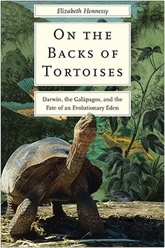
On the Backs of Tortoises: Darwin, the Galapagos, and the Fate of an Evolutionary Eden
Elizabeth Hennessy. On the Backs of Tortoises: Darwin, the Galapagos, and the Fate of an Evolutionary Eden. Yale University Press, 2019.
An insightful exploration of the iconic Galápagos tortoises, and how their fate is inextricably linked to our own in a rapidly changing world The Galápagos archipelago is often viewed as a last foothold of pristine nature. For sixty years, conservationists have worked to restore this evolutionary Eden after centuries of exploitation at the hands of pirates, whalers, and island settlers. This book tells the story of the islands’ namesakes—the giant tortoises—as coveted food sources, objects of natural history, and famous icons of conservation and tourism. By doing so, it brings into stark relief the paradoxical, and impossible, goal of conserving species by trying to restore a past state of prehistoric evolution. The tortoises, Elizabeth Hennessy demonstrates, are not prehistoric, but rather microcosms whose stories show how deeply human and nonhuman life are entangled. In a world where evolution is thoroughly shaped by global history, Hennessy puts forward a vision for conservation based on reckoning with the past, rather than trying to erase it.

The Interrogation Rooms of the Korean War: The Untold History
Monica Kim. The Interrogation Rooms of the Korean War: The Untold History. Princeton University Press, 2019.
Traditional histories of the Korean War have long focused on violations of the thirty-eighth parallel, the line drawn by American and Soviet officials in 1945 dividing the Korean peninsula. But The Interrogation Rooms of the Korean War presents an entirely new narrative, shifting the perspective from the boundaries of the battlefield to inside the interrogation room. Upending conventional notions of what we think of as geographies of military conflict, Monica Kim demonstrates how the Korean War evolved from a fight over territory to one over human interiority and the individual human subject, forging the template for the US wars of intervention that would predominate during the latter half of the twentieth century and beyond. Kim looks at how, during the armistice negotiations, the United States and their allies proposed a new kind of interrogation room: one in which POWs could exercise their “free will” and choose which country they would go to after the ceasefire. The global controversy that erupted exposed how interrogation rooms had become a flashpoint for the struggles between the ambitions of empire and the demands for decolonization, as the aim of interrogation was to produce subjects who attested to a nation’s right to govern. The complex web of interrogators and prisoners—Japanese-American interrogators, Indian military personnel, Korean POWs and interrogators, and American POWs—that Kim uncovers contradicts the simple story in US popular memory of “brainwashing” during the Korean War. Bringing together a vast range of sources that track two generations of people moving between three continents, The Interrogation Rooms of the Korean War delves into an essential yet overlooked aspect of modern warfare in the twentieth century.
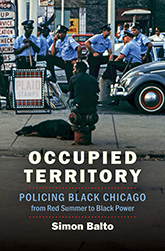
Occupied Territory: Policing Black Chicago from Red Summer to Black Power
Simon Balto. Occupied Territory: Policing Black Chicago from Red Summer to Black Power. University of North Carolina Press, 2019.
In July 1919, an explosive race riot forever changed Chicago. For years, black southerners had been leaving the South as part of the Great Migration. Their arrival in Chicago drew the ire and scorn of many local whites, including members of the city’s political leadership and police department, who generally sympathized with white Chicagoans and viewed black migrants as a problem population. During Chicago’s Red Summer riot, patterns of extraordinary brutality, negligence, and discriminatory policing emerged to shocking effect. Those patterns shifted in subsequent decades, but the overall realities of a racially discriminatory police system persisted. In this history of Chicago from 1919 to the rise and fall of Black Power in the 1960s and 1970s, Simon Balto narrates the evolution of racially repressive policing in black neighborhoods as well as how black citizen-activists challenged that repression. Balto demonstrates that punitive practices by and inadequate protection from the police were central to black Chicagoans’ lives long before the late-century “wars” on crime and drugs. By exploring the deeper origins of this toxic system, Balto reveals how modern mass incarceration, built upon racialized police practices, emerged as a fully formed machine of profoundly antiblack subjugation.

Political Survivors: The Resistance, the Cold War, and the Fight against Concentration Camps after 1945
Emma Kuby. Political Survivors: The Resistance, the Cold War, and the Fight Against Concentration Camps After 1945. Cornell University Press, 2019.
In 1949, as Cold War tensions in Europe mounted, French intellectual and former Buchenwald inmate David Rousset called upon fellow concentration camp survivors to denounce the Soviet Gulag as a “hallucinatory repetition” of Nazi Germany’s most terrible crime. In Political Survivors, Emma Kuby tells the riveting story of what followed his appeal, as prominent members of the wartime Resistance from throughout Western Europe united to campaign against the continued existence of inhumane internment systems around the world. The International Commission against the Concentration Camp Regime brought together those originally deported for acts of anti-Nazi political activity who believed that their unlikely survival incurred a duty to bear witness for other victims. Over the course of the next decade, these pioneering activists crusaded to expose political imprisonment, forced labor, and other crimes against humanity in Franco’s Spain, Maoist China, French Algeria, and beyond. Until now, the CIA’s secret funding of Rousset’s movement has remained in the shadows. Kuby reveals this clandestine arrangement between European camp survivors and American intelligence agents. She also brings to light how Jewish Holocaust victims were systematically excluded from Commission membership – a choice that fueled the group’s rise, but also helped lead to its premature downfall. The history that she unearths provides a striking new vision of how wartime memory shaped European intellectual life and ideological struggle after 1945, showing that the key lessons Western Europeans drew from the war centered on “the camp,” imagined first and foremost as a site of political repression rather than ethnic genocide. Political Survivors argues that Cold War dogma and acrimony, tied to a distorted understanding of WWII’s chief atrocities, overshadowed the humanitarian possibilities of the nascent anti-concentration camp movement as Europe confronted the violent decolonizing struggles of the 1950s.

Beyond Death: The Politics of Suicide and Martyrdom in Korea
Charles Kim, Jungwon Kim, Hwasook Nam, and Serk-Bae Suh. Beyond Death: The Politics of Suicide and Martyrdom in Korea. University of Washington Press, 2019.
Suicide and martyrdom are closely intertwined with Korean social and political processes. In this first book-length study of the evolving ideals of honorable death and martyrdom from the Chosŏn Dynasty (1392–1910) to contemporary South Korea, interdisciplinary essays explore the changing ways in which Korean historical agents have considered what constitutes a sociopolitically meaningful death and how the surviving community should remember such events. Among the topics covered are the implications of women’s chaste suicides and men’s righteous killings in the evolving Confucian-influenced social order of the latter half of the Chosŏn Dynasty; changing nation-centered constructions of sacrifice and martyrdom put forth by influential intellectual figures in mid-twentieth-century South Korea, which were informed by the politics of postcolonial transition and Cold War ideology; and the decisive role of martyrdom in South Korea’s interlinked democracy and labor movements, including Chun Tae-il’s self-immolation in 1970, the loss of hundreds of lives during the Kwangju Uprising of 1980, and the escalation of protest suicides in the 1980s and early 1990s.
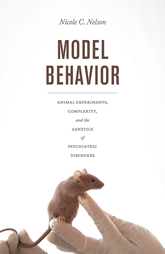
Model Behavior: Animal Experiments, Complexity, and the Genetics of Psychiatric Disorders
Nicole C. Nelson. Model Behavior: Animal Experiments, Complexity, and the Genetics of Psychiatric Disorders. University of Chicago Press, 2018.
Mice are used as model organisms across a wide range of fields in science today—but it is far from obvious how studying a mouse in a maze can help us understand human problems like alcoholism or anxiety. How do scientists convince funders, fellow scientists, the general public, and even themselves that animal experiments are a good way of producing knowledge about the genetics of human behavior? In Model Behavior, Nicole C. Nelson takes us inside an animal behavior genetics laboratory to examine how scientists create and manage the foundational knowledge of their field. Behavior genetics is a particularly challenging field for making a clear-cut case that mouse experiments work, because researchers believe that both the phenomena they are studying and the animal models they are using are complex. These assumptions of complexity change the nature of what laboratory work produces. Whereas historical and ethnographic studies traditionally portray the laboratory as a place where scientists control, simplify, and stabilize nature in the service of producing durable facts, the laboratory that emerges from Nelson’s extensive interviews and fieldwork is a place where stable findings are always just out of reach. The ongoing work of managing precarious experimental systems means that researchers learn as much—if not more—about the impact of the environment on behavior as they do about genetics. Model Behavior offers a compelling portrait of life in a twenty-first-century laboratory, where partial, provisional answers to complex scientific questions are increasingly the norm.

Natural Resources and the New Frontier: Constructing Modern China’s Borderlands
Judd Kinzley. Natural Resources and the New Frontier: Constructing Modern China’S Borderlands. University of Chicago Press, 2018.
China’s westernmost province of Xinjiang has experienced escalating cycles of violence, interethnic strife, and state repression since the 1990s. In their search for the roots of these growing tensions, scholars have tended to focus on ethnic clashes and political disputes. In Natural Resources and the New Frontier, historian Judd C. Kinzley takes a different approach—one that works from the ground up to explore the infrastructural and material foundation of state power in the region. As Kinzley argues, Xinjiang’s role in producing various natural resources for regional powers has been an important but largely overlooked factor in fueling unrest. He carefully traces the buildup to this unstable situation over the course of the twentieth century by focusing on the shifting priorities of Chinese, Soviet, and provincial officials regarding the production of various resources, including gold, furs, and oil among others. Through his archival work, Kinzley offers a new way of viewing Xinjiang that will shape the conversation about this important region and offer a model for understanding the development of other frontier zones in China as well as across the global south.

Guide to Byzantine Historical Writing
Leonora Neville. Guide to Byzantine Historical Writing. Cambridge University Press, 2018.
This handy reference guide makes it easier to access and understand histories written in Greek between 600 and 1480 CE. Covering classicizing histories that continued ancient Greek traditions of historiography, sweeping, fast-paced ‘chronicle’ type histories, and dozens of idiosyncratic historical texts, it distills the results of complex, multi-lingual, specialist scholarship into clear explanations of the basic information needed to approach each medieval Greek history. It provides a sound basis for further research on each text by describing what we know about the time of composition, content covered by the history, authorship, extant manuscripts, previous editions and translations, and basic bibliography. Even-handed explanations of scholarly debates give readers the information they need to assess controversies independently. A comprehensive introduction orients students and non-specialists to the traditions and methods of Byzantine historical writing. It will prove an invaluable timesaver for Byzantinists and an essential entry point for classicists, western medievalists, and students.
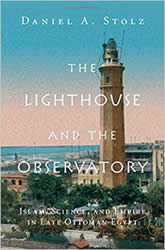
The Lighthouse and the Observatory: Islam, Science, and Empire in Late Ottoman Egypt
Daniel Stolz. The Lighthouse and the Observatory: Islam, Science, and Empire in Late Ottoman Egypt. Cambridge University Press, 2018.
An observatory and a lighthouse form the nexus of this major new investigation of science, religion, and the state in late Ottoman Egypt. Astronomy, imperial bureaucrats, traditionally educated Muslim scholars, and reformist Islamic publications, such as The Lighthouse, are linked to examine the making of knowledge, the performance of piety, and the operation of political power through scientific practice. Contrary to ideas of Islamic scientific decline, Muslim scholars in the nineteenth century used a dynamic tradition of knowledge to measure time, compute calendars, and predict planetary positions. The rise of a ‘new astronomy’ is revealed to owe much to projects of political and religious reform: from the strengthening of the multiple empires that exercised power over the Nile Valley; to the ‘modernization’ of Islamic centers of learning; to the dream of a global Islamic community that would rely on scientific institutions to coordinate the timing of major religious duties.

The Uses of the Bible in Crusader Sources
Elizabeth Lapina (Co-editor), and Nicholas Morton (Co-editor). The Uses of the Bible in Crusader Sources. Brill, 2017.
The Uses of the Bible in Crusader Sources sets out to understand the ideology and spirituality of crusading by exploring the biblical imagery and exegetical interpretations which formed its philosophical basis. Medieval authors frequently drew upon scripture when seeking to justify, praise, or censure the deeds of crusading warriors on many frontiers. After all, as the fundamental written manifestation of God’s will for mankind, the Bible was the ultimate authority for contemporary writers when advancing their ideas and framing their world view. This volume explores a broad spectrum of biblically-derived themes surrounding crusading and, by doing so, seeks to better comprehend a thought world in which lethal violence could be deemed justifiable according to Christian theology. Contributors are: Jessalynn Bird, Adam M. Bishop, John D. Cotts, Sini Kangas, Thomas Lecaque, T. J. H. McCarthy, Nicholas Morton, Torben Kjersgaard Nielsen, Luigi Russo, Uri Shachar, Iris Shagrir, Kristin Skottki, Katherine Allen Smith, Thomas W. Smith, Carol Sweetenham, Miriam Rita Tessera, Jan Vandeburie, Julian J. T. Yolles, and Lydia Marie Walker.
The Experiential Caribbean: Creating Knowledge and Healing in the Early Modern Atlantic
Pablo F. Gómez. The Experiential Caribbean: Creating Knowledge and Healing in the Early Modern Atlantic. University of North Carolina Press, 2018.
Opening a window on a dynamic realm far beyond imperial courts, anatomical theaters, and learned societies, Pablo F. Gómez examines the strategies that Caribbean people used to create authoritative, experientially based knowledge about the human body and the natural world during the long seventeenth century. Gómez treats the early modern intellectual culture of these mostly black and free Caribbean communities on its own merits and not only as it relates to well-known frameworks for the study of science and medicine. Drawing on an array of governmental and ecclesiastical sources—notably Inquisition records—Gómez highlights more than one hundred black ritual practitioners regarded as masters of healing practices and as social and spiritual leaders. He shows how they developed evidence-based healing principles based on sensorial experience rather than on dogma. He elucidates how they nourished ideas about the universality of human bodies, which contributed to the rise of empirical testing of disease origins and cures. Both colonial authorities and Caribbean people of all conditions viewed this experiential knowledge as powerful and competitive. In some ways, it served to respond to the ills of slavery. Even more crucial, however, it demonstrates how the black Atlantic helped creatively to fashion the early modern world.

Youth for Nation: Culture and Protest in Cold War South Korea
Charles Kim. Youth for Nation: Culture and Protest in Cold War South Korea. 2017.
This in-depth exploration of culture, media, and protest follows South Korea’s transition from the Korean War to the political struggles and socioeconomic transformations of the Park Chung Hee era. Although the post–Korean War years are commonly remembered as a time of crisis and disarray, Charles Kim contends that they also created a formative and productive juncture in which South Koreans reworked pre-1945 constructions of national identity to meet the political and cultural needs of postcolonial nation-building. He explores how state ideologues and mainstream intellectuals expanded their efforts by elevating the nation’s youth as the core protagonist of a newly independent Korea. By designating students and young men and women as the hope and exemplars of the new nation-state, the discursive stage was set for the remarkable outburst of the April Revolution in 1960.Kim’s interpretation of this seminal event underscores student participants’ recasting of anticolonial resistance memories into South Korea’s postcolonial politics. This pivotal innovation enabled protestors to circumvent the state’s official anticommunism and, in doing so, brought about the formation of a culture of protest that lay at the heart of the country’s democracy movement from the 1960s to the 1980s. The positioning of women as subordinates in the nation-building enterprise is also shown to be a direct translation of postwar and Cold War exigencies into the sphere of culture; this cultural conservatism went on to shape the terrain of gender relations in subsequent decades. A meticulously researched cultural history, Youth for Nation illuminates the historical significance of the postwar period through a rigorous analysis of magazines, films, textbooks, archival documents, and personal testimonies. In addition to scholars and students of twentieth-century Korea, the book will be welcomed by those interested in Cold War cultures, social movements, and democratization in East Asia.

In the Shadows of the American Century: The Rise and Decline of US Global Power
Alfred W. McCoy. In the Shadows of the American Century: The Rise and Decline of US Global Power. Haymarket Books, 2017.
Explores the distinctive instruments of American ascent to global domination and hegemony–including covert intervention, client elites, psychological torture, and surveillance. In a completely original analysis, prize-winning historian Alfred W. McCoy explores America’s rise as a world power—from the 1890s through the Cold War—and its bid to extend its hegemony deep into the twenty-first century through a fusion of cyberwar, space warfare, trade pacts, and military alliances. McCoy then analyzes the marquee instruments of US hegemony—covert intervention, client elites, psychological torture, and worldwide surveillance. Peeling back layers of secrecy, McCoy exposes a military and economic battle for global domination fought in the shadows, largely unknown to those outside the highest rungs of power. Can the United States extend the “American Century” or will China guide the globe for the next hundred years? McCoy devotes his final chapter to these questions, boldly laying out a series of scenarios that could lead to the end of Washington’s world domination by 2030.

Poverty, Wealth, and Well-Being: Experiencing Penia in Democratic Athens
Claire Taylor. Poverty, Wealth, and Well-Being: Experiencing Penia in Democratic Athens. Oxford: Oxford University Press, 2017.
Examines not only the discourses surrounding poverty, but also the well-being of those categorized as poor and their experiences of poverty Provides a critical reassessment of poverty in the ancient world which is in line with contemporary research within the social sciences Develops a methodology which includes women, slaves, and foreigners as well as male citizens in discussion of poverty and well-being Brings together literary, epigraphic, and archaeological evidence to examine alternate modes of expression among non-elites in Athens
The Cambridge History of Judaism: Volume 8. The Modern World, 1815–2000
Tony Michels (Co-editor), and Mitchell B. Hart (Co-editor). The Cambridge History of Judaism: Volume 8. The Modern World, 1815–2000. Cambridge University Press, 2017.
The eighth and final volume of The Cambridge History of Judaism covers the period from roughly 1815–2000. Exploring the breadth and depth of Jewish societies and their manifold engagements with aspects of the modern world, it offers overviews of modern Jewish history, as well as more focused essays on political, social, economic, intellectual and cultural developments. The first part presents a series of interlocking surveys that address the history of diverse areas of Jewish settlement. The second part is organized around the emancipation. Here, chapter themes are grouped around the challenges posed by and to this elemental feature of Jewish life in the modern period. The third part adopts a thematic approach organized around the category ‘culture’, with the goal of casting a wide net in terms of perspectives, concepts and topics. The final part then focuses on the twentieth century, offering readers a sense of the dynamic nature of Judaism and Jewish identities and affiliations.

Confronting Capital and Empire: Rethinking Kyoto School Philosophy
Viren Murthy (Co-editor), Fabian Schäfer (Co-editor), and Maz Ward (Co-editor). Confronting Capital and Empire: Rethinking Kyoto School Philosophy. Brill, 2017.
Confronting Capital and Empire inquires into the relationship between philosophy, politics and capitalism by rethinking Kyoto School philosophy in relation to history. The Kyoto School was an influential group of Japanese philosophers loosely related to Kyoto Imperial University’s philosophy department, including such diverse thinkers as Nishida Kitarō, Tanabe Hajime, Nakai Masakazu and Tosaka Jun. Confronting Capital and Empire presents a new perspective on the Kyoto School by bringing the school into dialogue with Marx and the underlying questions of Marxist theory. The volume brings together essays that analyse Kyoto School thinkers through a Marxian and/or critical theoretical perspective, asking: in what ways did Kyoto School thinkers engage with their historical moment? What were the political possibilities immanent in their thought? And how does Kyoto School philosophy speak to the pressing historical and political questions of our own moment?

East-Asian Marxisms and Their Trajectories
Viren Murthy (Co-editor), and Joyce C.H. Liu (Co-editor). East-Asian Marxisms and Their Trajectories. Routledge Taylor & Francis Group, 2017.
In this volume, leading scholars from around the world suggest that radical ideologies have shaped complex historical processes in East Asia by examining how intellectuals and activists interpreted, rethought and criticized Marxism in East Asia. The contributors to this volume ask how we can use Marxism to understand East Asia in a global capitalist world, and where the problems that Marxism highlighted, including imperialism, domination and inequality, are increasingly prevalent. The volume draws on various disciplines to reinterpret Marx, and shed light on the complex dynamics of global capitalism in various historical/national contexts. The distinguished contributors illuminate, rethink and make accessible highly complex Marxist concepts, such as the question of class contradiction, the temporalities of capitalism, real and formal subsumption, relative surplus value and the commodity form, the question of class and the proletariat. At a time when people around the world are struggling to cope with the crises of global capitalism, this volume on regional responses to capitalism is especially welcome. It will be of interest to students and scholars of East Asian studies, social and political theory, sociology and globalization studies.

Street Archives and City Life: Popular Intellectuals in Postcolonial Tanzania
Emily Callaci. Street Archives and City Life: Popular Intellectuals in Postcolonial Tanzania. Duke University Press, 2017.
In Street Archives and City Life Emily Callaci maps a new terrain of political and cultural production in mid- to late twentieth-century Tanzanian urban landscapes. While the postcolonial Tanzanian ruling party (TANU) adopted a policy of rural socialism known as Ujamaa between 1967 and 1985, an influx of youth migrants to the city of Dar es Salaam generated innovative forms of urbanism through the production and circulation of what Callaci calls street archives. These urban intellectuals neither supported nor contested the ruling party’s anti-city philosophy; rather, they navigated the complexities of inhabiting unplanned African cities during economic crisis and social transformation through various forms of popular texts that included women’s Christian advice literature, newspaper columns, self-published pulp fiction novellas, and song lyrics. Through these textual networks, Callaci shows how youth migrants and urban intellectuals in Dar es Salaam fashioned a collective ethos of postcolonial African citizenship. This spirit ushered in a revolution rooted in the city and its networks—an urban revolution that arose in spite of the nation-state’s pro-rural ideology. Intro to Street Archives and City Life (pdf) made available courtesy of Duke Press.
The Routledge Handbook of Asian American Studies
Cindy I-Fen Cheng (Editor). The Routledge Handbook of Asian American Studies. Routledge, 2016.
The Routledge Handbook of Asian American Studies brings together leading scholars and scholarship to capture the state of the field of Asian American Studies, as a generation of researchers have expanded the field with new paradigms and methodological tools. Inviting readers to consider new understandings of the historical work done in the past decades and the place of Asian Americans in a larger global context, this ground-breaking volume illuminates how research in the field of Asian American Studies has progressed. Previous work in the field has focused on establishing a place for Asian Americans within American history. This volume engages more contemporary research, which draws on new archives, art, literature, film, and music, to examine how Asian Americans are redefining their national identities, and to show how race interacts with gender, sexuality, class, and the built environment, to reveal the diversity of the United States. Organized into five parts, and addressing a multitude of interdisciplinary areas of interest to Asian American scholars, it covers: a reframing of key themes such as transnationality, postcolonialism, and critical race theory U.S. imperialism and its impact on Asian Americans war and displacement the garment industry Asian Americans and sports race and the built environment social change and political participation and many more themes. Exploring people, practice, politics, and places, this cutting-edge volume brings together the best themes current in Asian American Studies today, and is a vital reference for all researchers in the field.

Anna Komnene: The Life and Work of a Medieval Historian
Leonora Neville. Anna Komnene: The Life and Work of a Medieval Historian. Oxford University Press, 2016.
Onassis Series in Hellenic Culture First book devoted to understanding Anna Komnene since 1929, and the first ever to systematically examine how she presents herself in the Alexiad Offers a systematic explanation of the relationship between Anna’s gender and her writing Brings the life and work of a major, but understudied, medieval female author to a wide audience

Beer of Broadway Fame: The Piel Family and Their Brooklyn Brewery
Alfred W. McCoy. Beer of Broadway Fame: The Piel Family and Their Brooklyn Brewery. SUNY Press, 2016.
Explores the hundred-year history of Piel Bros., one of the prominent German American brands that once made New York City the brewing capital of America. For more than a century, New York City was the brewing capital of America, with more breweries producing more beer than any other city, including Milwaukee and St. Louis. In Beer of Broadway Fame, Alfred W. McCoy traces the hundred-year history of the prominent Brooklyn brewery Piel Bros., and provides an intimate portrait of the company’s German American family. Through quality and innovation, Piel Bros. grew from Brooklyn’s smallest brewery in 1884, producing only 850 kegs, into the sixteenth-largest brewery in America, brewing over a million barrels by 1952. Through a narrative spanning three generations, McCoy examines the demoralizing impact of pervasive US state surveillance during World War I and the Cold War, as well as the forced assimilation that virtually erased German American identity from public life after World War I. McCoy traces Piel Bros.’s changing fortunes from its early struggle to survive in New York’s Gilded Age beer market, the travails of Prohibition with police raids and gangster death threats, to the crushing competition from the big national brands after World War II. Through a fusion of corporate records with intimate personal correspondence, McCoy reveals the social forces that changed a great city, the US brewing industry, and the country’s economy.

The Worlds of American Intellectual History
Jennifer Ratner-Rosenhagen (Co-editor), Joel Isaac (Co-editor), James T. Kloppenberg (Co-editor), and Michael O’Brien (Co-editor). The Worlds of American Intellectual History. Oxford Universiity Press, 2016.
The essays in this book demonstrate the breadth and vitality of American intellectual history. Their core theme is the diversity of both American intellectual life and of the frameworks that we must use to make sense of that diversity. The Worlds of American Intellectual History has at its heart studies of American thinkers. Yet it follows these thinkers and their ideas as they have crossed national, institutional, and intellectual boundaries. The volume explores ways in which American ideas have circulated in different cultures. It also examines the multiple sites–from social movements, museums, and courtrooms to popular and scholarly books and periodicals–in which people have articulated and deployed ideas within and beyond the borders of the United States. At these cultural frontiers, the authors demonstrate, multiple interactions have occurred – some friendly and mutually enriching, others laden with tension, misunderstandings, and conflict. The same holds for other kinds of borders, such as those within and between scholarly disciplines, or between American history and the histories of other cultures. The richness of contemporary American intellectual history springs from the variety of worlds with which it must engage. Intellectual historians have always relished being able to move back and forth between close readings of particular texts and efforts to make sense of broader cultural dispositions. That range is on display in this volume, which includes essays by scholars as fully at home in the disciplines of philosophy, literature, economics, sociology, political science, education, science, religion, and law as they are in history. It includes essays by prominent historians of European thought, attuned to the transatlantic conversations in which Europeans and Americans have been engaged since the seventeenth century, and American historians whose work has carried them not only to different regions in North America but across the North Atlantic to Europe, across the South Atlantic to Africa, and across the Pacific to South Asia.

Communities and Networks in the Ancient Greek World
Claire Taylor (Co-editor), and Kostas Vlassopoulos (Co-editor). Communities and Networks in the Ancient Greek World. Oxford: Oxford University Press, 2015.
This volume examines the diversity of networks and communities in the classical and early Hellenistic Greek world, with particular emphasis on those which took shape within and around Athens. In doing so it highlights not only the processes that created, modified, and dissolved these communities, but shines a light on the interactions through which individuals with different statuses, identities, levels of wealth, and connectivity participated in ancient society. By drawing on two distinct conceptual approaches, that of network studies and that of community formation, Communities and Networks in the Ancient Greek World showcases a variety of approaches which fall under the umbrella of ‘network thinking’ in order to move the study of ancient Greek history beyond structuralist polarities and functionalist explanations. The aim is to reconceptualize the polis not simply as a citizen club, but as one inter-linked community amongst many. This allows subaltern groups to be seen not just as passive objects of exclusion and exploitation but active historical agents, emphasizes the processes of interaction as well as the institutions created through them, and reveals the interpenetration between public institutions and private networks which integrated different communities within the borders of a polis and connected them with the wider world.

The Crusades and Visual Culture
Elizabeth Lapina (Co-editor), April Jehan Morris (Co-editor), Laura J Whatley (Co-editor), and Susanna A. Throop (Co-editor). The Crusades and Visual Culture. Ashgate, 2015.
The crusades, whether realized or merely planned, had a profound impact on medieval and early modern societies. Numerous scholars in the fields of history and literature have explored the influence of crusading ideas, values, aspirations and anxieties in both the Latin States and Europe. However, there have been few studies dedicated to investigating how the crusading movement influenced and was reflected in medieval visual cultures. Written by scholars from around the world working in the domains of art history and history, the essays in this volume examine the ways in which ideas of crusading were realized in a broad variety of media (including manuscripts, cartography, sculpture, mural paintings, and metalwork). Arguing implicitly for recognition of the conceptual frameworks of crusades that transcend traditional disciplinary boundaries, the volume explores the pervasive influence and diverse expression of the crusading movement from the twelfth through the fifteenth centuries.

Riotous Flesh: Women, Physiology, and the Solitary Vice in Nineteenth-Century America
April Haynes. Riotous Flesh: Women, Physiology, and the Solitary Vice in Nineteenth-Century America. University of Chicago Press, 2015.
Nineteenth-century America saw numerous campaigns against masturbation, which was said to cause illness, insanity, and even death. Riotous Flesh explores women’s leadership of those movements, with a specific focus on their rhetorical, social, and political effects, showing how a desire to transform the politics of sex created unexpected alliances between groups that otherwise had very different goals. As April R. Haynes shows, the crusade against female masturbation was rooted in a generally shared agreement on some major points: that girls and women were as susceptible to masturbation as boys and men; that “self-abuse” was rooted in a lack of sexual information; and that sex education could empower women and girls to master their own bodies. Yet the groups who made this education their goal ranged widely, from “ultra” utopians and nascent feminists to black abolitionists. Riotous Flesh explains how and why diverse women came together to popularize, then institutionalize, the condemnation of masturbation, well before the advent of sexology or the professionalization of medicine.

Warfare and the Miraculous in the Chronicles of the First Crusade
Elizabeth Lapina. Warfare and the Miraculous in the Chronicles of the First Crusade. Penn State University Press, 2015.
In Warfare and the Miraculous in the Chronicles of the First Crusade, Elizabeth Lapina examines a variety of these chronicles, written both by participants in the crusade and by those who stayed behind. Her goal is to understand the enterprise from the perspective of its contemporaries and near contemporaries. Lapina analyzes the diversity of ways in which the chroniclers tried to justify the First Crusade as a “holy war,” where physical violence could be not just sinless, but salvific. The book focuses on accounts of miracles reported to have happened in the course of the crusade, especially the miracle of the intervention of saints in the Battle of Antioch. Lapina shows why and how chroniclers used these miracles to provide historical precedent and to reconcile the messiness of history with the conviction that history was ordered by divine will. In doing so, she provides an important glimpse into the intellectual efforts of the chronicles and their authors, illuminating their perspectives toward the concepts of history, salvation, and the East. Warfare and the Miraculous in the Chronicles of the First Crusade demonstrates how these narratives sought to position the crusade as an event in the time line of sacred history. Lapina offers original insights into the effects of the crusade on the Western imaginary as well as how medieval authors thought about and represented history.

Protest on the Page: Essays on Print and the Culture of Dissent since 1865
Jennifer Ratner-Rosenhagen (Co-editor), James L. Baughman (Co-editor), and James P. Danky (Co-editor). Protest on the Page: Essays on Print and the Culture of Dissent since 1865. University of Wisconsin Press, 2015.
The use of print to challenge prevailing ideas and conventions has a long history in American public life. As dissenters in America sought social change, they used print to document, articulate, and disseminate their ideas to others. Protest always begins on the margins, but print is the medium that allows it to reach a larger audience. In Protest on the Page, scholars in multiple disciplines offer ten original essays that examine protest print culture in America since 1865. They explore the surprising range of dissidents who enlisted print in their causes—from vegetarians and anarchists at the advent of the twentieth century, to midcentury evangelicals and tween comic book readers, to GIs and feminists in the 1970s–’80s. Together they demonstrate that print has never been a neutral medium, but rather has been instrumental in shaping the substance of protest and its audiences.

Writing, Publishing, and Reading Local Gazetteers in Imperial China, 1100-1700
Joe Dennis. Writing, Publishing, and Reading Local Gazetteers in Imperial China, 1100-1700. Harvard University Press, 2015.
This book is the definitive study of imperial Chinese local gazetteers, one of the most important sources for premodern Chinese studies. Methodologically innovative, it represents a major contribution to the history of books, publishing, reading, and society. By examining how gazetteers were read, Joseph R. Dennis illustrates their significance in local societies and national discourses. His analysis of how gazetteers were initiated and produced reconceptualizes the geography of imperial Chinese publishing. Whereas previous studies argued that publishing, and thus cultural and intellectual power, were concentrated in the southeast, Dennis shows that publishing and book ownership were widely dispersed throughout China and books were found even in isolated locales. Adding a dynamic element to our earlier understanding of the publishing industry, Dennis tracks the movements of manuscripts to printers and print labor to production sites. By reconstructing printer business zones, he demonstrates that publishers operated across long distances in trans-regional markets. He also creates the first substantial data set on publishing costs in early modern China—a foundational breakthrough in understanding the world of Chinese books. Dennis’s work reveals areas for future research on newly-identified regional publishing centers and the economics of book production.

Fatal Isolation: The Devastating Paris Heat Wave of 2003
Richard C. Keller. Fatal Isolation: The Devastating Paris Heat Wave of 2003. University of Chicago Press, 2015.
Shortlisted for the American Library in Paris Book Award, 2015 In a cemetery on the southern outskirts of Paris lie the bodies of nearly a hundred of what some have called the first casualties of global climate change. They were the so-called abandoned victims of the worst natural disaster in French history, the devastating heat wave that struck in August 2003, leaving 15,000 dead. They died alone in Paris and its suburbs, and were then buried at public expense, their bodies unclaimed. They died, and to a great extent lived, unnoticed by their neighbors–their bodies undiscovered in some cases until weeks after their deaths. Fatal Isolation tells the stories of these victims and the catastrophe that took their lives. It explores the multiple narratives of disaster–the official story of the crisis and its aftermath, as presented by the media and the state; the life stories of the individual victims, which both illuminate and challenge the ways we typically perceive natural disasters; and the scientific understandings of disaster and its management. Fatal Isolation is both a social history of risk and vulnerability in the urban landscape and a story of how a city copes with emerging threats and sudden, dramatic change.

Neither Peace nor Freedom: The Cultural Cold War in Latin America
Patrick Iber. Neither Peace nor Freedom: The Cultural Cold War in Latin America. Harvard University Press, 2015.
During the Cold War, left-wing Latin American artists, writers, and scholars worked as diplomats, advised rulers, opposed dictators, and even led nations. Their competing visions of social democracy and their pursuit of justice, peace, and freedom led them to organizations sponsored by the governments of the Cold War powers: the Soviet-backed World Peace Council, the U.S.-supported Congress for Cultural Freedom, and, after the 1959 Cuban Revolution, the homegrown Casa de las Américas. Neither Peace nor Freedom delves into the entwined histories of these organizations and the aspirations and dilemmas of intellectuals who participated in them, from Diego Rivera and Pablo Neruda to Gabriel Garcia Marquez and Jorge Luis Borges. Patrick Iber corrects the view that such individuals were merely pawns of the competing superpowers. Movements for democracy and social justice sprung up among pro-Communist and anti-Communist factions, and Casa de las Américas promoted a brand of revolutionary nationalism that was beholden to neither the Soviet Union nor the United States. But ultimately, intellectuals from Latin America could not break free from the Cold War’s rigid binaries. With the Soviet Union demanding fealty from Latin American communists, the United States zealously supporting their repression, and Fidel Castro pushing for regional armed revolution, advocates of social democracy found little room to promote their ideals without compromising them. Cold War politics had offered utopian dreams, but intellectuals could get neither the peace nor the freedom they sought.
Citizens of Asian America: Democracy and Race during the Cold War
Cindy I-Fen Cheng. Citizens of Asian America: Democracy and Race During the Cold War. NYU Press, 2014.
During the Cold War, Soviet propaganda highlighted U.S. racism in order to undermine the credibility of U.S. democracy. In response, incorporating racial and ethnic minorities in order to affirm that America worked to ensure the rights of all and was superior to communist countries became a national imperative. In Citizens of Asian America , Cindy I-Fen Cheng explores how Asian Americans figured in this effort to shape the credibility of American democracy, even while the perceived “foreignness” of Asian Americans cast them as likely alien subversives whose activities needed monitoring following the communist revolution in China and the outbreak of the Korean War. While histories of international politics and U.S. race relations during the Cold War have largely overlooked the significance of Asian Americans, Cheng challenges the black-white focus of the existing historiography. She highlights how Asian Americans made use of the government’s desire to be leader of the “free world” by advocating for civil rights reforms, such as housing integration, increased professional opportunities, and freedom from political persecution. Further, Cheng examines the liberalization of immigration policies, which worked not only to increase the civil rights of Asian Americans but also to improve the nation’s ties with Asian countries, providing an opportunity for the U.S. government to broadcast, on a global scale, the freedom and opportunity that American society could offer.

A Companion to Global Historical Thought
Viren Murthy (Co-editor), Andrew Sartori (Co-editor), and Prasenjit Duara (Co-editor). A Companion to Global Historical Thought. Wiley, 2014.
A Companion to Global Historical Thought provides an in-depth overview of the development of historical thinking from the earliest times to the present, across the world, directly addressing the issues of historical thought in a globalized context. Provides an overview of the development of historical thinking from the earliest times to the present, across the world, through essays written by a team of leading international scholars Complements the Companion to Western Historical Thought, placing non-Western perspectives on historiography at the center of the discussion Explores the different historical traditions that have shaped the discipline, and the challenges posed by modernity and globalization

The Challenge of Linear Time: Nationhood and the Politics of History in East Asia
Viren Murthy. The Challenge of Linear Time: Nationhood and the Politics of History in East Asia. Brill, 2014.
Edited by: Viren Murthy, University of Wisconsin–Madison and Axel Schneider, University of Göttingen The papers collected in this volume congeal around a debate about the ways and extent of the dominance of linear time and progressive history and the concomitant delineation of the nation in Chinese and Japanese historiography. As China and Japan entered the global capitalist system of nation states, the Chinese and Japanese regimes implemented a number of reforms, which resulted in transformations that affected everyday experience. In the face of imperialism and the perceived threat of being split up, the Meiji and late Qing governments radically reoriented policies in order to become wealthy and powerful in the global arena. People not only began to experience time and space in new ways, but elites also were increasingly exposed to Western theories of history and concepts of nationhood, which became dominant. These changes contributed to the production of new types of historical consciousness and collective identity. The essays in this volume each provide a perspective on the complex ways in which imagining national and regional identity in East Asia were and continue to be enmeshed with visions of time and history. This book should be of interest to all those who are interested in nationalism, modernity in China and Japan, global capitalism and the politics of time.

All Men Free and Brethren: Essays on the History of African American Freemasonry
Stephen Kantrowitz. All Men Free and Brethren: Essays on the History of African American Freemasonry. Cornell University Press, 2013.
In early March 1775, an Irish soldier initiated a dozen or more black Bostonian men into a lodge of Freemasons, making them probably the first people of African descent formally admitted into Freemasonry in the Atlantic world. Prince Hall, a freedman, would emerge as the leader of this group as they worked together to establish a tradition of African American Freemasonry that has persisted ever since—a tradition that still carries his name. All Men Free and Brethren is the first in-depth historical consideration of Prince Hall freemasonry from the Revolutionary era to the early decades of the twentieth century. Through a growing network of lodges, African American Masons together promoted fellowship, Christianity, and social respectability, while standing against slavery and white supremacy. The contributors to this book examine key aspects in the history of the Prince Hall Masons, from accounts of specific lodges and leaders to broader themes in African American history: abolitionist activism, the limits of freedom during Reconstruction, political oration, the role of women in the black community, and relationships between Masonry and African American churches. Also included are several appendixes containing key texts from Prince Hall Masonry, a glossary of Masonic terms, and lists of archival repositories and contact information for present-day lodges. Edited by Peter P. Hinks and Stephen Kantrowitz, All Men Free and Brethren is a major contribution of the history of Freemasonry, African American history, and the broader history of race, citizenship, and community in the United States.

Testing Wars in the Public Schools: A Forgotten History
William Reese. Testing Wars in the Public Schools: A Forgotten History. Harvard University Press, 2013.
Written tests to evaluate students were a radical and controversial innovation when American educators began adopting them in the 1800s. Testing quickly became a key factor in the political battles during this period that gave birth to America’s modern public school system. William J. Reese offers a richly detailed history of an educational revolution that has so far been only partially told. Single-classroom schools were the norm throughout the United States at the turn of the nineteenth century. Pupils demonstrated their knowledge by rote recitation of lessons and were often assessed according to criteria of behavior and discipline having little to do with academics. Convinced of the inadequacy of this system, the reformer Horace Mann and allies on the Boston School Committee crafted America’s first written exam and administered it as a surprise in local schools in 1845. The embarrassingly poor results became front-page news and led to the first serious consideration of tests as a useful pedagogic tool and objective measure of student achievement. A generation after Mann’s experiment, testing had become widespread. Despite critics’ ongoing claims that exams narrowed the curriculum, ruined children’s health, and turned teachers into automatons, once tests took root in American schools their legitimacy was never seriously challenged. Testing Wars in the Public Schools puts contemporary battles over scholastic standards and benchmarks into perspective by showcasing the historic successes and limitations of the pencil-and-paper exam.

Beyond the Metropolis: Second Cities and Modern Life in Interwar Japan
Louise Young. Beyond the Metropolis: Second Cities and Modern Life in Interwar Japan. University of California Press, 2013.
In Beyond the Metropolis, Louise Young looks at the emergence of urbanism in the interwar period, a global moment when the material and ideological structures that constitute “the city” took their characteristic modern shape. In Japan, as elsewhere, cities became the staging ground for wide ranging social, cultural, economic, and political transformations. The rise of social problems, the formation of a consumer marketplace, the proliferation of streetcars and streetcar suburbs, and the cascade of investments in urban development reinvented the city as both socio-spatial form and set of ideas. Young tells this story through the optic of the provincial city, examining four second-tier cities: Sapporo, Kanazawa, Niigata, and Okayama. As prefectural capitals, these cities constituted centers of their respective regions. All four grew at an enormous rate in the interwar decades, much as the metropolitan giants did. In spite of their commonalities, local conditions meant that policies of national development and the vagaries of the business cycle affected individual cities in diverse ways. As their differences reveal, there is no single master narrative of twentieth century modernization. By engaging urban culture beyond the metropolis, this study shows that Japanese modernity was not made in Tokyo and exported to the provinces, but rather co-constituted through the circulation and exchange of people and ideas throughout the country and beyond.
Without Borders or Limits: An Interdisciplinary Approach to Anarchist Studies
Jorell Meléndez-Badillo (Editor). Without Borders or Limits: An Interdisciplinary Approach to Anarchist Studies. Cambridge Scholars Publishers, 2013.
This volume of collected essays brings together conversations, papers, and debates from the Third Annual North American Anarchist Studies Network Conference in San Juan, Puerto Rico. Nathan Jun and Jorell A. Meléndez aspire to go beyond a simple collection of papers and instead aim to maintain a dialogue among different academic fields with the sole task of comprehending and re-thinking anarchist studies. With over twenty-one chapters written by a diverse range of activists, organizers, musicians, artists, poets, and academics, this book transgresses the apparent simplicity of the study of anarchism with a dynamic and interdisciplinary approach that crystallizes and emulates the heterogeneous nature of the anarchist ideal. From theory and philosophy to historical analyses, methodologies, and perspectives, from different manifestations in the arts, media, and culture to religion, ethics, and spirituality, from the intersectionality of animal liberation and queer struggles to contemporary praxis and organizing, the authors explore different topics from a critical perspective that is often lacking in their respective academic fields. This book is a must-buy for critical teachers, students, and activists interested in studying anarchism and the different ways in which we can transform our reality.

Transfeminist Perspectives in and beyond Transgender and Gender Studies
Finn Enke. Transfeminist Perspectives in and Beyond Transgender and Gender Studies. Temple University Press, 2012.
If feminist studies and transgender studies are so intimately connected, why are they not more deeply integrated? Offering multidisciplinary models for this assimilation, the vibrant essays in Transfeminist Perspectives in and beyond Transgender and Gender Studies suggest timely and necessary changes for institutions of higher learning. Responding to the more visible presence of transgender persons as well as gender theories, the contributing essayists focus on how gender is practiced in academia, health care, social services, and even national border patrols. Working from the premise that transgender is both material and cultural, the contributors address such aspects of the university as administration, sports, curriculum, pedagogy, and the appropriate location for transgender studies. Combining feminist theory, transgender studies, and activism centered on social diversity and justice, these essays examine how institutions as lived contexts shape everyday life.

More Than Freedom: Fighting for Black Citizenship in a White Republic
Stephen Kantrowitz. More Than Freedom: Fighting for Black Citizenship in a White Republic. Penguin Press, 2012.
Abraham Lincoln’s Emancipation Proclamation is generally understood as the moment African Americans became free, and Reconstruction as the ultimately unsuccessful effort to extend that victory by establishing equal citizenship. In More Than Freedom, award-winning historian Stephen Kantrowitz boldly redefines our understanding of this entire era by showing that the fight to abolish slavery was always part of a much broader campaign to establish full citizenship for African Americans and find a place to belong in a white republic. More Than Freedom chronicles this epic struggle through the lived experiences of black and white activists in and around Boston, including both famous reformers such as Frederick Douglass and Charles Sumner and lesser-known but equally important figures like the journalist William Cooper Nell and the ex-slaves Lewis and Harriet Hayden. While these freedom fighters have traditionally been called abolitionists, their goals and achievements went far beyond emancipation. They mobilized long before they had white allies to rely on and remained militant long after the Civil War ended. These black freedmen called themselves “colored citizens” and fought to establish themselves in American public life, both by building their own networks and institutions and by fiercely, often violently, challenging proslavery and inegalitarian laws and prejudice. But as Kantrowitz explains, they also knew that until the white majority recognized them as equal participants in common projects they would remain a suspect class. Equal citizenship meant something far beyond freedom: not only full legal and political rights, but also acceptance, inclusion and respect across the color line. Even though these reformers ultimately failed to remake the nation in the way they hoped, their struggle catalyzed the arrival of Civil War and left the social and political landscape of the Union forever altered. Without their efforts, war and Reconstruction could hardly have begun. Bringing a bold new perspective to one of our nation’s defining moments, More Than Freedom helps to explain the extent and the limits of the so-called freedom achieved in 1865 and the legacy that endures today.

Torture and Impunity: The U.S. Doctrine of Coercive Interrogation
Alfred W. McCoy. Torture and Impunity: The U.S. Doctrine of Coercive Interrogation. Madison: University of Wisconsin Press, 2012.
Many Americans have condemned the “enhanced interrogation” techniques used in the War on Terror as a transgression of human rights. But the United States has done almost nothing to prosecute past abuses or prevent future violations. Tracing this knotty contradiction from the 1950s to the present, historian Alfred W. McCoy probes the political and cultural dynamics that have made impunity for torture a bipartisan policy of the U.S. government. During the Cold War, McCoy argues, the U.S. Central Intelligence Agency covertly funded psychological experiments designed to weaken a subject’s resistance to interrogation. After the 9/11 terrorist attacks, the CIA revived these harsh methods, while U.S. media was flooded with seductive images that normalized torture for many Americans. Ten years later, the U.S. had failed to punish the perpetrators or the powerful who commanded them, and continued to exploit intelligence extracted under torture by surrogates from Somalia to Afghanistan. Although Washington has publicly distanced itself from torture, disturbing images from the prisons at Abu Ghraib and Guantanamo are seared into human memory, doing lasting damage to America’s moral authority as a world leader.

Endless Empire: Spain’s Retreat, Europe’s Eclipse, America’s Decline
Alfred W. McCoy. Endless Empire: Spain’s Retreat, Europe’s Eclipse, America’s Decline. Madison: University of Wisconsin Press, 2012.
As the American century of global dominion draws to a close, the signs of geopolitical change are gathering like thunderheads on the horizon. Is the United States poised at the brink of decline? What can the downfall of European empires tell us about America’s future as a superpower? Throughout four millennia of recorded history there has been no end to empire, but instead an endless succession of empires. After five centuries of sustained expansion, the half-dozen European powers that ruled half of humanity collapsed with stunning speed after World War II, creating a hundred emerging nations in Asia and Africa. Amid this imperial transition, the United States became the new global hegemon, dominating this world order with an array of power that closely resembled that of its European predecessors. As Brazil, Russia, India, China, and the European Union now rise in global influence, twenty leading historians from four continents take a timely look backward and forward to discover patterns of eclipse in past empires that are already shaping a decline in U.S. global power, including: Erosion of economic and fiscal strength needed for military power on a global scale Misuse of military power through micro-military misadventures Breakdown of alliances among major powers Weakened controls over the subordinate elites critical for any empire’s exercise of global power Insufficient technological innovation to sustain global force projection.
Jewish Radicals: A Documentary History
Tony Michels. Jewish Radicals: A Documentary History. NYU Press, 2012.
Jewish Radicals explores the intertwined histories of Jews and the American Left through a rich variety of primary documents. Written in English and Yiddish, these documents reflect the entire spectrum of radical opinion, from anarchism to social democracy, Communism to socialist-Zionism. Rank-and-file activists, organizational leaders, intellectuals, and commentators, from within the Jewish community and beyond, all have their say. Their stories crisscross the Atlantic, spanning from the United States to Europe and British-ruled Palestine. The documents illuminate in fascinating detail the efforts of large numbers of Jews to refashion themselves as they confronted major problems of the twentieth century: poverty, anti-semitism, the meaning of American national identity, war, and totalitarianism. In this comprehensive sourcebook, the story of Jewish radicals over seven decades is told for the first time in their own words.

Heroes and Romans in Twelfth-Century Byzantium: The Material for History of Nikephoros Bryennios
Leonora Neville. Heroes and Romans in Twelfth-Century Byzantium: The Material for History of Nikephoros Bryennios. Cambridge University Press, 2012.
Nikephoros Bryennios’ history of the Byzantine Empire in the 1070s is a story of civil war and aristocratic rebellion in the midst of the Turkish conquest of Anatolia. Commonly remembered as the passive and unambitious husband of Princess Anna Komnene (author of the Alexiad), Bryennios is revealed as a skilled author whose history draws on cultural memories of classical Roman honor and proper masculinity to evaluate the politicians of the 1070s and implicitly to exhort his twelfth-century contemporaries to honorable behavior. Bryennios’ story valorizes the memory of his grandfather and other honorable, but failed, generals of the eleventh century while subtly portraying the victorious Alexios Komnenos as un-Roman. This reading of the Material for History sheds new light on twelfth-century Byzantine culture and politics, especially the contested accession of John Komnenos, the relationship between Bryennios’ history and the Alexiad and the function of cultural memories of Roman honor in Byzantium.

American Nietzsche: A History of an Icon and His Ideas
Jennifer Ratner-Rosenhagen. American Nietzsche: A History of an Icon and His Ideas. University of Chicago Press, 2012.
If you were looking for a philosopher likely to appeal to Americans, Friedrich Nietzsche would be far from your first choice. After all, in his blazing career, Nietzsche took aim at nearly all the foundations of modern American life: Christian morality, the Enlightenment faith in reason, and the idea of human equality. Despite that, for more than a century Nietzsche has been a hugely popular—and surprisingly influential—figure in American thought and culture. In American Nietzsche, Jennifer Ratner-Rosenhagen delves deeply into Nietzsche’s philosophy, and America’s reception of it, to tell the story of his curious appeal. Beginning her account with Ralph Waldo Emerson, whom the seventeen-year-old Nietzsche read fervently, she shows how Nietzsche’s ideas first burst on American shores at the turn of the twentieth century, and how they continued alternately to invigorate and to shock Americans for the century to come. She also delineates the broader intellectual and cultural contexts within which a wide array of commentators—academic and armchair philosophers, theologians and atheists, romantic poets and hard-nosed empiricists, and political ideologues and apostates from the Left and the Right—drew insight and inspiration from Nietzsche’s claims for the death of God, his challenge to universal truth, and his insistence on the interpretive nature of all human thought and beliefs. At the same time, she explores how his image as an iconoclastic immoralist was put to work in American popular culture, making Nietzsche an unlikely posthumous celebrity capable of inspiring both teenagers and scholars alike. A penetrating examination of a powerful but little-explored undercurrent of twentieth-century American thought and culture, American Nietzsche dramatically recasts our understanding of American intellectual life—and puts Nietzsche squarely at its heart.

Ancient Graffiti in Context
Claire Taylor (Co-editor), and J.A. Baird (Co-editor). Ancient Graffiti in Context. London & New York: Routledge, 2012.
Graffiti are ubiquitous within the ancient world, but remain underexploited as a form of archaeological or historical evidence. They include a great variety of texts and images written or drawn inside and outside buildings, in public and private places, on monuments in the city, on objects used in daily life, and on mountains in the countryside. In each case they can be seen as actively engaging with their environment in a variety of ways. Ancient Graffiti in Context interrogates this cultural phenomenon and by doing so, brings it into the mainstream of ancient history and archaeology. Focusing on different approaches to and interpretations of graffiti from a variety of sites and chronological contexts, Baird and Taylor pose a series of questions not previously asked of this evidence, such as: What are graffiti, and how can we interpret them? In what ways, and with whom, do graffiti communicate? To what extent do graffiti represent or subvert the cultural values of the society in which they occur? By comparing themes across time and space, and viewing graffiti in context, this book provides a series of interpretative strategies for scholars and students of the ancient world. As such it will be essential reading for Classical archaeologists and historians alike.

The Political Philosophy of Zhang Taiyan: The Resistance of Consciousness
Viren Murthy. The Political Philosophy of Zhang Taiyan: The Resistance of Consciousness. Brill, 2011.
Zhang Taiyan (1868-1936) is famous for being one of the first thinkers in China to promote revolution in the early twentieth century. Scholars have addressed Zhang’s revolutionary and nationalist thought, but until this work there has not been any sustained engagement with Zhang’s Buddhist writings which aimed to understand and criticize the world from the perspective of consciousness. These philosophical works are significant because they exemplify how, as Chinese intellectuals entered the global capitalist world, they constantly tried to find resources to create an alternative. As the author argues in the conclusion, this desire to create an alternative to capitalism remained throughout twentieth century China and continues today in the works of critical intellectuals such as Wang Hui. Thus this work is important not only to understand our past, but to hope for a better future.

Who Deserves to Die?: Constructing the Executable Subject
Karl Shoemaker. Who Deserves to Die?: Constructing the Executable Subject. University of Massachusetts Press, 2011.
How do we select those who will be subject to capital punishment? How do we identify the worst of the worst and decide who among them can and should be executed? Today these questions are more pressing than they have ever been. As the number of people sentenced to death and executed declines in the United States, those who are executed stand out as distinctive kinds of criminals, distinctive kinds of people. Does a death sentence affirm or deny their humanity? Is such a sentence an act of revenge or a carefully calculated act of justice? These are more than questions for policy and law. They are one way of getting a handle on how our culture understands what makes life worth preserving and of delving into its complex calculus of punishment and retribution. Who Deserves to Die? brings together a distinguished group of death penalty scholars to assess the forms of legal subjectivity and legal community that are supported and constructed by the doctrines and practices of punishment by death in the United States. They help us understand what we do and who we become when we decide who is fit for execution.

Sanctuary and Crime in the Middle Ages, 400-1500
Karl Shoemaker. Sanctuary and Crime in the Middle Ages, 400-1500. Fordham University Press, 2011.
Sanctuary and Crime rethinks the history of sanctuary protections in the Western legal tradition. Until the sixteenth century, every major medieval legal tradition afforded protections to fugitive criminals who took sanctuary in churches. Sanctuary-seeking criminals might have been required to perform penance or go into exile, but they were guaranteed, at least in principle, immunity from corporal and capital punishment. In the sixteenth century, sanctuary protections were abolished throughout Europe, uprooting an ancient tradition and raising a new set of juridical arguments about law, crime and the power to punish. Sanctuary law has not received very much scholarly attention. According to the prevailing explanation among earlier generations of legal historians, sanctuary was an impediment to effective criminal law and social control, but was made necessary by rampant violence and weak political order in the medieval world. Contrary to the conclusions of the relatively scant literature on the topic, Sanctuary and Crime argues that the practice of sanctuary was not simply an instrumental device intended as a response to weak and splintered medieval political authority. Nor can sanctuary laws be explained as simple ameliorative responses to harsh medieval punishments and the specter of uncontrolled blood-feuds. This book seeks to integrate the history of sanctuary law with the history of criminal law in medieval Europe. It does so by first situating sanctuary law within the early Christian traditions of intercession and penance as well as late-imperial Roman law. The book then traces the transmission of Romano-Christian sanctuary legislation into the feuding traditions of early medieval Europe, showing how sanctuary law was an important emblem of Christian kingship and was integrated into a broad range of social, legal, ecclesiastical and political practices. By the late twelfth-century, sanctuary had been domesticated within the procedures of royal law in England. Unmoored from its taproots in penitential and intercessory practices, sanctuary became a central feature of the emergent law of felony in the early English common law. While sanctuary was widely recognized throughout late medieval Europe, medieval English records provide rich accounts of sanctuary in everyday medieval life and the book reflects the prominence of the English sources. The book concludes by examining the legal arguments in both English and Roman-canonical legal traditions that led to the restriction and abolition of sanctuary privileges in the sixteenth-century and which ushered in a new age of criminal law grounded in deterrence and a state-centered view of punishment and social control.

Domingos Álvares, African Healing, and the Intellectual History of the Atlantic World
James Sweet. Domingos Álvares, African Healing, and the Intellectual History of the Atlantic World. Chapel Hill, NC: University of North Carolina Press, 2011.
Between 1730 and 1750, powerful healer and vodun priest Domingos Álvares traversed the colonial Atlantic world like few Africans of his time–from Africa to South America to Europe–addressing the profound alienation of warfare, capitalism, and the African slave trade through the language of health and healing. In Domingos Álvares, African Healing, and the Intellectual History of the Atlantic World, James H. Sweet finds dramatic means for unfolding a history of the eighteenth-century Atlantic world in which healing, religion, kinship, and political subversion were intimately connected.

Unconscious Dominions: Psychoanalysis, Colonial Trauma, and Global Sovereignties
Warwick Anderson (Co-editor), Deborah Jenson (Co-editor), and Richard C. Keller (Co-editor). Unconscious Dominions: Psychoanalysis, Colonial Trauma, and Global Sovereignties. Duke University Press, 2011.
By the 1920s, psychoanalysis was a technology of both the late-colonial state and anti-imperialism. Insights from psychoanalysis shaped European and North American ideas about the colonial world and the character and potential of native cultures. Psychoanalytic discourse, from Freud’s description of female sexuality as a “dark continent” to his conceptualization of primitive societies and the origins of civilization, became inextricable from the ideologies underlying European expansionism. But as it was adapted in the colonies and then the postcolonies, psychoanalysis proved surprisingly useful for theorizing anticolonialism and postcolonial trauma. Our understandings of culture, citizenship, and self have a history that is colonial and psychoanalytic, but, until now, this intersection has scarcely been explored, much less examined in comparative perspective. Taking on that project, Unconscious Dominions assembles essays based on research in Australia, Brazil, France, Haiti, and Indonesia, as well as India, North Africa, and West Africa. Even as they reveal the modern psychoanalytic subject as constitutively colonial, they shed new light on how that subject went global: how people around the world came to recognize the hybrid configuration of unconscious, ego, and superego in themselves and others. Contributors Warwick Anderson Alice Bullard John Cash Joy Damousi Didier Fassin Christiane Hartnack Deborah Jenson Richard C. Keller Ranjana Khanna Mariano Plotkin Hans Pols

Beyond the Royal Gaze: Clanship and Public Healing in Buganda
Neil Kodesh. Beyond the Royal Gaze: Clanship and Public Healing in Buganda. University of Virginia Press, 2010.
Winner of the 2011 African Studies Association Herskovits Award, Beyond the Royal Gaze shifts the perspective from which we view early African politics by asking what Buganda, a kingdom located on the northwest shores of Lake Victoria in present-day Uganda, looked like to people who were not of the center but nevertheless became central to its functioning. Drawing on insights from a variety of disciplines—history, historical linguistics, archaeology, and anthropology—Neil Kodesh argues that the domains of politics and public healing were intimately entwined in Buganda from the sixteenth through the early nineteenth centuries. Drawing on extensive fieldwork conducted throughout Buganda, Kodesh demonstrates how efforts to ensure collective prosperity and perpetuity—usually expressed in the language of health and healing—lay at the heart of community-building processes in Buganda. Kodesh’s work offers a novel approach to the use of oral sources and opens up new possibilities for researching and writing histories of more distant periods in Africa’s past. Beyond the Royal Gaze will appeal to students and scholars of health and healing, political complexity, and the production of knowledge in places where limited documentary evidence exists.

The African Diaspora and the Disciplines
James Sweet, and Tejumola Olaniyan (Co-editor). The African Diaspora and the Disciplines. Indiana University Press, 2010.
Focusing on the problems and conflicts of doing African diaspora research from various disciplinary perspectives, these essays situate, describe, and reflect on the current practice of diaspora scholarship. Tejumola Olaniyan, James H. Sweet, and the international group of contributors assembled here seek to enlarge understanding of how the diaspora is conceived and explore possibilities for the future of its study. With the aim of initiating interdisciplinary dialogue on the practice of African diaspora studies, they emphasize learning from new perspectives that take advantage of intersections between disciplines. Ultimately, they advocate a fuller sense of what it means to study the African diaspora in a truly global way.

Enregistrer les morts, identifier les surmortalités Une comparaison Angleterre, États-Unis et France
Richard C. Keller (Editor), Robert Dingwall (Editor), and Carine Vassy (Editor). Enregistrer Les Morts, Identifier Les surmortalités Une Comparaison Angleterre, États-Unis Et France. Presses de l’EHESP, l’Ecole des Hautes Etudes en Santé Publique, 2010.
La canicule de 2003, qui a tué 15 000 personnes en France sans que cette surmortalité ait été identifiée rapidement, a suscité des interrogations sur la capacité des pouvoirs publics à dénombrer les morts avec exactitude, à détecter les crises sanitaires et à prévenir l’apparition de drames semblables. Comment enregistre-t-on les morts ? Quelles sont les informations que l’on cherche ainsi à obtenir et dans quels buts ?Pour répondre à ces questions, qui se posent dans tous les pays industrialisés, quatre sociologues et un historien se sont intéressés aux modalités d’enregistrement de la mortalité en Angleterre, aux États-Unis et en France. Leur étude montre que ces modalités reflètent des choix de société, plus ou moins anciens, qui diffèrent d’un pays à l’autre. Pourquoi les Français sont-ils obsédés par la confidentialité des causes de la mort ? Pourquoi les Anglais pratiquent-ils vingt fois plus d’autopsies qu’en France ? Comment les Américains inscrivent-ils l’enregistrement des morts dans la lutte contre le terrorisme ? En principe, les trois pays produisent des données de mortalité similaires, susceptibles de faire l’objet de comparaisons internationales. En pratique, les modes de construction de l’information sont très variables, et les préoccupations de santé publique sont loin d’être prioritaires.

Uncommon Defense: Indian Allies in the Black Hawk War
John W. Hall. Uncommon Defense: Indian Allies in the Black Hawk War. Harvard University Press, 2009.
In the spring of 1832, when the Indian warrior Black Hawk and a thousand followers marched into Illinois to reoccupy lands earlier ceded to American settlers, the U.S. Army turned to rival tribes for military support. Elements of the Menominee, Dakota, Potawatomi, and Ho Chunk tribes willingly allied themselves with the United States government against their fellow Native Americans in an uncommon defense of their diverse interests. As the Black Hawk War came only two years after the passage of the Indian Removal Act and is widely viewed as a land grab by ravenous settlers, the military participation of these tribes seems bizarre. What explains this alliance? In order to grasp Indian motives, John Hall explores their alliances in earlier wars with colonial powers as well as in intertribal antagonisms and conflicts. In the crisis of 1832, Indians acted as they had traditionally, leveraging their relationship with a powerful ally to strike tribal enemies, fulfill important male warrior expectations, and pursue political advantage and material gain. However, times had changed and, although the Indians achieved short-term objectives, they helped create conditions that permanently changed their world. Providing a rare view of Indian attitudes and strategies in war and peace, Hall deepens our understanding of Native Americans and the complex roles they played in the nation’s history. More broadly, he demonstrates the risks and lessons of small wars that entail an “uncommon defense” by unlikely allies in pursuit of diverse, even conflicting, goals.

Policing America’s Empire: The United States, the Philippines, and the Rise of the Surveillance State
Alfred W. McCoy. Policing America’s Empire: The United States, the Philippines, and the Rise of the Surveillance State. Madison: University of Wisconsin Press, 2009.
At the dawn of the twentieth century, the U.S. Army swiftly occupied Manila and then plunged into a decade-long pacification campaign with striking parallels to today’s war in Iraq. Armed with cutting-edge technology from America’s first information revolution, the U.S. colonial regime created the most modern police and intelligence units anywhere under the American flag. In Policing America’s Empire Alfred W. McCoy shows how this imperial panopticon slowly crushed the Filipino revolutionary movement with a lethal mix of firepower, surveillance, and incriminating information. Even after Washington freed its colony and won global power in 1945, it would intervene in the Philippines periodically for the next half-century—using the country as a laboratory for counterinsurgency and rearming local security forces for repression. In trying to create a democracy in the Philippines, the United States unleashed profoundly undemocratic forces that persist to the present day. But security techniques bred in the tropical hothouse of colonial rule were not contained, McCoy shows, at this remote periphery of American power. Migrating homeward through both personnel and policies, these innovations helped shape a new federal security apparatus during World War I. Once established under the pressures of wartime mobilization, this distinctively American system of public- private surveillance persisted in various forms for the next fifty years, as an omnipresent, sub rosa matrix that honeycombed U.S. society with active informers, secretive civilian organizations, and government counterintelligence agencies. In each succeeding global crisis, this covert nexus expanded its domestic operations, producing new contraventions of civil liberties—from the harassment of labor activists and ethnic communities during World War I, to the mass incarceration of Japanese Americans during World War II, all the way to the secret blacklisting of suspected communists during the Cold War.

Colonial Crucible: Empire in the Making of the Modern American State
Alfred W. McCoy (Editor), and Francisco Scarano (Editor). Colonial Crucible: Empire in the Making of the Modern American State. Madison: University of Wisconsin Press, 2009.
At the end of the nineteenth century the United States swiftly occupied a string of small islands dotting the Caribbean and Western Pacific, from Puerto Rico and Cuba to Hawaii and the Philippines. Colonial Crucible: Empire in the Making of the Modern American State reveals how this experiment in direct territorial rule subtly but profoundly shaped U.S. policy and practice—both abroad and, crucially, at home. Edited by Alfred W. McCoy and Francisco A. Scarano, the essays in this volume show how the challenge of ruling such far-flung territories strained the U.S. state to its limits, creating both the need and the opportunity for bold social experiments not yet possible within the United States itself. Plunging Washington’s rudimentary bureaucracy into the white heat of nationalist revolution and imperial rivalry, colonialism was a crucible of change in American statecraft. From an expansion of the federal government to the creation of agile public-private networks for more effective global governance, U.S. empire produced far-reaching innovations. Moving well beyond theory, this volume takes the next step, adding a fine-grained, empirical texture to the study of U.S. imperialism by analyzing its specific consequences. Across a broad range of institutions—policing and prisons, education, race relations, public health, law, the military, and environmental management—this formative experience left a lasting institutional imprint. With each essay distilling years, sometimes decades, of scholarship into a concise argument, Colonial Crucible reveals the roots of a legacy evident, most recently, in Washington’s misadventures in the Middle East.

An Anarchy of Families: State and Family in the Philippines
Alfred W. McCoy (Editor). An Anarchy of Families: State and Family in the Philippines. Madison: University of Wisconsin Press, 2009.
Winner of the Philippine National Book Award, this pioneering volume reveals how the power of Filipino family-based oligarchies both derives from and contributes to a weak, corrupt state. From provincial warlords to modern managers, prominent Philippine leaders have fused family, politics, and business to subvert public institutions and amass private wealth—an historic pattern that continues to the present day. Edited by Alfred W. McCoy, An Anarchy of Families explores the pervasive influence of the modern dynasties that have led the Philippines during the past century. From the Osmeñas to the Lopezes and Pardo de Taveras, elite Filipino families have acted as formidable coalitions —controlling capital, dominating national politics, and deploying paramilitary force. Beyond Manila, strong men such as Ramon Durano, Ali Dimaporo, and Justiniano Montano have used “guns, goons, and gold” to accumulate wealth and power in far-flung islands and provinces.
Sojourners in a Strange Land: Jesuits and Their Scientific Missions in Late Imperial China
Florence C. Hsia. Sojourners in a Strange Land: Jesuits and Their Scientific Missions in Late Imperial China. University of Chicago Press, 2009.
Though Jesuits assumed a variety of roles as missionaries in late imperial China, their most memorable guise was that of scientific expert, whose maps, clocks, astrolabes, and armillaries reportedly astonished the Chinese. But the icon of the missionary-scientist is itself a complex myth. Masterfully correcting the standard story of China Jesuits as simple conduits for Western science, Florence C. Hsia shows how these missionary-scientists remade themselves as they negotiated the place of the profane sciences in a religious enterprise. Sojourners in a Strange Land develops a genealogy of Jesuit conceptions of scientific life within the Chinese mission field from the sixteenth through eighteenth centuries. Analyzing the printed record of their endeavors in natural philosophy and mathematics, Hsia identifies three models of the missionary man of science by their genres of writing: mission history, travelogue, and academic collection. Drawing on the history of early modern Europe’s scientific, religious, and print culture, she uses the elaboration and reception of these scientific personae to construct the first collective biography of the Jesuit missionary-scientist’s many incarnations in late imperial China.

At the Edge of the Forest : Essays on Cambodia, History, and Narrative in Honor of David Chandler
Anne Hansen. At the Edge of the Forest : Essays on Cambodia, History, and Narrative in Honor of David Chandler. Cornell University SEAP Press, 2008.
Inspired by David Chandler’s groundbreaking work on Cambodian attempts to find order in the aftermath of turmoil, these essays explore Cambodian history using a rich variety of sources that cast light on Khmer perceptions of violence, wildness, and order, examining the “forest” and cultured space, and the fraught “edge” where they meet.
Flesh and Blood: Organ Transplantation and Blood Transfusion in 20th Century America
Susan E. Lederer. Flesh and Blood: Organ Transplantation and Blood Transfusion in 20th Century America. Oxford University Press, 2008.
Organ transplantation is one of the most dramatic interventions in modern medicine. Since the 1950s thousands of people have lived with ‘new’ hearts, kidneys, lungs, corneas, and other organs and tissues transplanted into their bodies. From the beginning, though, there was simply a problem: surgeons often encountered shortages of people willing and able to give their organs and tissues. To overcome this problem, they often brokered financial arrangements. Yet an ethic of gift exchange coexisted with the ‘commodification of the body’. The same duality characterized the field of blood transfusion, which was essential to the development of modern surgery.

Hot and Bothered: Women, Medicine, and Menopause in Modern America
Judith A. Houck. Hot and Bothered: Women, Medicine, and Menopause in Modern America. Harvard University Press, 2008.
How did menopause change from being a natural (and often welcome) end to a woman’s childbearing years to a deficiency disease in need of medical and pharmacological intervention? As she traces the medicalization of menopause over the last 100 years, historian Judith Houck challenges some widely held assumptions. Physicians hardly foisted hormones on reluctant female patients; rather, physicians themselves were often reluctant to claim menopause as a medical problem and resisted the widespread use of hormone therapy for what was, after all, a normal transition in a woman’s lifespan. Houck argues that the medical and popular understandings of menopause at any given time depended on both pharmacological options and cultural ideas and anxieties of the moment. As women delayed marriage and motherhood and entered the workforce in greater numbers, the medical understanding, cultural meaning, and experience of menopause changed. By examining the history of menopause over the course of the twentieth century, Houck shows how the experience and representation of menopause has been profoundly influenced by biomedical developments and by changing roles for women and the changing definition of womanhood.

Finding the Movement: Sexuality, Contested Space, and Feminist Activism
Finn Enke. Finding the Movement: Sexuality, Contested Space, and Feminist Activism. Duke University Press, 2007.
In Finding the Movement, Anne Enke reveals that diverse women’s engagement with public spaces gave rise to and profoundly shaped second-wave feminism. Focusing on women’s activism in Detroit, Chicago, and Minneapolis-St. Paul during the 1960s and 1970s, Enke describes how women across race and class created a massive groundswell of feminist activism by directly intervening in the urban landscape. They secured illicit meeting spaces and gained access to public athletic fields. They fought to open bars to women and abolish gendered dress codes and prohibitions against lesbian congregation. They created alternative spaces, such as coffeehouses, where women could socialize and organize. They opened women-oriented bookstores, restaurants, cafes, and clubs, and they took it upon themselves to establish women’s shelters, health clinics, and credit unions in order to support women’s bodily autonomy. By considering the development of feminism through an analysis of public space, Enke expands and revises the historiography of second-wave feminism. She suggests that the movement was so widespread because it was built by people who did not identify themselves as feminists as well as by those who did. Her focus on claims to public space helps to explain why sexuality, lesbianism, and gender expression were so central to feminist activism. Her spatial analysis also sheds light on hierarchies within the movement. As women turned commercial, civic, and institutional spaces into sites of activism, they produced, as well as resisted, exclusionary dynamics.

How to Behave: Buddhism and Modernity in Colonial Cambodia, 1860–1930
Anne Hansen. How to Behave: Buddhism and Modernity in Colonial Cambodia, 1860–1930. University of Hawai’i Press, 2007.
This ambitious cross-disciplinary study of Buddhist modernism in colonial Cambodia breaks new ground in understanding the history and development of religion and colonialism in Southeast Asia.

Rethinking the History of American Education
William Reese. Rethinking the History of American Education. Palgrave Macmillan, 2007.
This collection of original essays examines the history of American education as it has developed as a field since the 1970s and moves into a post-revisionist era and looks forward to possible new directions for the future. Contributors take a comprehensive approach, beginning with colonial education and spanning to modern day, while also looking at various aspects of education, from higher education, to curriculum, to the manifestation of social inequality in education. The essays speak to historians, educational researchers, policy makers and others seeking fresh perspectives on questions related to the historical development of schooling in the United States.

History, Education, and the Schools
William Reese. History, Education, and the Schools. Palgrave Macmillan, 2007.
This book grapples with two basic questions. What is history? And How can history help illuminate contemporary concerns about the nature and character of America’s schools? From antiquity to the postmodern present, history has served multiple purposes, including a basic human need to learn from what came before. Americans have long invested considerable time, energy, and emotion in their schools, both private and public, and a knowledge of history helps explain why.

Colonial Madness: Psychiatry in French North Africa
Richard C. Keller. Colonial Madness: Psychiatry in French North Africa. University of Chicago Press, 2007.
Nineteenth-century French writers and travelers imagined Muslim colonies in North Africa to be realms of savage violence, lurid sexuality, and primitive madness. Colonial Madness traces the genealogy and development of this idea from the beginnings of colonial expansion to the present, revealing the ways in which psychiatry has been at once a weapon in the arsenal of colonial racism, an innovative branch of medical science, and a mechanism for negotiating the meaning of difference for republican citizenship. Drawing from extensive archival research and fieldwork in France and North Africa, Richard Keller offers much more than a history of colonial psychology. Colonial Madness explores the notion of what French thinkers saw as an inherent mental, intellectual, and behavioral rift marked by the Mediterranean, as well as the idea of the colonies as an experimental space freed from the limitations of metropolitan society and reason. These ideas have modern relevance, Keller argues, reflected in French thought about race and debates over immigration and France’s postcolonial legacy.
An Element of Controversy: The Life of Chlorine in Science, Medicine, Technology and War
Hasok Chang (Co-editor), and Catherine M. Jackson (Co-editor). An Element of Controversy: The Life of Chlorine in Science, Medicine, Technology and War. British Society for the History of Science, 2007.
“This book is more than an excellent discussion of the various controversies that have surrounded the element chlorine since it was discovered in the 18th century. … Beyond serving as a historical analysis, the book deserves attention because it was created by groups of undergraduate students in a series of classes at University College, London, from 2000 to 2005. Each year the students passed their work along to the next group, so that the final version was a collaborative effort. The result demonstrates not just an excellent historical resource but also a highly successful educational experiment.” –Choice (May 2008)

A Question of Torture: CIA Interrogation, from the Cold War to the War on Terror
Alfred W. McCoy. A Question of Torture: CIA Interrogation, from the Cold War to the War on Terror. New York: Metropolitan Books, 2006.
In this revelatory account of the CIA’s fifty-year effort to develop new forms of torture, historian Alfred W. McCoy locates the deep roots of recent scandals at Abu Ghraib and Guantánamo in a long-standing, covert program of interrogation. A Question of Torture investigates the CIA’s practice of “sensory deprivation” and “self-inflicted pain,” in which techniques including isolation, hooding, hours of standing, and manipulation of time assault the victim’s senses and destroy the basis of personal identity. McCoy traces the spread of these practices across the globe, from Vietnam to Iran to Central America, and argues that after 9/11, psychological torture became the weapon of choice in the CIA’s global prisons, reinforced by “rendition” of detainees to “torture-friendly” countries. Finally, McCoy shows that information extracted by coercion is worthless, making a strong case for the FBI’s legal methods of interrogation. Scrupulously documented and grippingly told, A Question of Torture is a devastating indictment of inhumane practices that have damaged America’s laws, military, and international standing.

Empire of Nations: Ethnographic Knowledge and the Making of the Soviet Union
Francine Hirsch. Empire of Nations: Ethnographic Knowledge and the Making of the Soviet Union. Cornell University Press, 2005.
When the Bolsheviks seized power in 1917, they set themselves the task of building socialism in the vast landscape of the former Russian Empire, a territory populated by hundreds of different peoples belonging to a multitude of linguistic, religious, and ethnic groups. Before 1917, the Bolsheviks had called for the national self-determination of all peoples and had condemned all forms of colonization as exploitative. After attaining power, however, they began to express concern that it would not be possible for Soviet Russia to survive without the cotton of Turkestan and the oil of the Caucasus. In an effort to reconcile their anti-imperialist position with their desire to hold on to as much territory as possible, the Bolsheviks integrated the national idea into the administrative-territorial structure of the new Soviet state. In Empire of Nations, Francine Hirsch examines the ways in which former imperial ethnographers and local elites provided the Bolsheviks with ethnographic knowledge that shaped the very formation of the new Soviet Union. The ethnographers—who drew inspiration from the Western European colonial context—produced all-union censuses, assisted government commissions charged with delimiting the USSR’s internal borders, led expeditions to study “the human being as a productive force,” and created ethnographic exhibits about the “Peoples of the USSR.” In the 1930s, they would lead the Soviet campaign against Nazi race theories . Hirsch illuminates the pervasive tension between the colonial-economic and ethnographic definitions of Soviet territory; this tension informed Soviet social, economic, and administrative structures. A major contribution to the history of Russia and the Soviet Union, Empire of Nations also offers new insights into the connection between ethnography and empire.
A Fire in Their Hearts: Yiddish Socialists in New York
Tony Michels. A Fire in Their Hearts: Yiddish Socialists in New York. Harvard University Press, 2005.
In a compelling history of the Jewish community in New York during four decades of mass immigration, Tony Michels examines the defining role of the Yiddish socialist movement in the American Jewish experience. The movement, founded in the 1880s, was dominated by Russian-speaking intellectuals, including Abraham Cahan, Mikhail Zametkin, and Chaim Zhitlovsky. Socialist leaders quickly found Yiddish essential to convey their message to the Jewish immigrant community, and they developed a remarkable public culture through lectures and social events, workers’ education societies, Yiddish schools, and a press that found its strongest voice in the mass-circulation newspaper Forverts. Arguing against the view that socialism and Yiddish culture arrived as Old World holdovers, Michels demonstrates that they arose in New York in response to local conditions and thrived not despite Americanization, but because of it. And the influence of the movement swirled far beyond the Lower East Side, to a transnational culture in which individuals, ideas, and institutions crossed the Atlantic. New York Jews, in the beginning, exported Yiddish socialism to Russia, not the other way around. The Yiddish socialist movement shaped Jewish communities across the United States well into the twentieth century and left an important political legacy that extends to the rise of neoconservatism. A story of hopeful successes and bitter disappointments, A Fire in Their Hearts brings to vivid life this formative period for American Jews and the American left.

America’s Public Schools: From the Common School to ‘No Child Left Behind’
William Reese. America’S Public Schools: From the Common School to ‘No Child Left Behind’. The Johns Hopkins University Press, 2005.
In this update to his landmark publication, William J. Reese offers a comprehensive examination of the trends, theories, and practices that have shaped America’s public schools over the last two centuries. Reese approaches this subject along two main lines of inquiry—education as a means for reforming society and ongoing reform within the schools themselves. He explores the roots of contemporary educational policies and places modern battles over curriculum, pedagogy, race relations, and academic standards in historical perspective. A thoroughly revised epilogue outlines the significant challenges to public school education within the last five years. Reese analyzes the shortcomings of “No Child Left Behind” and the continued disjuncture between actual school performance and the expectations of government officials. He discusses the intrusive role of corporations, economic models for enticing better teacher performance, the continued impact of conservatism, and the growth of home schooling and charter schools. Informed by a breadth of historical scholarship and based squarely on primary sources, this volume remains the standard text for future teachers and scholars of education.

Rearranging the Landscape of the Gods: The Politics of a Pilgrimage Site in Japan, 1573-1912
Sarah Thal. Rearranging the Landscape of the Gods: The Politics of a Pilgrimage Site in Japan, 1573-1912. University of Chicago Press, 2005.
When people create new societies, economies, and nations—both now and in the past—they create gods, rituals, and miracles to support them. Even what seem to be some of the most timeless and sacred sites in the world have been shaped, reshaped, and reinterpreted by countless people to produce oases of peace and nature today. Using miracle tales, votive plaques, diaries, and newspapers, Sarah Thal traces such changes at one of the most popular Japanese pilgrimage sites of the nineteenth and twentieth centuries: the shrine of Konpira on the island of Shikoku. This rich and fascinating history explores how people from all walks of life gave shape to the gods, shrines, and rituals so often attributed to ancient, indigenous Japan. Thal shows how worshippers and priests, rulers and entrepreneurs, repeatedly rebuilt and reinterpreted Konpira to reflect their needs and aspirations in a changing world—and how, in doing so, they helped shape the structures of the modern state, economy, and society in turn. Rearranging the Landscape of the Gods will be welcomed by all scholars of Japanese history and by students of religion interested in the construction of modernity.

Authority in Byzantine Provincial Society, 950–1100
Leonora Neville. Authority in Byzantine Provincial Society, 950–1100. Cambridge University Press, 2004.
Acting essentially to maintain power and collect taxes, the emperors of the Byzantine Empire (ca. 950-1100) did not attempt to govern provincial society. As a result, provincial households took advantage of this situation by competing for local control over each other whenever they could. This book describes the power-holders in the central provinces in a detailed comparison of the provincial strength of the imperial government and the mechanics of local authority.

The Politics of Heroin: CIA Complicity in the Global Drug Trade
Alfred W. McCoy. The Politics of Heroin: CIA Complicity in the Global Drug Trade. New York: Lawrence Hill Books, 2003.
The first book to prove CIA and U.S. government complicity in global drug trafficking, The Politics of Heroin includes meticulous documentation of dishonesty and dirty dealings at the highest levels from the Cold War until today. Maintaining a global perspective, this groundbreaking study details the mechanics of drug trafficking in Asia, Europe, the Middle East, and South and Central America. New chapters detail U.S. involvement in the narcotics trade in Afghanistan and Pakistan before and after the fall of the Taliban, and how U.S. drug policy in Central America and Colombia has increased the global supply of illicit drugs.

Recreating Africa: Culture, Kinship, and Religion in the African-Portuguese World, 1441-1770
James Sweet. Recreating Africa: Culture, Kinship, and Religion in the African-Portuguese World, 1441-1770. Chapel Hill, NC: University of North Carolina Press, 2003.
Exploring the cultural lives of African slaves in the early colonial Portuguese world, with an emphasis on the more than one million Central Africans who survived the journey to Brazil, James Sweet lifts a curtain on their lives as Africans rather than as incipient Brazilians. Focusing first on the cultures of Central Africa from which the slaves came–Ndembu, Imbangala, Kongo, and others–Sweet identifies specific cultural rites and beliefs that survived their transplantation to the African-Portuguese diaspora, arguing that they did not give way to immediate creolization in the New World but remained distinctly African for some time. Slaves transferred many cultural practices from their homelands to Brazil, including kinship structures, divination rituals, judicial ordeals, ritual burials, dietary restrictions, and secret societies. Sweet demonstrates that the structures of many of these practices remained constant during this early period, although the meanings of the rituals were often transformed as slaves coped with their new environment and status. Religious rituals in particular became potent forms of protest against the institution of slavery and its hardships. In addition, Sweet examines how certain African beliefs and customs challenged and ultimately influenced Brazilian Catholicism. Sweet’s analysis sheds new light on African culture in Brazil’s slave society while also enriching our understanding of the complex process of creolization and cultural survival.

Ben Tillman and the Reconstruction of White Supremacy
Stephen Kantrowitz. Ben Tillman and the Reconstruction of White Supremacy. UNC Press, 2000.
Through the life of Benjamin Ryan Tillman (1847-1918), South Carolina’s self-styled agrarian rebel, this book traces the history of white male supremacy and its discontents from the era of plantation slavery to the age of Jim Crow. As an anti-Reconstruction guerrilla, Democratic activist, South Carolina governor, and U.S. senator, Tillman offered a vision of reform that was proudly white supremacist. In the name of white male militance, productivity, and solidarity, he justified lynching and disfranchised most of his state’s black voters. His arguments and accomplishments rested on the premise that only productive and virtuous white men should govern and that federal power could never be trusted. Over the course of his career, Tillman faced down opponents ranging from agrarian radicals to aristocratic conservatives, from woman suffragists to black Republicans. His vision and his voice shaped the understandings of millions and helped create the violent, repressive world of the Jim Crow South. Friend and foe alike–and generations of historians–interpreted Tillman’s physical and rhetorical violence in defense of white supremacy as a matter of racial and gender instinct. This book instead reveals that Tillman’s white supremacy was a political program and social argument whose legacies continue to shape American life.

Closer Than Brothers: Manhood at the Philippine Military Academy
Alfred W. McCoy. Closer Than Brothers: Manhood at the Philippine Military Academy. New Haven: Yale University Press, 1999.
In this innovative book, Alfred W. McCoy takes a new approach to the military and political history of the Philippines. Comparing two generations of graduates from the Philippine Military Academy (PMA)—the classes of 1940 and 1971—McCoy uncovers fundamental differences in their academic socialization and subsequent ascent to power. Viewed through this comparative lens, the story of these two classes becomes the history of the entire Philippine army, offering important insights into the complexities of Filipino involvement in war and peace from the 1930s to the 1990s. Drawing on extensive interviews with these officers, as well as on diaries and memoirs, the book details for the first time activities of the secretive brotherhood that is the Filipino officer corps. Members of the class of 1940, who bonded to one another in PMA training modeled after West Point’s, emerged from heroic battles against Japanese invaders with their belief in civil supremacy over the military affirmed. In postwar decades, they actively blocked coup attempts. By contrast, the class of ’71 emerged from the academy to become the fist of the Marcos dictatorship. Their involvement in torture ruptured the academy’s socialization and inspired them to launch six coup attempts in the late 1980s. The collective biographies of these officers offer insights not only into Philippine history but also into topics of wider global import—the influence of male gender on a distinctly gendered institution, the causes of coup d’état, and the collective trauma of torture.

Hoosier Schools: Past and Present
William Reese. Hoosier Schools: Past and Present. Indiana University Press, 1998.
Since the 1980s the U.S. has been preoccupied by school reform. Demands by parents, reformers, and politicians have included a return to basics, a longer school year, accountability through statewide testing, more effective vocational training, and workforce preparation for a more global, technological economy. Activists sometimes forget that schools are a product of history, that many proposed reforms have been tried before with mixed results, and that understanding the past offers a valuable perspective on current efforts to improve schools. Indian turned to public schools in the mid-nineteenth century to help solve a host of social, political, and economic problems. Despite conservative critics’ fears of ‘creeping federalism,’ public schools remain largely a state and local responsibility. This volume presents a series of original studies of school reform in Indiana, from the crucial decades before the Civil War to the most recent efforts to reshape local schools for a postmodern society.

Japan’s Total Empire: Manchuria and the Culture of Wartime Imperialism
Louise Young. Japan’s Total Empire: Manchuria and the Culture of Wartime Imperialism. University of California Press, 1998.

The Origins of the American High School
William Reese. The Origins of the American High School. Yale University Press, 1995.
This engrossing book tells the story of American high schools in the nineteenth century. William Reese analyzes the social changes and political debates that shaped these institutions across the nation—from the first public high school, established in Massachusetts in 1821, to the 1880s, by which time a majority of secondary students in the North were enrolled in high schools. Reese also explores in generous detail the experience of going to school. Drawing on the writings of local educators and school administrators as well as on student newspapers, diaries, and memoirs, he brings to life the high schools of a century ago, revealing what students studied and how they behaved, what teachers expected of them and how they taught, and how boys and girls, whites and blacks, and children in different parts of the nation perceived their schools. America’s earliest public high schools were built in major cities along the eastern seaboard, and they became an important factor in the building of free public school systems, bringing a broad range of middle-class citizens into their orbit. Reese shows that although high schools were condemned by critics as elite institutions of classical learning, they were in fact largely dedicated to offering talented, mostly middle-class youth a quality education in modern, practical subjects.
Subjected to Science: Human Experimentation in America before the Second World War
Susan E. Lederer. Subjected to Science: Human Experimentation in America before the Second World War. Johns Hopkins University Press, 1995.
Long before the U.S. government began conducting secret radiation and germ-warfare experiments, and long before the Tuskegee syphilis experiments, medical professionals had introduced—and hotly debated the ethics of—the use of human subjects in medical experiments. In Subjected to Science, Susan Lederer provides the first full-length history of biomedical research with human subjects in the earlier period, from 1890 to 1940. Lederer offers detailed accounts of experiments—benign and otherwise—conducted on both healthy and unhealthy men, women, and children, including the yellow fever experiments (which ultimately became the subject of a Broadway play and Hollywood film), Udo Wile’s “dental drill” experiments on insane patients, and Hideyo Noguchi’s syphilis experiments, which involved injecting a number of healthy children and adults with the syphilis germ, luetin.

United Government and Russian Foreign Policy, 1900-1914
David McDonald. United Government and Russian Foreign Policy, 1900-1914. Harvard University Press, 1992.
In 1904 a small, distant war brought Russia to the brink of internal collapse – and yet within ten years the country embroiled itself in an incomparably larger conflict close to home. How the war with Japan and its aftermath actually steered Russia toward such an unlikely, fateful decision is the subject of David McDonald’s book, an analysis of Russian foreign policy on the eve of World War I. The revolutions that followed the Russo-Japanese War confirmed Russian statesmen in their belief that complications abroad threatened the domestic order. McDonald shows how this perceived connection prompted the institutional measures intended to minimize the risks of foreign entanglements, principally the reform of the Council of Ministers as a “United Government” that would share the emperor’s role in forming foreign policy. These measures, as McDonald demonstrates, had a decisive effect on Russia’s restrained response to trouble in the Balkans, and consequently, on the course of world history. McDonald’s analysis integrates the history of Russian foreign policy at this critical juncture with accounts of the “crisis of autocracy” that marked the early 20th century. Depicting Nicholas II’s struggle with his ministers over the direction of foreign policy, the book offers insight into the evaluation of the bureaucratic state and its relation to domestic society in late imperial Russia.

The Social History of American Education
William Reese. The Social History of American Education. University of Illinois Press, 1988.
For over twenty-five years, the History of Education Quarterly has served as the meeting ground for a generation of the leading experts in educational and social history. For scholars and students alike, Edward McClellan and William Reese bring together the major ideas of some of its most prominent contributors. Bridging the span of American education history from the colonial era to the present, these essays offer extensive coverage of such topics as women’s education, the education of minority groups, and the social dimensions of educational reform.

Power and the Promise of School Reform: Grassroots Movements During the Progressive Era
William Reese. Power and the Promise of School Reform: Grassroots Movements During the Progressive Era. Rev. edition, Teachers College Press, 1986.
This book is a comparative analysis of the tensions, compromises and conflicts over school reform in four urban school systems in the United States. In examining the contradictory forces that shaped urban education in the U.S., it illuminates how grassroots movements operated during the early twentieth century. Unlike many of the standard histories of American education, which focus on New England and Eastern cities, this study analyzes schooling in Rochester, New York; Toledo, Ohio; Milwaukee, Wisconsin; and Kansas City, Missouri. It explores the ways in which diverse community groups struggled to make local schools responsive institutions in a time of dramatic change. School reform was a dominant motif of the Progressive era, but community organizations from local Socialists to parent-teacher associations fought against the contemporary trend toward centralization and elitist politics. This book focuses on the social movements and people instrumental in the struggle for reforms, describing how organized women, labor, and urban radicals became dynamic, resourceful and successful participants in movements to improve schools in local communities.