Emeriti Bookshelf
Submit a book to the Emeriti Bookshelf
Sheer Misery Soldiers in Battle in WWII
Mary Lou Roberts. Sheer Misery Soldiers in Battle in WWII. University of Chicago Press, 2021.
Marching across occupied France in 1944, American GI Leroy Stewart had neither death nor glory on his mind: he was worried about his underwear, which was engaged in a relentless crawl of its own. Similar complaints of physical discomfort pervade infantrymen’s memories of the European theater, whether the soldiers were British, American, German, or French. Wet, freezing misery with no end in sight—this was life for millions of enlisted men during World War II. Sheer Misery trains a humane and unsparing eye on the corporeal experiences of the soldiers who fought in Belgium, France, and Italy during the last two years of the war. In the horrendously unhygienic and often lethal conditions of the front line, their bodies broke down, stubbornly declaring their needs for warmth, rest, and good nutrition. Feet became too swollen to march, fingers too frozen to pull triggers; stomachs cramped, and diarrhea stained underwear and pants. Turning away from the accounts of high-level military strategy that dominate many WWII chronicles, acclaimed historian Mary Louise Roberts instead relies on diaries and letters to bring to life visceral sense memories like the moans of the “screaming meemies,” the acrid smell of cordite, and the shockingly mundane sight of rotting corpses. As Roberts writes, “For soldiers who fought, the war was above all about their bodies.”
Empire of Rubber: Firestone’s Scramble for Land and Power in Liberia
Gregg Mitman. Empire of Rubber: Firestone’s Scramble for Land and Power in Liberia. The New Press, 2021.
In the early 1920s, Americans owned 80 percent of the world’s automobiles and consumed 75 percent of the world’s rubber. But only one percent of the world’s rubber grew under the U.S. flag, creating a bottleneck that hampered the nation’s explosive economic expansion. To solve its conundrum, the Firestone Tire and Rubber Company turned to a tiny West African nation, Liberia, founded in 1847 as a free Black republic. Empire of Rubber tells a sweeping story of capitalism, racial exploitation, and environmental devastation, as Firestone transformed Liberia into America’s rubber empire. Historian and filmmaker Gregg Mitman scoured remote archives to unearth a history of promises unfulfilled for the vast numbers of Liberians who toiled on rubber plantations built on taken land. Mitman reveals a history of racial segregation and medical experimentation that reflected Jim Crow America—on African soil. As Firestone reaped fortunes, wealth and power concentrated in the hands of a few elites, fostering widespread inequalities that fed unrest, rebellions and, eventually, civil war. A riveting narrative of ecology and disease, of commerce and science, and of racial politics and political maneuvering, Empire of Rubber uncovers the hidden story of a corporate empire whose tentacles reach into the present.
The Making of the Indo-Islamic World c.700–1800 CE
André Wink. The Making of the Indo-Islamic World c.700–1800 CE. Cambridge University Press, 2020.
In a new accessible narrative, Andre Wink presents his major reinterpretation of the long-term history of India and the Indian Ocean region from the perspective of world history and geography. Situating the history of the Indianized territories of South Asia and Southeast Asia within the wider history of the Islamic world, he argues that the long-term development and transformation of Indo-Islamic history is best understood as the outcome of a major shift in the relationship between the sedentary peasant societies of the river plains, the nomads of the great Saharasian arid zone and the seafaring populations of the Indian Ocean. This revisionist work redraws the Asian past as the outcome of the fusion of these different types of settled and mobile societies, placing geography and environment at the centre of human history. Provides a world-historical perspective on the history of South and Southeast Asia. Introduces an environmental and geographical dimension to Indian history. Situates the history of the Indianized territories of South Asia and Southeast Asia within the wider history of the Islamic world.
The Abrahamic Religions: A Very Short Introduction
Charles L. Cohen. The Abrahamic Religions: A Very Short Introduction. Oxford University Press, 2020.
In the book of Genesis, God bestows a new name upon Abram–Abraham, a father of many nations. With this name and his Covenant, Abraham would become the patriarch of three of the world’s major religions: Judaism, Christianity, and Islam. Connected by their mutual–if differentiated–veneration of the One God proclaimed by Abraham, these traditions share much beyond their origins in the ancient Israel of the Old Testament. This Very Short Introduction explores the intertwined histories of these monotheistic religions, from the emergence of Christianity and Islam to the violence of the Crusades and the cultural exchanges of al-Andalus. Each religion continues to be shaped by this history but has also reacted to the forces of modernity and politics. Movements such as the Reformation and that led by seventh-century Kharijites have emerged, intentioned to reform or restore traditional religious practice but quite different in their goals and effects. Relationships with states, among them Israel and Saudi Arabia, have also figured importantly in their development. The Abrahamic Religions: A Very Short Introduction brings these traditions together into a common narrative, lending much needed context to the story of Abraham and his descendants. ABOUT THE SERIES: The Very Short Introductions series from Oxford University Press contains hundreds of titles in almost every subject area. These pocket-sized books are the perfect way to get ahead in a new subject quickly. Our expert authors combine facts, analysis, perspective, new ideas, and enthusiasm to make interesting and challenging topics highly readable.
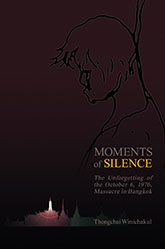
Moments of Silence: The Unforgetting of the October 6, 1976, Massacre in Bangkok
Thongchai Winichakul. Moments of Silence: The Unforgetting of the October 6, 1976, Massacre in Bangkok. University of Hawaii Press, 2020.
The massacre on October 6, 1976, in Bangkok was brutal and violent, its savagery unprecedented in modern Thai history. Four decades later there has been no investigation into the atrocity; information remains limited, the truth unknown. There has been no collective coming to terms with what happened or who is responsible. Thai society still refuses to confront this dark page in its history.Moments of Silence focuses on the silence that surrounds the October 6 massacre. Silence, the book argues, is not forgetting. Rather it signals an inability to forget or remember—or to articulate a socially meaningful memory. It is the “unforgetting,” the liminal domain between remembering and forgetting. Historian Thongchai Winichakul, a participant in the events of that day, gives the silence both a voice and a history by highlighting the factors that contributed to the unforgetting amidst changing memories of the massacre over the decades that followed. They include shifting political conditions and context, the influence of Buddhism, the royal-nationalist narrative of history, the role played by the monarchy as moral authority and arbiter of justice, and a widespread perception that the truth might have devastating ramifications for Thai society. The unforgetting impacted both victims and perpetrators in different ways. It produced a collective false memory of an incident that never took place, but it also produced silence that is filled with hope and counter-history. Moments of Silence tells the story of a tragedy in Thailand—its victims and survivors—and how Thai people coped when closure was unavailable in the wake of atrocity. But it also illuminates the unforgetting as a phenomenon common to other times and places where authoritarian governments flourish, where atrocities go unexamined, and where censorship (imposed or self-directed) limits public discourse. The tensions inherent in the author’s dual role offer a riveting story, as well as a rare and intriguing perspective. Most of all, this provocative book makes clear the need to provide a place for past wrongs in the public memory.
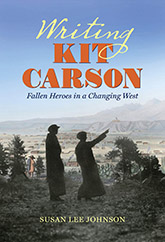
Writing Kit Carson Fallen Heroes in a Changing West
Susan Lee Johnson. Writing Kit Carson Fallen Heroes in a Changing West. University of North Carolina Press, 2020.
In this critical biography, Susan Lee Johnson braids together lives over time and space, telling tales of two white women who, in the 1960s, wrote books about the fabled frontiersman Christopher “Kit” Carson: Quantrille McClung, a Denver librarian who compiled the Carson-Bent-Boggs Genealogy, and Kansas-born but Washington, D.C.- and Chicago-based Bernice Blackwelder, a singer on stage and radio, a CIA employee, and the author of Great Westerner: The Story of Kit Carson. In the 1970s, as once-celebrated figures like Carson were falling headlong from grace, these two amateur historians kept weaving stories of western white men, including those who married American Indian and Spanish Mexican women, just as Carson had wed Singing Grass, Making Out Road, and Josefa Jaramillo.Johnson’s multilayered biography reveals the nature of relationships between women historians and male historical subjects and between history buffs and professional historians. It explores the practice of history in the context of everyday life, the seductions of gender in the context of racialized power, and the strange contours of twentieth-century relationships predicated on nineteenth-century pasts. On the surface, it tells a story of lives tangled across generation and geography. Underneath run probing questions about how we know about the past and how that knowledge is shaped by the conditions of our knowing. Published in association with the William P. Clements Center for Southwest Studies at Southern Methodist University in Dallas, Texas
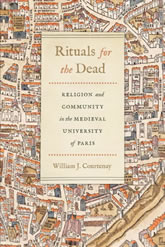
Rituals for the Dead: Religion and Community in the Medieval University of Paris
William J. Courtenay. Rituals for the Dead: Religion and Community in the Medieval University of Paris. University of Notrre Dame Press, 2019.
In his fascinating new book, based on the Conway Lectures he delivered at Notre Dame in 2016, William Courtenay examines aspects of the religious life of one medieval institution, the University of Paris, in the thirteenth and fourteenth centuries. In place of the traditional account of teaching programs and curriculum, however, the focus here is on religious observances and the important role that prayers for the dead played in the daily life of masters and students. Courtenay examines the university as a consortium of sub-units in which the academic and religious life of its members took place, and in which prayers for the dead were a major element. Throughout the book, Courtenay highlights reverence for the dead, which preserved their memory and was believed to reduce the time in purgatory for deceased colleagues and for founders of and donors to colleges. The book also explores the advantages for poor scholars of belonging to a confraternal institution that provided benefits to all members regardless of social background, the areas in which women contributed to the university community, including the founding of colleges, and the growth of Marian piety, seeking her blessing as patron of scholarship and as protector of scholars. Courtenay looks at attempts to offset the inequality between the status of masters and students, rich and poor, and college founders and fellows, in observances concerned with death as well as rewards and punishments in the afterlife. Rituals for the Dead is the first book-length study of religious life and remembrances for the dead at the medieval University of Paris. Scholars of medieval history will be an eager audience for this title.
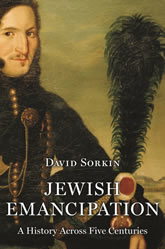
Jewish Emancipation: A History Across Five Centuries
David Sorkin. Jewish Emancipation: A History Across Five Centuries. Princeton University Press, 2019.
For all their unquestionable importance, the Holocaust and the founding of the State of Israel now loom so large in modern Jewish history that we have mostly lost sight of the fact that they are only part of—and indeed reactions to—the central event of that history: emancipation. In this book, David Sorkin seeks to reorient Jewish history by offering the first comprehensive account in any language of the process by which Jews became citizens with civil and political rights in the modern world. Ranging from the mid-sixteenth century to the beginning of the twenty-first, Jewish Emancipation tells the ongoing story of how Jews have gained, kept, lost, and recovered rights in Europe, North Africa, the Middle East, the United States, and Israel. Emancipation, Sorkin shows, was not a one-time or linear event that began with the Enlightenment or French Revolution and culminated with Jews’ acquisition of rights in Central Europe in 1867–71 or Russia in 1917. Rather, emancipation was and is a complex, multidirectional, and ambiguous process characterized by deflections and reversals, defeats and successes, triumphs and tragedies. For example, American Jews mobilized twice for emancipation: in the nineteenth century for political rights, and in the twentieth for lost civil rights. Similarly, Israel itself has struggled from the start to institute equality among its heterogeneous citizens. By telling the story of this foundational but neglected event, Jewish Emancipation reveals the lost contours of Jewish history over the past half millennium.
The Oxford Encyclopedia of African Historiography: Methods and Sources
Thomas Spear. The Oxford Encyclopedia of African Historiography: Methods and Sources. Oxford University Press, 2019.
The difficulties of exploring African history, especially for earlier periods, have spurred the development of a wide range of methodologies and approaches, such that Wyatt McGaffey once termed it “the decathlon of the social sciences.” Historians have long utilized archaeology, ethnography, historical linguistics, and oral traditions in their study of the continent, but are only beginning to explore the possibilities of genetics or many of the techniques used by modern archaeology and other emerging sciences. And as digital sources-from historical documents and statistics to cartographic, climatic, demographic, and environmental modeling-proliferate, so do the problems in using them. The Oxford Encyclopedia of African Historiography: Methods and Sources examines how these developments have influenced the scholarship that historians produce. Such methods continue to evolve, demanding that historians develop basic understandings of them. Thus, the two-volume Encyclopedia builds a theoretical foundation for the field, expanding the ways that Africa can be studied, and recovering the histories of the continent that often appear outside of the documentary record.
Future Remains: A Cabinet of Curiosities for the Anthropocene.
Marco Armiero (Co-editor), Robert S. Emmett (Co-editor), and Gregg Mitman (Co-editor). Future Remains: A Cabinet of Curiosities for the Anthropocene. University of Chicago Press, 2018.
What can a pesticide pump, a jar full of sand, or an old calico print tell us about the Anthropocene—the age of humans? Just as paleontologists look to fossil remains to infer past conditions of life on earth, so might past and present-day objects offer clues to intertwined human and natural histories that shape our planetary futures. In this era of aggressive hydrocarbon extraction, extreme weather, and severe economic disparity, how might certain objects make visible the uneven interplay of economic, material, and social forces that shape relationships among human and nonhuman beings? Future Remains is a thoughtful and creative meditation on these questions. The fifteen objects gathered in this book resemble more the tarots of a fortuneteller than the archaeological finds of an expedition—they speak of planetary futures. Marco Armiero, Robert S. Emmett, and Gregg Mitman have assembled a cabinet of curiosities for the Anthropocene, bringing together a mix of lively essays, creatively chosen objects, and stunning photographs by acclaimed photographer Tim Flach. The result is a book that interrogates the origins, implications, and potential dangers of the Anthropocene and makes us wonder anew about what exactly human history is made of.
Inge Morath: An Illustrated Biography
Linda Gordon. Inge Morath: An Illustrated Biography. Prestel Publishing, 2018.
An illustrated biography of one of the 20th century’s greatest photographers, this book looks at the life and work of Inge Morath. The late playwright Arthur Miller, speaking of his wife Inge Morath, said “She made poetry out of people and their places over half a century.” Morath’s curiosity, compassion, and bravery show vividly in this biography featuring stunning images from every stage of her career. Biographer Linda Gordon presents Morath traveling across the globe, often as a woman alone, quietly but firmly defying the conventions for what was appropriate for women at the time. Her photographs show her cosmopolitanism, which arose from her love of literature, her fluency in many languages, and her revulsion against Hitler’s Germany, where she spent her teenage years. Her respect for all the world’s cultures, from Spain to Iran to China, made her a kind of visual ethnographer. One of the first women to join the Magnum collective, Morath was a superb portraitist, particularly drawn to artists, such as painter Saul Steinberg, sculptor Louise Bourgeois, and writer Boris Pasternak. She worked mainly in black-and-white but also used color film exquisitely, even early in her career. Through Magnum assignments to document film sets she met Arthur Miller and their subsequent marriage lasted for forty years. Despite a variety of subject matter, Morath’s work is unified by an intimacy and comfort with the world’s many cultures. Truly a citizen of the world, her images are simultaneously universal and personal.
Biological Individuality: Integrating Scientific, Philosophical, and Historical Perspectives
Lidgard, Scott (Co-editor), and Lynn K. Nyhart (Co-editor). Biological Individuality: Integrating Scientific, Philosophical, and Historical Perspectives. University of Chicago Press, 2017.
Individuals are things that everybody knows—or thinks they do. Yet even scholars who practice or analyze the biological sciences often cannot agree on what an individual is and why. One reason for this disagreement is that the many important biological individuality concepts serve very different purposes—defining, classifying, or explaining living structure, function, interaction, persistence, or evolution. Indeed, as the contributors to Biological Individuality reveal, nature is too messy for simple definitions of this concept, organisms too quirky in the diverse ways they reproduce, function, and interact, and human ideas about individuality too fraught with philosophical and historical meaning. Bringing together biologists, historians, and philosophers, this book provides a multifaceted exploration of biological individuality that identifies leading and less familiar perceptions of individuality both past and present, what they are good for, and in what contexts. Biological practice and theory recognize individuals at myriad levels of organization, from genes to organisms to symbiotic systems. We depend on these notions of individuality to address theoretical questions about multilevel natural selection and Darwinian fitness; to illuminate empirical questions about development, function, and ecology; to ground philosophical questions about the nature of organisms and causation; and to probe historical and cultural circumstances that resonate with parallel questions about the nature of society. Charting an interdisciplinary research agenda that broadens the frameworks in which biological individuality is discussed, this book makes clear that in the realm of the individual, there is not and should not be a direct path from biological paradigms based on model organisms through to philosophical generalization and historical reification.
The Future of Interreligious Dialogue: A Multireligious Conversation on Nostra Aetate
Charles L. Cohen (Co-editor), Paul F. Knitter (Co-editor), and Ulrich Rosenhagen (Co-editor). The Future of Interreligious Dialogue: A Multireligious Conversation on Nostra Aetate. Orbis Books, 2017.
Drawn from a conference celebrating the 50th anniversary of the landmark Vatican II document, Nostra Aetate (“Declaration on the Relation of the Church to Non-Christian Religions”), this multi-perspective collection of essays by the world’s leading scholars of theology and interreligious dialogue brings new ferment to the field of interreligious understanding. In addition to the editors, contributors include (among others) John T. Thatamanil, John Borelli, Jeannine Hill Fletcher, Roger Haight, John Pawlikowski, Dwight Hopkins, Shira Lander, and Sallie B. King. Charles L. Cohen is E. Gordon Fox Professor of American Institutions at UW–Madison and former director of the Lubar Institute for the Study of the Abrahamic Religions. Paul F. Knitter is the Emeritus Paul Tillich Professor of Theology, World Religions, and Culture at Union Theological Seminary, New York. Ulrich Rosenhagen, formerly associate director of the Lubar Institute for the Study of the Abrahamic Religions, is a lecturer in religious studies at UW–Madison.

Reading Catechisms, Teaching Religion
Lee Palmer Wandel. Reading Catechisms, Teaching Religion. Brill, 2016.
Reading Catechisms, Teaching Religion makes two broad arguments. First, the sixteenth century witnessed a fundamental transformation in Christians’, Catholic and Evangelical, conceptualization of the nature of knowledge of Christianity and the media through which that knowledge was articulated and communicated. Christians had shared a sense that knowledge might come through visions, images, liturgy; catechisms taught that knowledge of ‘Christianity’ began with texts printed on a page. Second, codicil catechisms sought not simply to dissolve the material distinction between codex and person, but to teach catechumens to see specific words together as texts. The pages of catechisms were visual—they confound precisely that constructed modern bipolarity, word/image, or, conversely, that modern bipolarity obscures what sixteenth-century catechisms sought to do.
Documenting the World: Film, Photography, and the Scientific Record
Gregg Mitman (Co-editor), and Kelley Wilder (Co-editor). Documenting the World: Film, Photography, and the Scientific Record. University of Chicago Press, 2016.
Imagine the twentieth century without photography and film. Its history would be absent of images that define historical moments and generations: the death camps of Auschwitz, the assassination of John F. Kennedy, the Apollo lunar landing. It would be a history, in other words, of just artists’ renderings and the spoken and written word. To inhabitants of the twenty-first century, deeply immersed in visual culture, such a history seems insubstantial, imprecise, and even, perhaps, unscientific. Documenting the World is about the material and social life of photographs and film made in the scientific quest to document the world. Drawing on scholars from the fields of art history, visual anthropology, and science and technology studies, the chapters in this book explore how this documentation—from the initial recording of images, to their acquisition and storage, to their circulation—has altered our lives, our ways of knowing, our social and economic relationships, and even our surroundings. Far beyond mere illustration, photography and film have become an integral, transformative part of the world they seek to show us.
Africa, Journal of the International African Institute
Florence Bernault (Co-editor), and Jan-Georg Deutsch (Co-editor). Africa, Journal of the International African Institute. Cambridge University Press, 2015.
Violence is a murky issue to research and to theorize: this introduction suggests that it has also often been approached differently by anthropologists and historians. In the pages that follow, we reflect on the ways in which both disciplines have worked to interpret violent events in Africa, whether in the deep past, during the colonial era or in more recent periods. To better contextualize these disciplinary advances, we intersperse them with brief reviews of general theories on violence. The three articles featured in this special section, while dealing with very dissimilar case studies, provide common insights on three main themes. The first engages with the paradox of the contingency and continuity of violence, and with the unevenness of perpetrators, victims and targets. The second deals with the refractive meanings attached to violent events. The third probes, underneath the apparent turmoil of violent acts, the deep moral and cultural frameworks of action that underwrite them. We have composed this introduction around these main questions.
Newton’s Apple and Other Myths about Science
Kostas Kampourakis (Co-editor). Newton’S Apple and Other Myths about Science. Harvard University Press, 2015.
A falling apple inspired Isaac Newton’s insight into the law of gravity—or so the story goes. Is it true? Perhaps not. But the more intriguing question is why such stories endure as explanations of how science happens. Newton’s Apple and Other Myths about Science brushes away popular misconceptions to provide a clearer picture of great scientific breakthroughs from ancient times to the present. Among the myths refuted in this volume is the idea that no science was done in the Dark Ages, that alchemy and astrology were purely superstitious pursuits, that fear of public reaction alone led Darwin to delay publishing his theory of evolution, and that Gregor Mendel was far ahead of his time as a pioneer of genetics. Several twentieth-century myths about particle physics, Einstein’s theory of relativity, and more are discredited here as well. In addition, a number of broad generalizations about science go under the microscope of history: the notion that religion impeded science, that scientists typically adhere to a codified “scientific method,” and that a bright line can be drawn between legitimate science and pseudoscience. Edited by Ronald Numbers and Kostas Kampourakis, Newton’s Apple and Other Myths about Science debunks the widespread belief that science advances when individual geniuses experience “Eureka!” moments and suddenly comprehend what those around them could never imagine. Science has always been a cooperative enterprise of dedicated, fallible human beings, for whom context, collaboration, and sheer good luck are the essential elements of discovery.
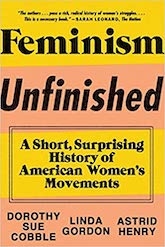
Feminism Unfinished A Short, Surprising History of American Women’s Movements
Dorothy Sue Cobble, Linda Gordon, and Astrid Henry. Feminism Unfinished A Short, Surprising History of American Women’S Movements. Liveright, 2015.
Eschewing the conventional wisdom that places the origins of the American women’s movement in the nostalgic glow of the late 1960s, Feminism Unfinished traces the beginnings of this seminal American social movement to the 1920s, in the process creating an expanded, historical narrative that dramatically rewrites a century of American women’s history. Also challenging the contemporary “lean-in,” trickle-down feminist philosophy and asserting that women’s histories all too often depoliticize politics, labor issues, and divergent economic circumstances, Dorothy Sue Cobble, Linda Gordon, and Astrid Henry demonstrate that the post-Suffrage women’s movement focused on exploitation of women in the workplace as well as on inherent sexual rights. The authors carefully revise our “wave” vision of feminism, which previously suggested that there were clear breaks and sharp divisions within these media-driven “waves.” Showing how history books have obscured the notable activism by working-class and minority women in the past, Feminism Unfinished provides a much-needed corrective.
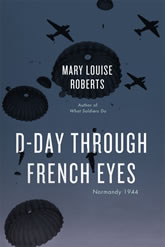
D-Day through French Eyes: Memoirs of Normandy 1944
Mary Lou Roberts. D-Day through French Eyes: Memoirs of Normandy 1944. University of Chicago Press, 2014.
“Like big black umbrellas, they rain down on the fields across the way, and then disappear behind the black line of the hedges.” Silent parachutes dotting the night sky—that’s how one woman in Normandy in June of 1944 learned that the D-Day invasion was under way. Though they yearned for liberation, the French in Normandy nonetheless had to steel themselves for war, knowing that their homes and land and fellow citizens would have to bear the brunt of the attack. Already battered by years of Nazi occupation, they knew they had one more trial to undergo even as freedom beckoned. With D-Day through French Eyes, Mary Louise Roberts turns the usual stories of D-Day around, taking readers across the Channel to view the invasion anew. Roberts builds her history from an impressive range of gripping first-person accounts of the invasion as seen by French citizens throughout the region. A farm family notices that cabbage is missing from their garden—then discovers that the guilty culprits are American paratroopers hiding in the cowshed. Fishermen rescue pilots from the wreck of their B-17, only to struggle to find clothes big enough to disguise them as civilians. A young man learns how to estimate the altitude of bombers and to determine whether a bomb was whistling overhead or silently headed straight for them. In small towns across Normandy, civilians hid wounded paratroopers, often at the risk of their own lives. When the allied infantry arrived, they guided soldiers to hidden paths and little-known bridges, giving them crucial advantages over the German occupiers. Through story after story, Roberts builds up an unprecedented picture of the face of battle as seen by grateful, if worried, civilians. As she did in her acclaimed account of GIs in postwar France, What Soldiers Do, Roberts here reinvigorates and reinvents a story we thought we knew. The result is a fresh perspective on the heroism, sacrifice, and achievement of D-Day.
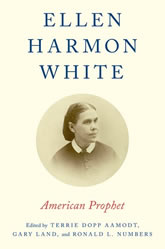
Ellen Harmon White: American Prophet
Terri Dopp Aamodt (Co-editor), and Gary Land (Co-editor). Ellen Harmon White: American Prophet. Oxford University Press, 2014.
Edited by Terrie Dopp Aamodt, the late Gary Land, and Ronald L. Numbers First comprehensive scholarly treatment of Ellen White’s life, career, and cultural context Measures White’s contribution to the development of Adventist theology in a new, comprehensive way Re-contextualizes White’s published spiritual advice letters, or testimonies Offers the most comprehensive assessment of biographers’ and historians’ response to White in the final historiographical essay
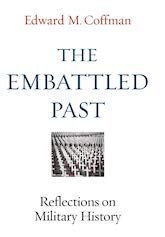
The Embattled Past: Reflections on Military History
Edward Coffman. The Embattled Past: Reflections on Military History. University Press of Kentucky, 2014.
Internationally recognized for having reinvigorated and redefined his field, distinguished military historian Edward M. Coffman is a dedicated and much-admired teacher and mentor. In The Embattled Past, several of his most important essays have been assembled into a collection that serves as an essential reference to the discipline and an initiation to the study of military history for aspiring scholars. Coffman’s introduction to the volume charts his own professional journey and sets the book within the larger context of Americans’ attitudes toward their military, both inside and outside of academia. The essays explore a range of critical issues in military historiography — such as strategies for conducting oral history and research methodologies — and examine questions at the heart of the field. Included are two seminal essays on World War I, which provide a fascinating overview of American war strategies and illuminate the reasons why so many historians have ignored this critical turning point in twentieth-century history. The volume concludes with an unpublished essay detailing Coffman’s experience of interviewing General Douglas MacArthur in 1960. This exciting new book offers readers insights into more than two hundred years of United States military history while also providing a comprehensive overview of Coffman’s stellar contributions to the field. Important and engaging, The Embattled Past is a primer on the profession from one of the most honored scholars of our time.
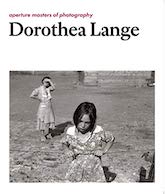
Dorothea Lange: Aperture Masters of Photography
Linda Gordon, and Dorothea Lange. Dorothea Lange: Aperture Masters of Photography. Aperture Publishing, 2014.
The Aperture Masters of Photography Series has become a touchstone of Aperture’s longstanding commitment to introducing the history and art of photography to a broader public. Each volume provides an ongoing comprehensive view of the artists who have helped shape the medium. Initially presented as the History of Photography Series in 1976, the first volume featured Henri Cartier-Bresson and was edited by legendary French publisher Robert Delpire, who cofounded the series with Aperture’s own Michael Hoffman. Twenty volumes have been published in total, each of them devoted to an image-maker whose achievements have accorded them vital importance in the history of photography. Each volume presents an evocative selection of the photographer’s life’s work, introduced with a foreword by a notable curator or historian of each artist. The series will be relaunched in Fall 2014, beginning with books on Paul Strand and Dorothea Lange, elegantly updated and refreshed for today’s photography-hungry audiences, and introducing new, image-by-image commentary and chronologies of the artists’ lives for each of the previously published titles. The series will also include entirely new titles on individual artists. The Aperture Masters of Photography Series is an unparalleled library of both historical and contemporary photographers, and serves as an accessible compilation for anyone studying the history of photography.
The French Revolution in Global Perspective
Suzanne Desan (Co-editor), Lynn Hunt (Co-editor), and William Max Nelson (Co-editor). The French Revolution in Global Perspective. Cornell University Press, 2013.
Situating the French Revolution in the context of early modern globalization for the first time, this book offers a new approach to understanding its international origins and worldwide effects. A distinguished group of contributors shows that the political culture of the Revolution emerged out of a long history of global commerce, imperial competition, and the movement of people and ideas in places as far flung as India, Egypt, Guiana, and the Caribbean. This international approach helps to explain how the Revolution fused immense idealism with territorial ambition and combined the drive for human rights with various forms of exclusion. The essays examine topics including the role of smuggling and free trade in the origins of the French Revolution, the entwined nature of feminism and abolitionism, and the influence of the French revolutionary wars on the shape of American empire. The French Revolution in Global Perspective illuminates the dense connections among the cultural, social, and economic aspects of the French Revolution, revealing how new political forms—at once democratic and imperial, anticolonial and centralizing—were generated in and through continual transnational exchanges and dialogues.
What Soldiers Do: Sex and the American GI in World War II France
Mary Lou Roberts. What Soldiers Do: Sex and the American GI in World War II France. University of Chicago Press, 2013.
How do you convince men to charge across heavily mined beaches into deadly machine-gun fire? Do you appeal to their bonds with their fellow soldiers, their patriotism, their desire to end tyranny and mass murder? Certainly—but if you’re the US Army in 1944, you also try another tack: you dangle the lure of beautiful French women, waiting just on the other side of the wire, ready to reward their liberators in oh so many ways. That’s not the picture of the Greatest Generation that we’ve been given, but it’s the one Mary Louise Roberts paints to devastating effect in What Soldiers Do. Drawing on an incredible range of sources, including news reports, propaganda and training materials, official planning documents, wartime diaries, and memoirs, Roberts tells the fascinating and troubling story of how the US military command systematically spread—and then exploited—the myth of French women as sexually experienced and available. The resulting chaos—ranging from flagrant public sex with prostitutes to outright rape and rampant venereal disease—horrified the war-weary and demoralized French population. The sexual predation, and the blithe response of the American military leadership, also caused serious friction between the two nations just as they were attempting to settle questions of long-term control over the liberated territories and the restoration of French sovereignty. While never denying the achievement of D-Day, or the bravery of the soldiers who took part, What Soldiers Do reminds us that history is always more useful—and more interesting—when it is most honest, and when it goes beyond the burnished beauty of nostalgia to grapple with the real lives and real mistakes of the people who lived it. A film, “Le Repos des guerriers,” based on What Soldiers Do, (MAHA Productions, France) was released in Spring 2015.
The Cambridge History of Science, Volume 2 Medieval Science
David C. Lindberg (Co-editor), and Michael H. Shank (Co-editor). The Cambridge History of Science, Volume 2 Medieval Science. Cambridge University Press, 2013.
This volume in the highly respected Cambridge History of Science series is devoted to the history of science in the Middle Ages from the North Atlantic to the Indus Valley. Medieval science was once universally dismissed as non-existent – and sometimes it still is. This volume reveals the diversity of goals, contexts, and accomplishments in the study of nature during the Middle Ages. Organized by topic and culture, its essays by distinguished scholars offer the most comprehensive and up-to-date history of medieval science currently available. Intended to provide a balanced and inclusive treatment of the medieval world, contributors consider scientific learning and advancement in the cultures associated with the Arabic, Greek, Latin, and Hebrew languages. Scientists, historians, and other curious readers will all gain a new appreciation for the study of nature during an era that is often misunderstood.
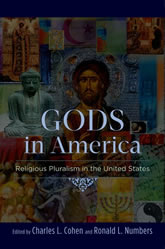
Gods in America: Religious Pluralism in the United States
Charles L. Cohen (Co-editor). Gods in America: Religious Pluralism in the United States. Oxford University Press, 2013.
Brings together leading scholars from a variety of disciplines to explain the historical roots of religious phenomena and assesses their impact on modern American society.
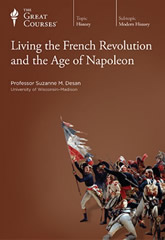
Video and Audio Course: Living the French Revolution and the Age of Napoleon
Suzanne Desan. Video and Audio Course: Living the French Revolution and the Age of Napoleon. The Great Courses, 2013.
In one of the most pivotal and exciting eras of European history, the French Revolution and Napoleonic Empire stunned the world and wrenched Europe toward modernity. The Revolution overthrew the monarchy to create a republic, leveled the aristocracy, replaced Catholicism with goddesses of liberty, set up Sister Republics in Europe, and sparked slave revolt in the French Caribbean. This radical experiment in democracy also unleashed the Terror and launched Napoleon Bonaparte, the brilliant politician and general who built an astonishing European Empire. Tracing events from the Old Regime court at Versailles to Napoleon’s fall at Waterloo, this course weaves together political and social analysis with personal stories: Marie-Antoinette, Robespierre, and Napoleon rub shoulders with workers storming the Bastille, women rioting for bread, and soldiers crossing Russia. The lectures also address big questions: Why did the ideals of “liberty and equality” become mired in Terror? How did the Revolution and Napoleonic Empire lay the foundations of modern politics, lead to the restructuring of Europe, and create repercussions from Haiti to India?
Rotuli Parisienses (2 vols.) Supplications to the Pope from the University of Paris, Volume III: 1378-1394
William J. Courtenay (Editor), and Eric D. Goddard (Editor). Rotuli Parisienses (2 vols.) Supplications to the Pope from the University of Paris, Volume III: 1378-1394. Brill, 2013.
Series: Education and Society in the Middle Ages and Renaissance, Volume: 44 This volume continues the edition of the rotuli, or lists of benefice supplications, sent to the papacy by masters, bachelors, and students at the University of Paris in the fourteenth century. It specifically covers the pontificate of the Avignon pope Clement VII (1378-1394). It also contains letters of provision, in abbreviated form, that resulted from those petitions, along with a large number of supplications from individual Parisian scholars either submitted independently or, more frequently, through another sponsor. In contrast to earlier papal beneficial policy, Pope Clement responded favorably to many petitions from students in the faculty of arts at Paris, some of them in the beginning years of their undergraduate education. Thus, in addition to providing important information on Parisian scholars and papal beneficial policy in the early years of the Papal Schism, it documents a portion of the university community otherwise invisible, namely undergraduate students, and reveals the connections between Parisian scholars and social and ecclesiastical patrons at the end of the fourteenth century. The book concludes with an index of the names of scholars and patrons as well as a place-name index locating the parish and collegiate churches mentioned in the texts. Along with the two earlier volumes, this edition represents the largest body of new documentation for the pre-fifteenth century University to appear since the publication of the Chartularium Universitatis Parisiensis at the end of the nineteenth century.
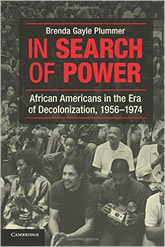
In Search of Power: African Americans in the Era of Decolonization, 1956–1974
Brenda Gayle Plummer. In Search of Power: African Americans in the Era of Decolonization, 1956–1974. Cambridge University Press, 2012.
In Search of Power is a history of the era of civil rights, decolonization, and Black Power. In the critical period from 1956 to 1974, the emergence of newly independent states worldwide and the struggles of the civil rights movement in the United States exposed the limits of racial integration and political freedom. Dissidents, leaders, and elites alike were linked in a struggle for power in a world where the rules of the game had changed. Brenda Gayle Plummer traces the detailed connections between African Americans’ involvement in international affairs and how they shaped American foreign policy, integrating African American history, the history of the African Diaspora, and the history of United States foreign relations. These topics, usually treated separately, not only offer a unified view of the period but also reassess controversies and events that punctuated this colorful era of upheaval and change. Unites African American history with the history of US foreign affairs Presents African American history as transnational Examines the ways in which both dissidents and elites were involved in the pursuit of power
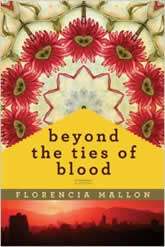
Beyond the Ties of Blood
Florencia Mallon. Beyond the Ties of Blood. Pegasus Books, 2012.
In the tradition of Isabel Allende, the debut novel from Chilean-American Florencia Mellon—a family saga that explores the lives touched by the tragedies of Chile’s vibrant history. In the political aftermath of the 1973 Chilean coup, Eugenia Aldunate is imprisoned and tortured. Her lover, Manuel, is savagely killed, one of the countless “disappeared” that would haunt Chile’s collective memory for decades. While still in the torture camp, Eugenia discovers she is pregnant and is exiled to Mexico and then to the United States to raise her daughter alone, forbidden to return. She builds a quiet life for herself as a journalist and professor, but the scars on her arms do not allow her to bury her past. Each night she aches for her homeland while fighting to suppress the horrific nightmares that still plague her. Nearly twenty years after her exile, Eugenia is called back to Chile to testify in Manuel’s case and help seek justice for the others who disappeared. A rare living witness to these “camps,” Eugenia must come to grips with the legacy of violence and traumas left by Pinochet’s dictatorship and find truth and solace in the stories of those she left behind. In the tradition of Kiran Desai’s The Inheritance of Loss and Julia Alvarez’s In the Time of Butterflies, Beyond the Ties of Blood is a tribute to the resilience of the human spirit and the transcendence of family.
The Weimar Moment Liberalism, Political Theology, and Law
Rudy J. Koshar (Editor). The Weimar Moment Liberalism, Political Theology, and Law. Lexington Books, 2012.
The Weimar Moment’s evocative assault on closure and political reaction, its offering of democracy against the politics of narrow self-interest cloaked in nationalist appeals to Volk and “community”—or, as would be the case in Nazi Germany, “race”—cannot but appeal to us today. This appeal—its historical grounding and content, its complexities and tensions, its variegated expressions across the networks of power and thought—is the essential context of the present volume, whose basic premise is unhappiness with Hegel’s remark that we learn no more from history than we cannot learn from it. The challenge of the papers in this volume is to provide the material to confront the present effectively drawing from what we can and do understand.

The Reformation: Towards a New History
Lee Palmer Wandel. The Reformation: Towards a New History. Cambridge University Press, 2011.
This book brings together two histories, of the Encounter between Europe and the western hemisphere that began in 1492 and the fragmentation of European Christendom in the sixteenth century, to recast the story of the Reformation. It restores to the polemics—“idolatry,” “true Christian,” “barbarian”—their deeply divisive force, even as it helps us to see past those polemics to divergent understandings of divinity, matter, and human nature. Every aspect of human life, from marriage and family through politics to conceptualizations of space and time was called into question. Debates on human nature and conversion forged new understandings of religious identity. Divergent understandings of human nature and its relationship to the material world divided Europeans on the nature and function of images and ritual. By the end of the century, there was not one “Christian religion,” but multiple understandings of person, matter, space, time—and of “religion” itself.

Wrestling with Nature: From Omens to Science
Peter Harrison (Co-editor), and Michael H. Shank (Co-editor). Wrestling With Nature: From Omens to Science. University of Chicago Press, 2011.
When and where did science begin? Historians have offered different answers to these questions, some pointing to Babylonian observational astronomy, some to the speculations of natural philosophers of ancient Greece. Others have opted for early modern Europe, which saw the triumph of Copernicanism and the birth of experimental science, while yet another view is that the appearance of science was postponed until the nineteenth century. Rather than posit a modern definition of science and search for evidence of it in the past, the contributors to Wrestling with Nature examine how students of nature themselves, in various cultures and periods of history, have understood and represented their work. The aim of each chapter is to explain the content, goals, methods, practices, and institutions associated with the investigation of nature and to articulate the strengths, limitations, and boundaries of these efforts from the perspective of the researchers themselves. With contributions from experts representing different historical periods and different disciplinary specializations, this volume offers a fresh perspective on the history of science and on what it meant, in other times and places, to wrestle with nature.
Ruptures Postcolonial
Florence Bernault. Ruptures Postcolonial. La Découverte, 2010.
Comment penser la France d’aujourd’hui sans verser dans la nostalgie à l’égard de sa mythique grandeur passée, et comment construire un nouveau « vivre ensemble » ? De quelle manière sortir des pièges de l’identité nationale et des fantasmes sur les dangers de l’immigration ? Comment penser les relations de la France dans le monde postcolonial, alors que le continent africain fête les cinquante ans d’indépendance des anciennes colonies françaises, que les territoires des outre-mers réclament de nouveaux rôles dans la République et que de nouveaux centres et périphéries émergent? Prolongeant le tableau dressé en 2005 dans La Fracture coloniale (également paru à La Découverte), les auteurs de ce livre apportent un éclairage original sur les courant encore mal connus en France des post-colonial et subaltern studies. Ils tentent de comprendre pourquoi ces courants engagent tant d’oppositions et de fantasmes et examinent la société française à l’épreuve des perspectives postcoloniales. Avec les contributions de spécialistes de tous horizons, internationalement reconnus, cet ouvrage constitue à la fois, une somme et une ouverture. Il analyse les mille facettes des effets contemporains de la période coloniale et incite à repenser la mondialisation, ainsi que la place des diasporas. Il s’attache à une critique des discriminations et des frontières politiques, interroge les enjeux culturels et les relations intercommunautaires, explique les conflits de mémoire, questionne les crises urbaines et explore les mouvements moiblisant les territoires des outre-mers
Theology and the Soul of the Liberal State
Leonard V. Kaplan, and Charles L. Cohen. Theology and the Soul of the Liberal State. Lexington Books, 2010.
Rising calls in both the United States and abroad for theologizing national agendas have renewed examinations about whether liberal states can accommodate such programs without either endangering citizens’ rights or trivializing religious concerns. Conventional wisdom suggests that theology is necessarily unfriendly to the liberal state, but neither philosophical analysis nor empirical argument has convincingly established that conclusion. Examining the problem from a variety of perspectives including law, philosophy, history, political theory, and religious studies, the essays in Theology and the Soul of the Liberal State suggest the possibilities for and limits on what theological reflection might contribute to liberal polities across the globe. Theology and the Soul of the Liberal State develops these issues under five headings. Part One explores “The Nature of Religious Argument” as it can inflect discussions of public policy, political theory, jurisprudence, and education. Part Two, “Theologies of the Marketplace,” notes that theology can by turns be highly critical, neutral, or even inordinately supportive of market operations. Part Three, “European Perspectives,” reviews and develops arguments from Abraham Kuyper, Karl Barth, and French post-modernists concerning how one might integrate theological discourse into the public sphere. Part Four offers Israel, Pakistan and Tibet as “Asian Perspectives” on how theology may comport with liberalism in recently created states (or, in the last case, a diasporic government-in-exile) where powerful religious constituencies make “secular” civil action extremely problematic. Finally, Part V, “Religion and Terror,” probes the vexed relationship between conceptions of divine and human justice, where the imperatives of theology and state confront each other most nakedly. Collectively, Theology and the Soul of the Liberal State suggests that the liberal state cannot keep theology out of public discourse and may even benefit from its intervention.
Reckoning with Pinochet: The Memory Question in Democratic Chile, 1989–2006
Steve J. Stern. Reckoning With Pinochet: The Memory Question in Democratic Chile, 1989–2006. Duke University Press, 2010.
Reckoning with Pinochet is the first comprehensive account of how Chile came to terms with General Augusto Pinochet’s legacy of human rights atrocities. An icon among Latin America’s “dirty war” dictators, Pinochet had ruled with extreme violence while building a loyal social base. Hero to some and criminal to others, the general cast a long shadow over Chile’s future. Steve J. Stern recounts the full history of Chile’s democratic reckoning, from the negotiations in 1989 to chart a post-dictatorship transition; through Pinochet’s arrest in London in 1998; the thirtieth anniversary, in 2003, of the coup that overthrew President Salvador Allende; and Pinochet’s death in 2006. He shows how transnational events and networks shaped Chile’s battles over memory, and how the Chilean case contributed to shifts in the world culture of human rights. Stern’s analysis integrates policymaking by elites, grassroots efforts by human rights victims and activists, and inside accounts of the truth commissions and courts where top-down and bottom-up initiatives met. Interpreting solemn presidential speeches, raucous street protests, interviews, journalism, humor, cinema, and other sources, he describes the slow, imperfect, but surprisingly forceful advance of efforts to revive democratic values through public memory struggles, despite the power still wielded by the military and a conservative social base including the investor class. Over time, resourceful civil-society activists and select state actors won hard-fought, if limited, gains. As a result, Chileans were able to face the unwelcome past more honestly, launch the world’s first truth commission to examine torture, ensnare high-level perpetrators in the web of criminal justice, and build a public culture of human rights. Stern provides an important conceptualization of collective memory in the wake of national trauma in this magisterial work of history.
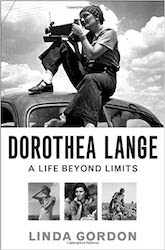
Dorothea Lange: A Life Beyond Limits
Linda Gordon. Dorothea Lange: A Life Beyond Limits. W. W. Norton & Company, 2010.
We all know Dorothea Lange’s iconic photos—the Migrant Mother holding her child, the shoeless children of the Dust Bowl—but now renowned American historian Linda Gordon brings them to three-dimensional life in this groundbreaking exploration of Lange’s transformation into a documentarist. Using Lange’s life to anchor a moving social history of twentieth-century America, Gordon masterfully re-creates bohemian San Francisco, the Depression, and the Japanese-American internment camps. Accompanied by more than one hundred images—many of them previously unseen and some formerly suppressed—Gordon has written a sparkling, fast-moving story that testifies to her status as one of the most gifted historians of our time. Finalist for the Los Angeles Times Book Prize; a New York Times Notable Book; New Yorker’s A Year’s Reading; and San Francisco Chronicle Best Book.
Family, Gender, and Law in Early Modern France
Suzanne Desan (Co-editor), and Jeffrey Merrick (Co-editor). Family, Gender, and Law in Early Modern France. Penn State University Press, 2009.
The essays in Family, Gender, and Law in Early Modern France explore how ordinary men and women negotiated power within early modern French households and continually reinvented their families in response to external forces. Larger processes, such as state building, religious reform, changing understandings of gender roles, and economic developments, influenced family practices in the areas of marriage, separation, guardianship, and illegitimacy. Relatives, gender, community, and the law imposed limits upon families but also provided opportunities for agency. Contributors investigate patterns of courtship and decisions about marriage; the financial power exercised by wives; marital conflict and related controversies about gender, sexuality, and social order; death and guardianship; and the legitimization of children born out of wedlock. While addressing a variety of topics, this volume focuses on family members as individuals with complicated agendas and strategies of their own.

Make Room for Daddy: The Journey from Waiting Room to Birthing Room
Judith W. Leavitt. Make Room for Daddy: The Journey from Waiting Room to Birthing Room. University of North Carolina Press, 2009.
Using fathers’ first-hand accounts from letters, journals, and personal interviews along with hospital records and medical literature, Judith Walzer Leavitt offers a new perspective on the changing role of expectant fathers from the 1940s to the 1980s. She shows how, as men moved first from the hospital waiting room to the labor room in the 1960s, and then on to the delivery and birthing rooms in the 1970s and 1980s, they became progressively more involved in the birth experience and their influence over events expanded. With careful attention to power and privilege, Leavitt charts not only the increasing involvement of fathers, but also medical inequalities, the impact of race and class, and the evolution of hospital policies. Illustrated with more than seventy images from TV, films, and magazines, this book provides important new insights into childbirth in modern America, even as it reminds readers of their own experiences.
Galileo Goes to Jail and Other Myths about Science and Religion
Galileo Goes to Jail and Other Myths about Science and Religion. Harvard University Press, 2009.
If we want nonscientists and opinion-makers in the press, the lab, and the pulpit to take a fresh look at the relationship between science and religion, Ronald L. Numbers suggests that we must first dispense with the hoary myths that have masqueraded too long as historical truths. Until about the 1970s, the dominant narrative in the history of science had long been that of science triumphant, and science at war with religion. But a new generation of historians both of science and of the church began to examine episodes in the history of science and religion through the values and knowledge of the actors themselves. Now Ronald Numbers has recruited the leading scholars in this new history of science to puncture the myths, from Galileo’s incarceration to Darwin’s deathbed conversion to Einstein’s belief in a personal God who “didn’t play dice with the universe.” The picture of science and religion at each other’s throats persists in mainstream media and scholarly journals, but each chapter in Galileo Goes to Jail shows how much we have to gain by seeing beyond the myths.
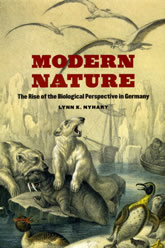
Modern Nature: The Rise of the Biological Perspective in Germany
Lynn K. Nyhart. Modern Nature: The Rise of the Biological Perspective in Germany. University of Chicago Press, 2009.
In Modern Nature,Lynn K. Nyhart traces the emergence of a “biological perspective” in late nineteenth-century Germany that emphasized the dynamic relationships among organisms, and between organisms and their environment. Examining this approach to nature in light of Germany’s fraught urbanization and industrialization, as well the opportunities presented by new and reforming institutions, she argues that rapid social change drew attention to the role of social relationships and physical environments in rendering a society—and nature—whole, functional, and healthy. This quintessentially modern view of nature, Nyhart shows, stood in stark contrast to the standard naturalist’s orientation toward classification. While this new biological perspective would eventually grow into the academic discipline of ecology, Modern Nature locates its roots outside the universities, in a vibrant realm of populist natural history inhabited by taxidermists and zookeepers, schoolteachers and museum reformers, amateur enthusiasts and nature protectionists. Probing the populist beginnings of animal ecology in Germany, Nyhart unites the history of popular natural history with that of elite science in a new way. In doing so, she brings to light a major orientation in late nineteenth-century biology that has long been eclipsed by Darwinism.
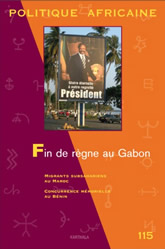
Politique africaine: Fin de regne au Gabon
Florence Bernault (Editor). Politique Africaine: Fin De Regne Au Gabon. Karthala, 2009.
Dossier coordonné par Florence BERNAULT et Joseph TONDA, avec les contributions de Mathilde DEBAIN, Martial MIDEPANI, Placide ONDO et Fanny PIGEAUD. Le décès, en juin 2009, d’Omar Bongo Odimba, doyen des chefs d’Etat du continent, semblait marquer un changement d’époque en Afrique centrale. Les rivalités entre successeurs potentiels, l’éclatement des divisions au sein du parti au pouvoir et les critiques croissantes de l’héritage du “bongoïsme” ont fait naître l’espoir d’une première alternance au Gabon dans une atmosphère de fin de règne. Pourtant, au sortir des élections contestées d’août 2009, le corps politique d’Omar Bongo a pu poursuivre son règne dans celui de son fils Ali. L’alchimie gabonaise de la “rupture dans la continuité” reproduit ainsi un système qui se donne à voir comme une “dystopie tropicale”. Ce dossier donne des clefs pour comprendre le fonctionnement de ce système, tout en explorant les mobilisations populaires qui le menacent. Il propose une réflexion sur le spectacle de la campagne électorale, la reproduction oligarchique des élites et l’émergence de nouveaux acteurs de la société civile dans l’épineuse “affaire des biens mal acquis”. Par-delà les ambitions des héritiers du bongoïsme, il explore les méandres de l’infrappolitique et les ressorts cachés du politique au Gabon qui s’expriment notamment à travers la passion de la rumeur, le kongossa, les fétiches du pouvoir ou la mise en abîme des “5 S du Système”.
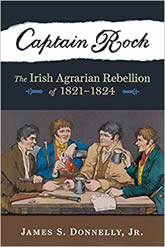
Captain Rock: The Irish Agrarian Rebellion of 1821—1824
James S. Donnelly, Jr. Captain Rock: The Irish Agrarian Rebellion of 1821—1824. University of Wisconsin Press, 2009.
Named for its mythical leader “Captain Rock,” avenger of agrarian wrongs, the Rockite movement of 1821–1824 in Ireland was notorious for its extraordinary violence. In Captain Rock, James S. Donnelly, Jr., offers both a fine-grained analysis of the conflict and a broad exploration of Irish rural society after the French revolutionary and Napoleonic wars. Originating in west Limerick, the Rockite movement spread quickly under the impact of a prolonged depression. Before long the insurgency embraced many of the better-off farmers. The intensity of the Rockites’ grievances, the frequency of their resort to sensational violence, and their appeal on such key issues as rents and tithes presented a nightmarish challenge to Dublin Castle—prompting in turn a major reorganization of the police, a purging of the local magistracy, the introduction of large military reinforcements, and a determined campaign of judicial repression. A great upsurge in sectarianism and millenarianism, Donnelly shows, added fuel to the conflagration. Inspired by prophecies of doom for the Anglo-Irish Protestants who ruled the country, the overwhelmingly Catholic Rockites strove to hasten the demise of the landed elite they viewed as oppressors. Drawing on a wealth of sources—including reports from policemen, military officers, magistrates, and landowners as well as from newspapers, pamphlets, parliamentary inquiries, depositions, rebel proclamations, and threatening missives sent by Rockites to their enemies—Captain Rock offers a detailed anatomy of a dangerous, widespread insurgency whose distinctive political contours will force historians to expand their notions of how agrarian militancy influenced Irish nationalism in the years before the Great Famine of 1845–1851.
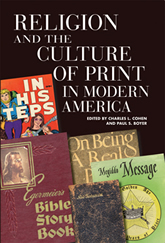
Religion and the Culture of Print in Modern America
Paul S. Boyer, and Charles L. Cohen. Religion and the Culture of Print in Modern America. University of Wisconsin Press, 2008.
Religion and the Culture of Print in Modern America explores how a variety of print media—religious tracts, newsletters, cartoons, pamphlets, self-help books, mass-market paperbacks, and editions of the Bible from the King James Version to contemporary “Bible-zines”—have shaped and been shaped by experiences of faith since the Civil War. Edited by Charles L. Cohen and Paul S. Boyer, whose comprehensive historical essays provide a broad overview to the topic, this book is the first on the history of religious print culture in modern America and a well-timed entry into the increasingly prominent contemporary debate over the role of religion in American public life.
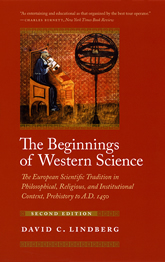
The Beginnings of Western Science: The European Scientific Tradition in Philosophical, Religious, and Institutional Context, Prehistory
David C. Lindberg. The Beginnings of Western Science: The European Scientific Tradition in Philosophical, Religious, and Institutional Context, Prehistory. University of Chicago Press, 2008.
When it was first published in 1992, The Beginnings of Western Science was lauded as the first successful attempt ever to present a unified account of both ancient and medieval science in a single volume. Chronicling the development of scientific ideas, practices, and institutions from pre-Socratic Greek philosophy to late-Medieval scholasticism, David C. Lindberg surveyed all the most important themes in the history of science, including developments in cosmology, astronomy, mechanics, optics, alchemy, natural history, and medicine. In addition, he offered an illuminating account of the transmission of Greek science to medieval Islam and subsequently to medieval Europe. The Beginnings of Western Science was, and remains, a landmark in the history of science, shaping the way students and scholars understand these critically formative periods of scientific development. It reemerges here in a second edition that includes revisions on nearly every page, as well as several sections that have been completely rewritten. For example, the section on Islamic science has been thoroughly retooled to reveal the magnitude and sophistication of medieval Muslim scientific achievement. And the book now reflects a sharper awareness of the importance of Mesopotamian science for the development of Greek astronomy. In all, the second edition of The Beginnings of Western Science captures the current state of our understanding of more than two millennia of science and promises to continue to inspire both students and general readers.
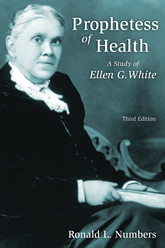
Prophetess of Health: A Study of Ellen G. White
Ronald Numbers. Prophetess of Health: A Study of Ellen G. White. Wm. B. Eerdmans Publishing Company, 2008.
Respected historian of science Ronald Numbers here examines one of the most influential, yet least examined, religious leaders in American history — Ellen G. White, the enigmatic visionary who founded the Seventh-day Adventist Church. Numbers scrutinizes White’s life (1827–1915), from her teenage visions and testimonies to her extensive advice on health reform, which influenced the direction of the church she founded. This third edition features a new preface and two key documents that shed further light on White — transcripts of the trial of Elder Israel Dammon in 1845 and the proceedings of the secret Bible Conferences in 1919.
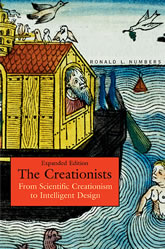
The Creationists: From Scientific Creationism to Intelligent Design (Expanded Edition)
Ronald Numbers. The Creationists: From Scientific Creationism to Intelligent Design (Expanded Edition). Harvard University Press, 2008.
In light of the embattled status of evolutionary theory, particularly as “intelligent design” makes headway against Darwinism in the schools and in the courts, this now classic account of the roots of creationism assumes new relevance. Expanded and updated to account for the appeal of intelligent design and the global spread of creationism, The Creationists offers a thorough, clear, and balanced overview of the arguments and figures at the heart of the debate. Praised by both creationists and evolutionists for its comprehensiveness, the book meticulously traces the dramatic shift among Christian fundamentalists from acceptance of the earth’s antiquity to the insistence of present-day scientific creationists that most fossils date back to Noah’s flood and its aftermath. Focusing especially on the rise of this “flood geology,” Ronald L. Numbers chronicles the remarkable resurgence of antievolutionism since the 1960s, as well as the creationist movement’s tangled religious roots in the theologies of late-nineteenth- and early-twentieth-century Baptists, Presbyterians, Lutherans, and Adventists, among others. His book offers valuable insight into the origins of various “creation science” think tanks and the people behind them. It also goes a long way toward explaining how creationism, until recently viewed as a “peculiarly American” phenomenon, has quietly but dynamically spread internationally—and found its expression outside Christianity in Judaism and Islam.
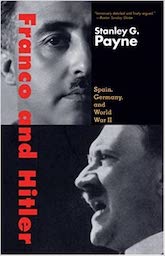
Franco and Hitler Spain, Germany, and World War II
Stanley Payne. Franco and Hitler Spain, Germany, and World War II. Yale University Press, 2008.
Was Franco sympathetic to Nazi Germany? Why didn’t Spain enter World War II? In what ways did Spain collaborate with the Third Reich? How much did Spain assist Jewish refugees? This is the first book in any language to answer these intriguing questions. Stanley Payne, a leading historian of modern Spain, explores the full range of Franco’s relationship with Hitler, from 1936 to the fall of the Reich in 1945. But as Payne brilliantly shows, relations between these two dictators were not only a matter of realpolitik. These two titanic egos engaged in an extraordinary tragicomic drama often verging on the dark absurdity of a Beckett or Ionesco play. Whereas Payne investigates the evolving relationship of the two regimes up to the conclusion of World War II, his principal concern is the enigma of Spain’s unique position during the war, as a semi-fascist country struggling to maintain a tortured neutrality. Why Spain did not enter the war as a German ally, joining with Hitler to seize Gibraltar and close the Mediterranean to the British navy, is at the center of Payne’s narrative. Franco’s only personal meeting with Hitler, in 1940 to discuss precisely this, is recounted here in groundbreaking detail that also sheds significant new light on the Spanish government’s vacillating policy toward Jewish refugees, on the Holocaust, and on Spain’s German connection throughout the duration of the war.

Cuba: contrapuntos de cultura, historia y sociedad
Francisco Scarano. Cuba: Contrapuntos De Cultura, Historia Y sociedad. Ediciones Callejón, 2007.
Cuba: contrapuntos de cultura, historia y sociedad es una nueva e importante colección cuyos ensayos recorren cinco siglos de la realidad cubana. El libro se constituye en un foro dentro del cual plantear asuntos de gran interés para los estudiosos, artistas e intelectuales públicos, así en la Isla como en las comunidades que comprenden la diáspora cubana. Cada ensayo deslinda una imagen profunda de la cultura cubana, entendida aquí simbólicamente como un contrapunto de voces que rebasan los límites de la polarización política y los silencios que suelen acompañarla. Todas las contribuciones abordan asuntos vitales y temas perennes, entre ellos, la ausencia o fragmentación del diálogo crítico; la forma en que los cubanos, no importa dónde se encuentren, dan testimonio acerca de “la condición cubana”; el desplazamiento de la culpa y la responsabilidad, y la búsqueda de principios guías y figuras inspiradoras en la gran cantera de la historia cubana. Cuba: Counterpoints on Culture, History, and Society is a major new collection of essays ranging over five centuries of the Cuban experience. The editors have provided a forum for the current concerns of scholars, artists, and public intellectuals, both in the island and across the communities that constitute the Cuban Diaspora. Each essay confirms a deep image of Cuban culture, symbolically understood in these pages as a musical dialogue of voices reaching beyond the limitations of political polarization and its attending silences. The essays address pressing questions and persistent themes, including the absence or fragmentation of critical dialogue, the manner in which Cubans, wherever they may be, give testimony about “the Cuban condition,” the habitual displacement of blame and responsibility, and the search for guiding principles and inspirational figures in the bedrock of Cuban history.
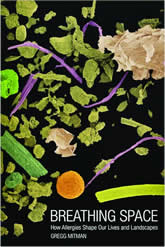
Breathing Space: How Allergies Shape Our Lives and Landscapes
Gregg Mitman. Breathing Space: How Allergies Shape Our Lives and Landscapes. Yale University Press, 2007.
Allergy is the sixth leading cause of chronic illness in the United States. More than fifty million Americans suffer from allergies, and they spend an estimated $18 billion coping with them. Yet despite advances in biomedicine and enormous investment in research over the past fifty years, the burden of allergic disease continues to grow. Why have we failed to reverse this trend? Breathing Space offers an intimate portrait of how allergic disease has shaped American culture, landscape, and life. Drawing on environmental, medical, and cultural history and the life stories of people, plants, and insects, Mitman traces how America’s changing environment from the late 1800s to the present day has led to the epidemic growth of allergic disease. We have seen a never-ending stream of solutions to combat allergies, from hay fever resorts, herbicides, and air-conditioned homes to numerous potions and pills. But, as Mitman shows, despite the quest for a magic bullet, none of the attempted solutions has succeeded. Until we address how our changing environment—physical, biological, social, and economic—has helped to create America’s allergic landscape, that hoped-for success will continue to elude us.
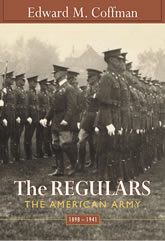
The Regulars The American Army, 1898–1941
The Regulars The American Army, 1898–1941. Harvard University Press, 2007.
In 1898 the American Regular Army was a small frontier constabulary engaged in skirmishes with Indians and protesting workers. Forty-three years later, in 1941, it was a large modern army ready to wage global war against the Germans and the Japanese. In this definitive social history of America’s standing army, military historian Edward Coffman tells how that critical transformation was accomplished. Coffman has spent years immersed in the official records, personal papers, memoirs, and biographies of regular army men, including such famous leaders as George Marshall, George Patton, and Douglas MacArthur. He weaves their stories, and those of others he has interviewed, into the story of an army which grew from a small community of posts in China and the Philippines to a highly effective mechanized ground and air force. During these years, the U.S. Army conquered and controlled a colonial empire, military staff lived in exotic locales with their families, and soldiers engaged in combat in Cuba and the Pacific. In the twentieth century, the United States entered into alliances to fight the German army in World War I, and then again to meet the challenge of the Axis Powers in World War II. Coffman explains how a managerial revolution in the early 1900s provided the organizational framework and educational foundation for change, and how the combination of inspired leadership, technological advances, and a supportive society made it successful. In a stirring account of all aspects of garrison life, including race relations, we meet the men and women who helped reconfigure America’s frontier army into a modern global force.
The Moral Property of Women: The History of Birth Control Politics in America
Linda Gordon. The Moral Property of Women: The History of Birth Control Politics in America. University of Illinois Press, 2007.
Linda Gordon’s classic study, The Moral Property of Women, is the most complete history of birth control ever written. It covers the entire history of the intense controversies about reproductive rights that have raged in the United States for more than 150 years, from the earliest attempts of women to organize for the legal control of their bodies to the effects of second-wave feminism. Gordon defines the role that birth control has played in society’s attitudes toward women, sexuality, and gender equality, arguing that reproductive control has always been central to women’s status. She shows how opposition to it has long been part of the conservative opposition to gender equality.
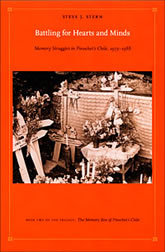
Battling for Hearts and Minds: Memory Struggles in Pinochet’s Chile, 1973-1988
Steve J. Stern. Battling for Hearts and Minds: Memory Struggles in Pinochet’S Chile, 1973-1988. Duke University Press, 2006.
Battling for Hearts and Minds is the story of the dramatic struggle to define collective memory in Chile during the violent, repressive dictatorship of General Augusto Pinochet, from the 1973 military coup in which he seized power through his defeat in a 1988 plebiscite. Steve J. Stern provides a riveting narration of Chile’s political history during this period. At the same time, he analyzes Chileans’ conflicting interpretations of events as they unfolded. Drawing on testimonios, archives, Truth Commission documents, radio addresses, memoirs, and written and oral histories, Stern identifies four distinct perspectives on life and events under the dictatorship. He describes how some Chileans viewed the regime as salvation from ruin by Leftists (the narrative favored by Pinochet’s junta), some as a wound repeatedly reopened by the state, others as an experience of persecution and awakening, and still others as a closed book, a past to be buried and forgotten. In the 1970s, Chilean dissidents were lonely “voices in the wilderness” insisting that state terror and its victims be recognized and remembered. By the 1980s, the dissent had spread, catalyzing a mass movement of individuals who revived public dialogue by taking to the streets, creating alternative media, and demanding democracy and human rights. Despite long odds and discouraging defeats, people of conscience—victims of the dictatorship, priests, youth, women, workers, and others—overcame fear and succeeded in creating truthful public memories of state atrocities. Recounting both their efforts and those of the regime’s supporters to win the battle for Chileans’ hearts and minds, Stern shows how profoundly the struggle to create memories, to tell history, matters. Battling for Hearts and Minds is the second volume in the trilogy The Memory Box of Pinochet’s Chile. The third book will examine Chileans’ efforts to achieve democracy while reckoning with Pinochet’s legacy.

The Eucharist in the Reformation: Incarnation and Liturgy
Lee Palmer Wandel. The Eucharist in the Reformation: Incarnation and Liturgy. Cambridge University Press, 2006.
This study traces the evolution of the words, “this is my body,” “this do,” and “remembrance of me” that divided Christendom in the sixteenth century. Lee Wandel focuses on the consequences of the different interpretations of these simple words in the delineation of the Lutheran, Reformed, and Catholic traditions. Finally, Wandel argues that the incarnation is at the center of the story of the Reformation and suggests how divergent religious identities were formed.
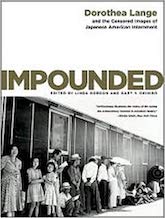
Impounded Dorothea Lange and the Censored Images of Japanese American Internment
Linda Gordon (Editor), and Gary Y Okihiro (Editor). Impounded Dorothea Lange and the Censored Images of Japanese American Internment. W. W. Norton & Company, 2006.
Censored by the U.S. Army, Dorothea Lange’s unseen photographs are the extraordinary photographic record of the Japanese American internment saga. This indelible work of visual and social history confirms Dorothea Lange’s stature as one of the twentieth century’s greatest American photographers. Presenting 119 images originally censored by the U.S. Army—the majority of which have never been published—Impounded evokes the horror of a community uprooted in the early 1940s and the stark reality of the internment camps. With poignancy and sage insight, nationally known historians Linda Gordon and Gary Okihiro illuminate the saga of Japanese American internment: from life before Executive Order 9066 to the abrupt roundups and the marginal existence in the bleak, sandswept camps. In the tradition of Roman Vishniac’s A Vanished World, Impounded, with the immediacy of its photographs, tells the story of the thousands of lives unalterably shattered by racial hatred brought on by the passions of war. A San Francisco Chronicle Best Book of 2006.
Experiencing Mount Vernon: Eyewitness Accounts, 1784–1865
Jean Lee. Experiencing Mount Vernon: Eyewitness Accounts, 1784–1865. University of Virginia Press, 2006.
George Washington, acutely aware of the accomplishments and potential of the American Revolution, used his Mount Vernon estate both to preserve the memory of events that had created a new nation and to forward his keen vision of what that nation might become. During the 1780s and 1790s, an era when neither public museums nor a national library existed, visitors to Mount Vernon viewed John Trumbull’s iconic image of the signing of the Declaration of Independence, Houdon’s famous bust of the countryís preeminent hero, and Washington’s voluminous wartime correspondence. More important, they listened as the Washingtons recalled the remarkable events that had forged independence and the unique American experiment in representative government. At Mount Vernon, too, Washington and his guests discussed how best to secure the success and well-being of the United States. Here was a place to contemplate “what the nation, at its best, might be.” Following George and Martha Washington’s deaths, the estate passed to four successive heirs, the last of whom deeded it to the Mount Vernon Ladies’ Association in 1860. While still in private hands, the property nonetheless attracted thousands of visitors each year, most of whom arrived after a fifteen-mile overland trek from Washington, D.C. With the establishment of regular steamboat access in the 1850s, the numbers swelled to ten thousand annually. The public claimed Mount Vernon as its own. In the words of a nineteenth-century Washington family member, “the Nation shares it with us.” In a remarkable display of civic religion that testified to the siteís enormous hold on the public imagination, Americans pronounced Mount Vernon sacred ground and made it the nationís most important site of revolutionary memory and inspiration. The sacred ground was, nonetheless, contested ground: visitors criticized the heirs’ management of the property; northerners abhorred the persistence of slavery at the estate. As pilgrims contemplated the highest ideals of the Revolution at Washington’s home and tomb, they often found their own society wanting. Amid escalating sectional strife in the 1850s, some argued that if Mount Vernon could be saved for the nation, the nation might be preserved from ruin. In letters and journals, newspaper and magazine articles, and public speeches, visitors recorded, often in detail and with intense emotion, their varied reactions to the site. Experiencing Mount Vernon presents the most informative of these accounts, as well as selected documents from the Washington owners (beginning with Washington himself, who in 1784 prematurely wrote Lafayette that, at his beloved home, he had “retired from all public employments”). Numerous maps, contemporary images, and annotations complement the texts. This book constitutes the only eyewitness chronicle we have of the Washington estate’s ascent to the status of national shrine, and it offers the closest possible evidence of Mount Vernonís singular role in helping forge American national identity.
Cuarenta preguntas fundamentales sobre la Guerra Civil
Stanley Payne. Cuarenta Preguntas Fundamentales Sobre La Guerra Civil. La Esfera de los Libros, 2006.
En este nuevo libro, el historiador Stanley G. Payne, autor de El colapso de la República -publicado con gran éxito por esta editorial-, plantea cuarenta preguntas fundamentales para comprender la Guerra Civil, desde su estallido y desarrollo a sus consecuencias. En cada capítulo logra la visión más clara ofrecida hasta ahora sobre el conflicto bélico español, y lo sitúa en un amplio contexto que supera las limitadas perspectivas con las que se ha estudiado hasta ahora. Así da respuestas detalladas, profundas y didácticas a interrogantes que han generado muchísima controversia a lo largo de setenta años, como por ejemplo si realmente fue inevitable la contienda, o qué hubiera pasado en el país si los militares no se hubieran sublevado; cuáles eran los objetivos de Hitler, Mussolini y la URSS cuando se decidieron a intervenir; por qué las democracias occidentales no ayudaron a la República; qué pasó con el oro de Moscú; qué papel jugaron los nacionalismos; cuáles fueron las consecuencias inmediatas y a largo plazo… Y, finalmente, una cuestión que sigue viva en la actualidad política: ¿ha logrado España superar, en pleno siglo XXI, la Guerra Civil, o todavía queda un camino por recorrer? TRANSLATION: In this new book, the historian Stanley G. Payne, author of The Collapse of the Republic -published with great success by this editorial-, asks forty fundamental questions to understand the Civil War, from its outbreak and development to its consequences. In each chapter he achieves the clearest vision offered so far on the Spanish war conflict, and places it in a broad context that goes beyond the limited perspectives with which it has been studied so far. Thus, he gives detailed, profound and didactic answers to questions that have generated a great deal of controversy over seventy years, such as whether the conflict was really inevitable, or what would have happened in the country if the military had not risen in revolt; what were the objectives of Hitler, Mussolini and the USSR when they decided to intervene; why the western democracies did not help the Republic; what happened to the Moscow gold; what role did nationalisms play; What were the immediate and long-term consequences … And finally, a question that is still alive today in politics: has Spain managed to overcome, in the 21st century, the Civil War, or is there still a way to go?
Thinking with Animals: New Perspectives on Anthropomorphism
Lorraine Daston (Editor), and Gregg Mitman (Editor). Thinking With Animals: New Perspectives on Anthropomorphism. Columbia University Press, 2005.
Is anthropomorphism a scientific sin? Scientists and animal researchers routinely warn against “animal stories,” and contrast rigorous explanations and observation to facile and even fanciful projections about animals. Yet many of us, scientists and researchers included, continue to see animals as humans and humans as animals. As this innovative new collection demonstrates, humans use animals to transcend the confines of self and species; they also enlist them to symbolize, dramatize, and illuminate aspects of humans’ experience and fantasy. Humans merge with animals in stories, films, philosophical speculations, and scientific treatises. In their performance with humans on many stages and in different ways, animals move us to think. From Victorian vivisectionists to elephant conservation, from ancient Indian mythology to pet ownership in the contemporary United States, our understanding of both animals and what it means to be human has been shaped by anthropomorphic thinking. The contributors to Thinking with Animals explore the how and why of anthropomorphism, drawing attention to its rich and varied uses. Prominent scholars in the fields of anthropology, ethology, history, and philosophy, as well as filmmakers and photographers, take a closer look at how deeply and broadly ways of imagining animals have transformed humans and animals alike. Essays in the book investigate the changing patterns of anthropomorphism across different time periods and settings, as well as their transformative effects, both figuratively and literally, upon animals, humans, and their interactions. Examining how anthropomorphic thinking “works” in a range of different contexts, contributors reveal the ways in which anthropomorphism turns out to be remarkably useful: it can promote good health and spirits, enlist support in political causes, sell products across boundaries of culture of and nationality, crystallize and strengthen social values, and hold up a philosophical mirror to the human predicament.
The Family on Trial in Revolutionary France
Suzanne Desan. The Family on Trial in Revolutionary France. University of California Press, 2004.
In a groundbreaking book that challenges many assumptions about gender and politics in the French Revolution, Suzanne Desan offers an insightful analysis of the ways the Revolution radically redefined the family and its internal dynamics. She shows how revolutionary politics and laws brought about a social revolution within households and created space for thousands of French women and men to reimagine their most intimate relationships. Families negotiated new social practices, including divorce, the reduction of paternal authority, egalitarian inheritance for sons and daughters alike, and the granting of civil rights to illegitimate children. Contrary to arguments that claim the Revolution bound women within a domestic sphere, The Family on Trial maintains that the new civil laws and gender politics offered many women unexpected opportunities to gain power, property, or independence. The family became a political arena, a practical terrain for creating the Republic in day-to-day life. From 1789, citizens across France—sons and daughters, unhappily married spouses and illegitimate children, pamphleteers and moralists, deputies and judges—all disputed how the family should be reformed to remake the new France. They debated how revolutionary ideals and institutions should transform the emotional bonds, gender dynamics, legal customs, and economic arrangements that structured the family. They asked how to bring the principles of liberty, equality, and regeneration into the home. And as French citizens confronted each other in the home, in court, and in print, they gradually negotiated new domestic practices that balanced Old Regime customs with revolutionary innovations in law and culture. In a narrative that combines national-level analysis with a case study of family contestation in Normandy, Desan explores these struggles to bring politics into households and to envision and put into practice a new set of familial relationships.
Remembering Pinochet’s Chile: On the Eve of London 1998
Steve J. Stern. Remembering Pinochet’S Chile: On the Eve of London 1998. Duke University Press, 2004.
In 1998, General Augusto Pinochet was arrested in London on charges of crimes against humanity. All over the world, but especially in Chile, the shocking arrest thrust the former dictator and the atrocities of his regime back into the public eye. During the two years just before the arrest, the renowned historian Steve J. Stern had been in Chile collecting oral histories of life under Pinochet as part of an investigation in the form and meaning of memories of state-sponsored atrocities. In this compelling work, Stern shares the recollections of individual Chileans and draws on their stories to provide a framework for understanding memory struggles in history. At once analytical, poignant, and personal, Remembering Pinochet’s Chile offers a human portrait of Chile’s memory on the eve of the London arrest. From a woman who recalls Pinochet’s overthrow of Salvador Allende as salvation from scarcity and chaos to an activist whose husband was tortured by state agents, and from a colonel who served under Pinochet to a mother who had two sons “disappeared,” these stories reveal how people connected their intimate personal memories with the collective memory of traumatic times. They draw the reader into a passionate quest to shape the remembered meaning of trauma and sate atrocity and, ultimately, to control the politics of truth and justice. Remembering Pinochet’s Chile presents not only a rounded portrait of Chile’s specific memory drama but also a method for tracing the historical unfolding of memory struggles in other societies that must reckon with experience of mass violence and crimes against humanity. Remembering Pinochet’s Chile is the first volume in The Memory of Pinochet’s Chile: A Trilogy. Subsequent volumes will trace the historical unfolding of Chile’s memory drama from the 1973 coup into the twenty-first century.
Landscapes of Exposure: Knowledge and Illness in Modern Environments
Gregg Mitman (Co-editor), Michelle Murphy (Co-editor), and Christopher Sellers (Co-editor). Landscapes of Exposure: Knowledge and Illness in Modern Environments. University of Chicago Press, 2004.
Bringing together historians of science and medicine with environmental historians, and adding more contemporary vantage points from geography, anthropology, and sociology, Osiris Volume 19: Landscapes of Exposure offers an unprecedented interdisciplinary depiction of how, over the nineteenth and twentieth centuries, scientists and lay people have generated methods for connecting health and place, disease and ecology, calculation and risk.

America (The Book) Teacher’s Edition: A Citizen’s Guide to Democracy Inaction
Stanley Schultz, and Jon Stewart. America (The Book) Teacher’s Edition: A Citizen’S Guide to Democracy Inaction. Grand Central Publishing, 2004.
A humor book written by Jon Stewart and other writers of The Daily Show that parodies and satirizes American politics and worldview. It has won several awards, and generated some controversy. An updated trade paperback edition was published in 2006 as a “Teacher’s Edition”, with updated coverage of the Supreme Court Justices (including Samuel Alito and John Roberts, who were appointed after the 2004 book’s publication), and fact checking by Stanley K. Schultz, professor emeritus of history at the University of Wisconsin–Madison,[1] with red marks and remarks appearing throughout, correcting the satirical “mistakes” (and a few honest errors) of the original edition.
The Spanish Civil War, the Soviet Union, and Communism
Stanley Payne. The Spanish Civil War, the Soviet Union, and Communism. Yale University Press, 2004.
In this compelling book Stanley G. Payne offers the first comprehensive narrative of Soviet and Communist intervention in the revolution and civil war in Spain. He documents in unprecedented detail Soviet strategies, Comintern activities, and the role of the Communist party in Spain from the early 1930s to the end of the civil war in 1939. Drawing on a very broad range of Soviet and Spanish primary sources, including many only recently available, Payne changes our understanding of Soviet and Communist intentions in Spain, of Stalin’s decision to intervene in the Spanish war, of the widely accepted characterization of the conflict as the struggle of fascism against democracy, and of the claim that Spain’s war constituted the opening round of World War II. The author arrives at a new view of the Spanish Civil War and concludes not only that the Democratic Republic had many undemocratic components but also that the position of the Communist party was by no means counterrevolutionary.
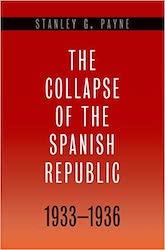
The Collapse of the Spanish Republic, 1933-1936: Origins of the Civil War
Stanley Payne. The Collapse of the Spanish Republic, 1933-1936: Origins of the Civil War. Yale University Press, 2004.
his book focuses on the short but crucial period that led to the collapse of the Spanish Republic and set the stage for the ensuing civil war. Stanley G. Payne, an internationally known scholar of modern Spanish history, details the political shifts that occurred from 1933 to 1936 and examines the actions and inactions of key actors during these years. Using their own memoirs, speeches, and declarations, he challenges previous perceptions of various major players, including President Alcalá Zamora. The breakdown of political coalitions and the internal rifts between Spain’s bourgeois and labor classes sparked many instances of violent dissent in the mid-1930s. The book addresses the election of 1933 and the destabilizing insurrection that followed, Alcalá Zamora’s failed attempts to control the major parties, and the backlash that resulted. The alliances of the socialist left with communism and the right with fascism are also explored, as is the role of forces outside Spain in spurring the violence that eventually exploded into war.
A History of Prison and Confinement in Africa
Florence Bernault. A History of Prison and Confinement in Africa. Heinemann, 2003.
Over the last 30 years, a substantial literature on the history of American and European prisons has developed. This collection is among the first in English to construct a history of prisons in Africa. Topics include precolonial punishments, living conditions in prisons and mining camps, ethnic mapping, contemporary refugee camps, and the political use of prison from the era of the slave trade to the Rwandan genocide of 1994.
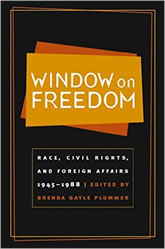
Window on Freedom: Race, Civil Rights, and Foreign Affairs, 1945-1988
Brenda Gayle Plummer (Editor). Window on Freedom: Race, Civil Rights, and Foreign Affairs, 1945-1988. University of North Carolina Press, 2003.
The civil rights movement in the United States drew strength from supporters of human rights worldwide. Once U.S. policy makers–influenced by international pressure, the courage of ordinary American citizens, and a desire for global leadership–had signed such documents as the United Nations charter, domestic calls for change could be based squarely on the moral authority of doctrines the United States endorsed abroad. This is one of the many fascinating links between racial politics and international affairs explored in Window on Freedom. Broad in chronological scope and topical diversity, the ten original essays presented here demonstrate how the roots of U.S. foreign policy have been embedded in social, economic, and cultural factors of domestic as well as foreign origin. They argue persuasively that the campaign to realize full civil rights for racial and ethnic minorities in America is best understood in the context of competitive international relations. The contributors are Carol Anderson, Donald R. Culverson, Mary L. Dudziak, Cary Fraser, Gerald Horne, Michael Krenn, Paul Gordon Lauren, Thomas Noer, Lorena Oropeza, and Brenda Gayle Plummer.

A History of Civilization, Vol. III: Europe in a Wider World: 1350-1650
Lee Palmer Wandel (Co-editor), and Robin W. Winks (Co-editor). A History of Civilization, Vol. III: Europe in a Wider World: 1350-1650. Oxford University Press, 2003.
This book is a compact, accessible history of the continent, during a time when it did not yet dominate the world in which it was situated. The text discusses the major events of the period, and also seeks to restore interconnections lost by thinkers who divided the period into “The Renaissance” and “The Reformation.” With twenty-five illustrations and nine detailed maps, this short textbook is perfect for students of European history

History Has Many Voices: In Honor of Robert McCune Kingdon
Lee Palmer Wandel. History Has Many Voices: In Honor of Robert McCune Kingdon. Truman State University Press, 2003.
This volume presents essays from eight scholars who trained with Robert Kingdon, a vanguard of early modern studies. He required students to go to primary sources, yet they were free to pursue their own curiosity. No matter what their approach to the sources, students were held to a high standard of thoroughness, precision, and attention to detail. This festschrift displays something of the diversity of language, source materials, methods, and visions that Kingdon encouraged in his students during his forty-year career in graduate education.
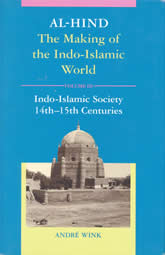
Al-Hind, Volume 3 Indo-Islamic Society, 14th- 15th Centuries
André Wink. Al-Hind, Volume 3 Indo-Islamic Society, 14th- 15th Centuries. Brill, 2003.
This third volume of Andre Wink’s acclaimed and pioneering Al-Hind:The Making of the Indo-Islamic World takes the reader from the late Mongol invasions to the end of the medieval period and the beginnings of early modern times in the late fifteenth and early sixteenth century. It breaks new ground by focusing attention on the role of geography, and more specifically on the interplay of nomadic, settled and maritime societies. In doing so, it presents a picture of the world of India and the Indian Ocean on the eve of the Portuguese discovery of the searoute: a world without stable parameters, of pervasive geophysical change, inchoate and instable urbanism, highly volatile and itinerant elites of nomadic origin, far-flung merchant diasporas, and a famine- and disease-prone peasantry whose life was a gamble on the monsoon.
When Science and Christianity Meet
David C. Lindberg (Co-editor). When Science and Christianity Meet. University of Chicago Press, 2003.
This book, in language accessible to the general reader, investigates twelve of the most notorious, most interesting, and most instructive episodes involving the interaction between science and Christianity, aiming to tell each story in its historical specificity and local particularity. Among the events treated in When Science and Christianity Meet are the Galileo affair, the seventeenth-century clockwork universe, Noah’s ark and flood in the development of natural history, struggles over Darwinian evolution, debates about the origin of the human species, and the Scopes trial. Readers will be introduced to St. Augustine, Roger Bacon, Pope Urban VIII, Isaac Newton, Pierre-Simon de Laplace, Carl Linnaeus, Charles Darwin, T. H. Huxley, Sigmund Freud, and many other participants in the historical drama of science and Christianity.
Irish Peasants: Violence and Political Unrest, 1780–1914
Samuel Clark (Editor), and James S. Donnelly, Jr. (Editor). Irish Peasants: Violence and Political Unrest, 1780–1914. University of Wisconsin Press, 2003.
“The strength of this volume cannot be conveyed by an itemisation of its contents; for what it provides is an incisive commentary on the newly-recognised landmarks of Irish agrarian history in the modern period. . . . The importance, even indispensability, of this achievement is compounded by exemplary editing.”—Roy Foster, London Times Literary Supplement “As a whole, the volume demonstrates the wealth, complexity, and sophistication of Irish rural studies. The book is essential reading for anyone involved in modern Irish history. It will also serve as an excellent introduction to this rich field for scholars of other peasant communities and all interested in problems of economic and political developments.”—American Historical Review
Tirunelveli’s Evangelical Christians: Two Centuries of Family Vamsâvali Traditions
Christian J. Barrigar (Editor). Tirunelveli’s Evangelical Christians: Two Centuries of Family Vamsâvali Traditions. SAIACS Press, 2003.
This volume is an act of remembering. Herein is a collection of eighteen family ‘vamsavazhi’ traditions from Tirunelveli – narratives of ancestors who became Christian in centuries past; recounting family joys; sufferings; virtues and failings that came with new faith and conversion. These chapters represent a partial recovery of a portion of their common past by some India’s Christians. Indeed, this uncovering and preserving of what lay buried in Tirunelveli’s past can serve as an impetus and model for Christian remembering elsewhere in South Asia.

Innovation in Maxwell’s Electromagnetic Theory: Molecular Vortices, Displacement Current, and Light
Daniel M. Siegel. Innovation in Maxwell’S Electromagnetic Theory: Molecular Vortices, Displacement Current, and Light. Cambridge University Press, 2003.
James Clerk Maxwell’s (1831–1879) contributions to twentieth-century science and technology – in particular, the displacement current and the electromagnetic theory of light – are among the most spectacular innovations in the history of physics, but the technical complexities and thematic subtleties of his work have been difficult to unravel. In considering the historical development of Maxwell’s work, Dr Siegel’s close analysis of the original texts – with careful attention to the equations as well as to the words – reveals that mechanical modeling played a crucial role in Maxwell’s initial conceptualizations of the displacement current and the electromagnetic character of light. Beyond this, Siegel locates Maxwell’s work in the full sweep of nineteenth-century electromagnetic theory – from Oersted, Ampere, and Faraday, through Hertz and Lorentz – and in the context of the methodological traditions and perspectives of early physics research at the Universities of Edinburgh and Cambridge.
What History Tells: George L. Mosse and the Culture of Modern Europe
Stanley Payne (Editor), and David J. Sorkin (Editor). What History Tells: George L. Mosse and the Culture of Modern Europe. University of Wisconsin Press, 2003.
What History Tells presents an impressive collection of critical papers from the September 2001 conference “An Historian’s Legacy: George L. Mosse and Recent Research on Fascism, Society, and Culture.” This book examines his historiographical legacy first within the context of his own life and the internal development of his work, and secondly by tracing the many ways in which Mosse influenced the subsequent study of contemporary history, European cultural history and modern Jewish history. The contributors are Steven E. Aschheim, David Sabean, Johann Sommerville, Emilio Gentile, Roger Griffin, Saul Friedländer, Jay Winter, Rudy Koshar, Robert Nye, Janna Bourke, Shulamit Volkov, and Emmanuel Sivan.

When a Flower Is Reborn: The Life and Times of a Mapuche Feminist
Florencia Mallon. When a Flower Is Reborn: The Life and Times of a Mapuche Feminist. Durham: Duke University Press, 2002.
A pathbreaking contribution to Latin American testimonial literature, When a Flower Is Reborn is activist Rosa Isolde Reuque Paillalef’s chronicle of her leadership within the Mapuche indigenous rights movement in Chile. Part personal reflection and part political autobiography, it is also the story of Reuque’s rediscovery of her own Mapuche identity through her political and human rights activism over the past quarter century. The questions posed to Reuque by her editor and translator, the distinguished historian Florencia Mallon, are included in the text, revealing both a lively exchange between two feminist intellectuals and much about the crafting of the testimonial itself. In addition, several conversations involving Reuque’s family members provide a counterpoint to her story, illustrating the variety of ways identity is created and understood. A leading activist during the Pinochet dictatorship, Reuque—a woman, a Catholic, and a Christian Democrat—often felt like an outsider within the male-dominated, leftist Mapuche movement. This sense of herself as both participant and observer allows for Reuque’s trenchant, yet empathetic, critique of the Mapuche ethnic movement and of the policies regarding indigenous people implemented by Chile’s post-authoritarian government. After the 1990 transition to democratic rule, Reuque collaborated with the government in the creation of the Indigenous Development Corporation (CONADI) and the passage of the Indigenous Law of 1993. At the same time, her deepening critiques of sexism in Chilean society in general, and the Mapuche movement in particular, inspired her to found the first Mapuche feminist organization and participate in the 1996 International Women’s Conference in Beijing. Critical of the democratic government’s inability to effectively address indigenous demands, Reuque reflects on the history of Mapuche activism, including its disarray in the early 1990s and resurgence toward the end of the decade, and relates her hopes for the future. An important reinvention of the testimonial genre for Latin America’s post-authoritarian, post-revolutionary era, When a Flower Is Reborn will appeal to those interested in Latin America, race and ethnicity, indigenous people’s movements, women and gender, and oral history and ethnography.
Disruptive Acts: The New Woman in Fin-de-Siecle France
Mary Lou Roberts. Disruptive Acts: The New Woman in Fin-De-Siecle France. University of Chicago Press, 2002.
In fin-de-siècle France, politics were in an uproar, and gender roles blurred as never before. Into this maelstrom stepped the “new women,” a group of primarily urban, middle-class French women who became the objects of intense public scrutiny. Some remained single, some entered nontraditional marriages, and some took up the professions of medicine and law, journalism and teaching. All of them challenged traditional notions of womanhood by living unconventional lives and doing supposedly “masculine” work outside the home. Mary Louise Roberts examines a constellation of famous new women active in journalism and the theater, including Marguerite Durand, founder of the women’s newspaper La Fronde; the journalists Séverine and Gyp; and the actress Sarah Bernhardt. Roberts demonstrates how the tolerance for playacting in both these arenas allowed new women to stage acts that profoundly disrupted accepted gender roles. The existence of La Fronde itself was such an act, because it demonstrated that women could write just as well about the same subjects as men—even about the volatile Dreyfus Affair. When female reporters for La Fronde put on disguises to get a scoop or wrote under a pseudonym, and when actresses played men on stage, they demonstrated that gender identities were not fixed or natural, but inherently unstable. Thanks to the adventures of new women like these, conventional domestic femininity was exposed as a choice, not a destiny. Lively, sophisticated, and persuasive, Disruptive Acts will be a major work not just for historians, but also for scholars of cultural studies, gender studies, and the theater.
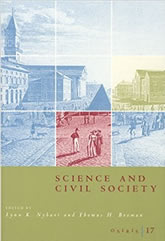
Science and Civil Society
Thomas H. Broman (Editor), and Lynn K. Nyhart (Editor). Science and Civil Society. University of Chicago Press, 2002.
This volume explores the varieties of relationships formed between science and civil society, at both the conceptual and institutional levels, since the late seventeenth century. It brings together general historians and historians of science with different national perspectives to confront the various ways sin which science and civil society have shaped one another in different times and places. How, when, and why did science become intertwined in the network of voluntary associations, professional groups and other institutions we understand as comprising “civil society”? How has science affected the ideology of civil society and thus the legitimacy of political authority in historical contexts as different as late eighteenth-century America, mid nineteenth-century Germany, and early twentieth-century China? How have scientists made use of the ideological links between science and civil political discourse to further their own professional ends? In contrast to much recent writing on civil society, this volume does not aim at making normative pronouncements about the role of civil society in promoting democratic polities, nor does it attempt to weigh the role of science in democracy. Instead, the essays examine how the fruitful interplay of beliefs concerning science and civil society has worked to legitimize the institutional forms of civil society and naturalize its ideologies, while at the same time giving to science its overwhelmingly powerful role in public life.
Christians, Cultural Interactions and India’s Religious Traditions
Judith M. Brown (Editor). Christians, Cultural Interactions and India’S Religious Traditions. Routledge, 2002.
Christianity has been one of India’s religious traditions since its beginning, but the 19th and 20th centuries saw a new wave of Protestant missionary concern with India which coincided with British rule on the subcontinent, and the growth of modern forms of communications. Christians became involved in new forms of cultural interaction, which have had a major impact on Indian culture and society. These essays examine the many and diverse cultural interactions which have occurred between Indian and foreign missionary Christians with India’s other religious traditions in the 19th and 20th centuries, showing how Christianity has played a significant role in the development of Indian culture at many levels, among both the educated and the poor.
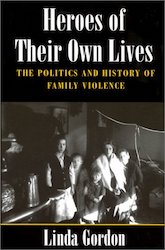
Heroes of Their Own Lives: The Politics and History of Family Violence–Boston, 1880-1960
Linda Gordon. Heroes of Their Own Lives: The Politics and History of Family Violence–Boston, 1880-1960. University of Illinois Press, 2002.
In this unflinching history of family violence, the historian Linda Gordon traces policies on child abuse and neglect, wife-beating, and incest from 1880 to 1960. Drawing on hundreds of case records from social agencies devoted to dealing with the problem, Gordon chronicles the changing visibility of family violence as gender, family, and political ideologies shifted. From the “discovery” of family violence in the 1870s–-when it was first identified as a social, rather than personal, problem–-to the women’s and civil rights movements of the twentieth century, Heroes of Their Own Lives illustrates how public perceptions of marriage, poverty, alcoholism, mental illness, and responsibility worked for and against the victims of family violence. Powerful, moving, and tightly argued, Heroes of Their Own Lives shows family violence to be an indicator of larger social problems. Examining its sources as well as its treatment, Gordon offers both an honest understanding of the problem and an unromantic view of the difficulties in stopping it.
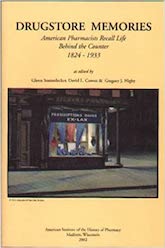
Drugstore Memories: American Pharmacists Recall Life Behind the Counter, 1824-1933
David L. Cowen (Editor), and Gregory Higby (Editor). Drugstore Memories: American Pharmacists Recall Life Behind the Counter, 1824-1933. American Institute of the History of Pharmacy, 2002.
Historical events can be described “from above” or “from the ground.” Historians, from their lofty academic perspective, write analyses and overviews that are supported by erudition and scholarly references. The man on the street, on the other hand, sees events from a different point of view — that is, from the ground — and his description of them, even if it lacks breadth, gives the reader the benefit of the immediacy and charm of the human touch. This book is a view from the ground of health care in the United States in the period between 1824 and 1933. The text consists entirely of “unpolished and unexpurgated” quotations from 59 practicing pharmacists that were found in diaries, memoirs, letters, and reminiscences, both published and unpublished. The quotations are arranged in chronologic order and are divided into two groups, one comprising quotations from the years 1824 to 1860 (part I), the other those from 1860 to 1933 (part II). The melancholic realism of Edward Hopper’s painting “Drug Store” appropriately graces the cover of the book. Old illustrations and photographs (see Figure) are interspersed throughout the text — one, for example, shows two children playing happily and next to them announces, “Cocaine Toothache Drops — Instantaneous Cure! Price 15 cents.” Although the book is concerned primarily with the practice of pharmacy, the medicine and the social conditions of the time unroll in the background as if on a movie screen. In the introduction, the editors provide an overview of the development of the practice of pharmacy in the 19th century. The reader will encounter old and obsolete drugs and treatments (including Dr. Morse’s Indian Root Pills, the use of hot bricks and mustard plaster to treat diphtheria, cod-liver oil, leeches, manna, senna, and castor oil), which are mentioned by practitioners who were familiar with their use. Firsthand experiences are illustrated by dozens of vignettes, anecdotes, stories, and interesting observations. For example, one selection notes that “In the summer of 1832 we had the first and most awful visitation of Asiatic cholera Philadelphia has ever experienced. . . . Many readers remember the camphor bags and Burgundy pitch plaster; the first worn in the bosom, suspended by a string around the neck, and the latter over the abdomen.” Another pharmacist recalls the days when “every child was a stinker because of a little bag of asafetida suspended over its chest.” “It is hard for us to realize,” notes a third, “that but a few years ago the druggist would either dig or buy roots and herbs to make many of his medicines. . . . Now proprietors . . . buy largely [ready-made] articles.” Another explains that “pharmacy laws were unknown in the days of which I speak [the 1860s]. Anyone who chose could sell drugs.” At least one selection focuses on the effects of the 18th Amendment, the National Prohibition Act, which went into effect in 1920: As a pharmacist, I well recall the U.S. government triplicate prescription forms. . . . It was a lot of paperwork. . . . Legal alcohol supplied to hospitals, pharmacies and dental offices often was diverted into other than medical channels. I remember lights in dental offices late into the night and sessions behind the prescription counter of pharmacies, long after they had closed the doors, where “happy hours” were frequent. This book should interest both the nonspecialist and the specialist. Within the limitations of a multiauthored work written “from the ground,” it offers a good and often charming view of pharmacy (with a glimpse of medicine and sociology) as it was practiced in the 19th and early 20th centuries, before the profound changes that occurred after the Second World War. Plinio Prioreschi, M.D., Ph.D.
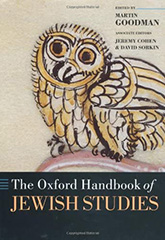
The Oxford Handbook of Jewish Studies
David J. Sorkin (Editor). The Oxford Handbook of Jewish Studies. Oxford University Press, 2002.
The Oxford Handbook of Jewish Studies covers all the main areas currently taught and researched as part of Jewish studies in universities throughout the world, especially in Europe, the United States, and Israel. The span of the volume chronologically and geographically is thus enormous, but all international contributors have in common their expertise in the study of the history, literature, religion, and culture of the Jews. Jewish studies is a comparatively young discipline which has grown over the past fifty years in a somewhat undisciplined way. In a period of great upheaval for Jews following the Holocaust, the creation of the State of Israel, the emergence of new forms of dialogue between Jews and Christians, deepening divisions between secular and religious Jews, and unprecedented assimilation by diaspora Jews to the wider culture, the study of Jewish traditions and history has rarely been dispassionate. There have been some attempts in recent years to encapsulate current conclusions about particular aspects of Jewish studies, but these other works aim to provide compendia of agreed facts rather than a survey of interests and directions such as is found in this text. The book begins with an examination of Jewish studies as an academic discipline in its own right. The first half of the volume is organized chronologically, followed by sections on languages and literature, general aspects of religion, and other branches of Jewish studies which have each accumulated a considerable corpus of scholarship over the past half-century.
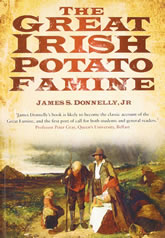
The Great Irish Potato Famine
James S. Donnelly, Jr. The Great Irish Potato Famine. Sutton Publishing, 2001.
The great Irish potato famine of the late 1840s and early 1850s was a massive social catastrophe which resulted in the death of about one million people – a scale of mortality which, taking into account the scale of Ireland’s population in 1845, places this disaster among the worst in modern world history. The famine was also largely responsible, in conjunction with British government politics, for one of the great international human migrations in modern history – the mass exodus of some two million people from Ireland, mostly to North America, in the years 1845-55.
Dear Sisters: Dispatches from the Women’s Liberation Movement
Rosalyn Baxandall (Editor), and Linda Gordon (Editor). Dear Sisters: Dispatches from the Women’S Liberation Movement. Basic Books Publishing, 2001.
The Great Arizona Orphan Abduction
Linda Gordon. The Great Arizona Orphan Abduction. Harvard University Press, 2001.
In 1904, New York nuns brought forty Irish orphans to a remote Arizona mining camp, to be placed with Catholic families. The Catholic families were Mexican, as was the majority of the population. Soon the town’s Anglos, furious at this “interracial” transgression, formed a vigilante squad that kidnapped the children and nearly lynched the nuns and the local priest. The Catholic Church sued to get its wards back, but all the courts, including the U.S. Supreme Court, ruled in favor of the vigilantes. The Great Arizona Orphan Abduction tells this disturbing and dramatic tale to illuminate the creation of racial boundaries along the Mexican border. Clifton/Morenci, Arizona, was a “Wild West” boomtown, where the mines and smelters pulled in thousands of Mexican immigrant workers. Racial walls hardened as the mines became big business and whiteness became a marker of superiority. These already volatile race and class relations produced passions that erupted in the “orphan incident.” To the Anglos of Clifton/Morenci, placing a white child with a Mexican family was tantamount to child abuse, and they saw their kidnapping as a rescue. Women initiated both sides of this confrontation. Mexican women agreed to take in these orphans, both serving their church and asserting a maternal prerogative; Anglo women believed they had to “save” the orphans, and they organized a vigilante squad to do it. In retelling this nearly forgotten piece of American history, Linda Gordon brilliantly recreates and dissects the tangled intersection of family and racial values, in a gripping story that resonates with today’s conflicts over the “best interests of the child.”
New Perspectives on the Haskalah
Shmuel Feiner (Editor), and David J. Sorkin (Editor). New Perspectives on the Haskalah. Littman Library, 2001.
Revises our understanding of the relationship between the Haskalah, Orthodoxy, and hasidism, reassesses the role of key individuals in the movement, and offers a new, more nuanced, definition of the Haskalah. Should be of interest to all students of modern Jewish history, literature, and culture in eighteenth-century Germany and eastern Europe in the nineteenth century.
Roaring Camp: The Social World of the California Gold Rush
Susan Lee Johnson. Roaring Camp: The Social World of the California Gold Rush. W. W. Norton & Company, 2000.
Historical insight is the alchemy that transforms the familiar story of the Gold Rush into something sparkling and new. The world of the Gold Rush that comes down to us through fiction and film—of unshaven men named Stumpy and Kentuck raising hell and panning for gold—is one of half-truths. In this brilliant work of social history, Susan Johnson enters the well-worked diggings of Gold Rush history and strikes a rich lode. She finds a dynamic social world in which the conventions of identity—ethnic, national, and sexual—were reshaped in surprising ways. She gives us the all-male households of the diggings, the mines where the men worked, and the fandango houses where they played. With a keen eye for character and story, Johnson restores the particular social world that issued in the Gold Rush myths we still cherish.
German Travel Cultures
Rudy J. Koshar. German Travel Cultures. Oxford, 2000.
Travel guidebooks are an important part of contemporary culture, but we know relatively little about their history and importance to the evolution of tourism. Germany not only produced the first international standard for travel handbooks, the Baedeker, but also became a major tourist destination early in the twentieth century. This is the first comprehensive discussion of the history of tourist guidebooks for any modern nation.Selecting representative texts – the first Baedeker to unified Germany, guides to Berlin sex life and sites of Nazi martyrdom, a tour guide for the German worker and American tourbooks to West Germany – this fascinating study relates the history of tourist literature to the formation of distinct ‘travel cultures’ oriented to specific audiences, tastes and ideologies.
From Monuments to Traces: Artifacts of German Memory, 1870-1990
Rudy J. Koshar. From Monuments to Traces: Artifacts of German Memory, 1870-1990. University of California Press, 2000.
Rudy Koshar constructs a powerful framework in which to examine the subject of German collective memory, which for more than a half century has been shaped by the experience of Nazism, World War II, and the Holocaust. Finding the assumptions of many writers and scholars shortsighted, Koshar surveys the evidence of postwar German memory in the context of previous traditions. From Monuments to Traces follows the evolution of German “memory landscapes” all the way from national unification in 1870-71 through the world wars and political division to reunification in 1990. The memory landscapes of any society may incorporate monuments, historical buildings, memorials and cemeteries, battlefields, streets, or natural environments that foster shared memories of important events or personalities. They may also be designed to divert public attention from embarrassing or traumatic histories. Koshar argues that in Germany, memory landscapes have taken shape according to four separate paradigms–the national monument, the ruin, the reconstruction, and the trace–which he analyzes in relation to the changing political agendas that have guided them over time. Despite the massive ruptures of Germany’s history, we see that significant continuities have served to counterbalance the traumas of the German past.
Politique africaine: “Pouvoirs sorciers en Afrique”
Florence Bernault (Editor). Politique Africaine: “Pouvoirs Sorciers En Afrique”. Karthala, 2000.
Contrairement aux hypothèses développementalistes des années 60-70, la sorcellerie n’a pas disparu sous la pression conjugée de la modernisation économique et politique. Elle s’affirme aujourd’hui comme une catégorie incontournable de la vie publique et privée en Afrique. Les hommes politiques sont fréquemment accusés de pratiques occultes, le pouvoir restant associé aux “forces de la nuit” ; des rituels spectaculaires réapparaissent dans les contextes de guerre et de violence. L’expansion de la sorcellerie se manifeste aussi dans la vie quotidienne, où les conflits domestiques ou de voisinage prennent souvent la forme d’accusations dans l’ordre de l’invisible. Comment interpréter ces phénomènes ?
Universities and Schooling in Medieval Society
William J. Courtenay (Editor), and J. Miethke (Editor). Universities and Schooling in Medieval Society. Brill, 2000.
Series: Education and Society in the Middle Ages and Renaissance, Volume: 10 The 10 papers in this volume examine university and pre-university education in the 14th to 16th centuries in Germany, Italy, France, and England. Topics covered include the recruitment and support of students, studying abroad, social status, careers of graduates, university rituals, the profession of schoolmaster, and the relation of the studia to the crown. Contributors include William J. Courtenay, Rainer Chr. Schwinges, Klaus Wriedt, Frank Rexroth, Darleen Pryds, Helmut G. Walther, Thomas Sullivan, O.S.B., Martin Kintzinger, Jo Ann Hoeppner Moran Cruz, and Jürgen Miethke.
Fascism in Spain, 1923–1977
Stanley Payne. Fascism in Spain, 1923–1977. University of Wisconsin Press, 2000.
Fascism in Spain, 1923–1977, by celebrated historian Stanley G. Payne, is the most comprehensive history of Spanish fascism to appear in any language. This authoritative study offers treatment of all the major doctrines, personalities, and defining features of the Spanish fascist movement, from its beginnings until after the death of General Francisco Franco in 1975. Payne describes and analyzes the development of the Falangist party both prior to and during the Spanish Civil War, presenting a detailed analysis of its transformation into the state party of the Franco regime—Falange Española Tradicionalista—as well as its ultimate conversion into the pseudofascist Movimiento Nacional. Payne devotes particular attention to the crucial years 1939–1942, when the Falangists endeavored to expand their influence and convert the Franco regime into a fully Fascist system. Fascism in Spain helps us to understand the personality of Franco, the way in which he handled conflict within the regime, and the reasons for the long survival of his rule. Payne concludes with the first full inquiry into the process of “defascistization,” which began with the fall of Mussolini in 1943 and extended through the Franco regime’s later efforts to transform the party into a more viable political entity.
Historia de España. 13: La época de Franco. La España del régimen 1939-1975
Stanley Payne. Historia De España. 13: La época De Franco. La España Del régimen 1939-1975. Espasa-Calpe, 2000.
The Berlin Haskalah and German Religious Thought
David J. Sorkin. The Berlin Haskalah and German Religious Thought. Vallentine Mitchell, 2000.
The Berlin Haskalah was the Jewish attempt to rearticulate belief to accommodate the new science and philosophy of the Enlightenment. This study argues that the Haskalah should be understood within the context of the wider Central European religious and intellectual changes.
Enfermement, Prison et Chatiments
Florence Bernault. Enfermement, Prison Et Chatiments. Karthala, 1999.
A la fin du XIXème siècle, sauf à l’intérieur de quelques garnisons et forts de traite européens de la côte, les prisons étaient inconnues en Afrique. Aujourd’hui, les Etats africains utilisent massivement le système pénitentiaire légué par les colonisateurs. Comme le rappellent chaque jour les prisons surpeuplées du Rwanda, la nuit carcérale étend désormais son ombre sur l’ensemble des sociétés au sud du Sahara.
Royalists and Patriots: Politics and Ideology in England 1603-1640
Johann Sommerville. Royalists and Patriots: Politics and Ideology in England 1603-1640. Addison Wesley/ Longman, 1999.
The early Stuart age was critical to England’s political and constitutional development, and has been the subject of passionate debate among historians. Some argue that the Civil War had few long-term origins; others discern deeper roots. But how did the men and women of the time see contemporary politics? What were the issues and the principles that mattered to them? And how did this ideological dimension contribute to the turbulent years before 1640? Strangely neglected amidst all the cut-and-thrust of modern historiographical controversy, this is the territory that Johann Sommerville explored in his widely-respected study (first published in 1986 as Politics and Ideology in England 1603-1640), which now appears in this major Second Edition. The result is not only an important contribution for historians; it also throws a vivid light on the political climate and preoccupation of Shakespeare and his contemporaries. As before, the first part offers a notably clear account of the main political theories current at the time, each located and discussed within its wider historical contexts. These include the Divine Right of Knights, the theory of the ancient constitution, and the idea that government is founded upon the consent of the governed. But political thought is rarely isolated from political practice: ideas have to come to terms with events, and theories are developed to justify concrete positions. In the seconded part, therefore, Johann Sommerville goes on to examine how these major theories were applied in practice to the burning issues of the day. To these ends, he analyses a large body of early seventeenth-century political literature – setting the work of famous theorists like Hobbes, Locke and Hooker against the backcloth of more humble writers, to clarify what was original in their work and what was the common currency of the age. He is then able to unravel the ideas and attitudes that contemporaries brought to such key topics as taxation without consent, the powers of arbitrary arrest, and the government of the Church. He shows how differences in political outlook influenced political practice and fueled the mutual distrust between the king and many of his powerful subjects. Civil War was not inevitable in England; but by dissecting the neglected ideological dimension of politics, Johann Sommerville reveals a major cause of the eventual breakdown of the peace. The Second Edition has been revised throughout to take account of recent research, and it contains an extensive new section reviewing the current state of historiographical debate. The suggestions for Further Reading have been updated; there is a useful new Chronology; and the entire text has been reset in a more readable format.

Women and Health in America
Judith W. Leavitt. Women and Health in America. University of Wisconsin Press, 1999.
In this thoroughly updated second edition, Judith Walzer Leavitt, a leading authority on the history of women’s health issues, has collected thirty-five articles representing important scholarship in this once-neglected field. Timely and fascinating, this volume is organized chronologically and then by topic, covering studies of women and health in the colonial and revolutionary periods and the nineteenth century through the Civil War. The remainder of the book concentrates on the late nineteenth and twentieth centuries and addresses such controversial issues as body image and physical fitness, sexuality, fertility, abortion and birth control, childbirth and motherhood, mental illness, women’s health care providers (midwives, nurses, physicians), and health reform and public health.
Reel Nature: America’s Romance With Wildlife on Film
Gregg Mitman. Reel Nature: America’S Romance With Wildlife on Film. Harvard University Press, 1999.
From the early exploits of Teddy Roosevelt in Africa to blockbuster films such as March of the Penguins, Gregg Mitman’s Reel Nature reveals how changing values, scientific developments, and new technologies have come to shape American encounters with wildlife on and off the big screen. Whether crafted to elicit thrills or to educate audiences about the real-life drama of threatened wildlife, nature films then and now have had an enormous impact on how Americans see, think about, consume, and struggle to protect animals across the globe.

Parisian Scholars in the Early Fourteenth Century: A Social Portrait. Cambridge Studies in Medieval Life and Thought
William J. Courtenay. Parisian Scholars in the Early Fourteenth Century: A Social Portrait. Cambridge Studies in Medieval Life and Thought. Cambridge University Press , 1999.
This study of the social, geographical and disciplinary composition of the scholarly community at the University of Paris in the early fourteenth century is based on the reconstruction of a remarkable document: the financial record of tax levied on university members in the academic year 1329–1330. Containing the names, financial level and often addresses of the majority of the masters and most prominent students, it is the single richest source for the social history of a medieval university before the late fourteenth century. After a thorough examination of the financial account, the history of such collections, and the case (a rape by a student) that precipitated legal expenses and the need for a collection, the book explores residential patterns, the relationship of students, masters and tutors, social class and levels of wealth, interaction with the royal court and the geographical background of university scholars.
East African Expressions: Of Christianity
Isaria N. Kimambo (Editor), and Thomas Spear (Editor). East African Expressions: Of Christianity. Ohio University Press, 1999.
Christianity has been spread in Africa by Africans. It is the story of peoples seizing control of their own spiritual destinies—rather than the commonplace notion that the continent’s Christian churches represent colonial and capitalist powers that helped subdue Africans to European domination. In short, once introduced, Christianity took on a powerful life of its own and spun out of the control of those who would retain ownership of doctrine and practice. East African Expressions of Christianity examines the experiences of African Christians as they explored the new faith, interpreted it in the context of their own values, appropriated it for themselves, and forged their own distinctive churches. Prominent Tanzanian and American historians, anthropologists, political scientists, and church people examine the translation of religious meanings across cultural boundaries; the religious and social appeal of the new faith; and the vital roles played by African evangelists, teachers, and translators in the spread of Christianity and the development of an African church.
Rural Communism in France, 1920-1939
Laird Boswell. Rural Communism in France, 1920-1939. Cornell University Press, 1998.
Communism has been an enduring presence on the French political scene for most of this century. It remains so in areas of the countryside, despite its collapse in the Soviet Union and in most of France’s urban areas. Shifting the emphasis away from the often-studied relationship between communism and the working class, Laird Boswell proposes a new interpretation of the French Communist Party’s success and illuminates rural social and political behavior during a critical period of economic crisis. Drawing on extensive interviews with thirty-four surviving communist militants and an analysis of voter behavior, this book focuses on the Party’s persistent strength during the interwar period in such rural strongholds as the Limousin and the Dordogne. Boswell shows how communism introduced modern politics in isolated rural communities, revived networks of village sociability and culture, and responded to the state’s inability to cope with the massive upheaval brought about by the gradual disappearance of peasant society. Boswell challenges standard interpretations that attribute Party success in rural areas to leftist voting traditions, red republicanism, or family structures. By showing how French peasants used the political arena to defend their interests, his book provides significant insights on the nature of European communism and on the transformation of the French countryside in the twentieth century.
Germany’s Transient Pasts: Historical Preservation and National Memory in Twentieth Century Germany
Rudy J. Koshar. Germany’s Transient Pasts: Historical Preservation and National Memory in Twentieth Century Germany. Chapel Hill: University of North Carolina Press, 1998.
Over the course of the twentieth century, Germans have venerated and maintained a variety of historical buildings–from medieval fortresses and cathedrals to urban districts and nineteenth-century working-class housing. But the practice of historic preservation has sometimes proven controversial, as different groups of Germans have sought to use historical architecture to represent competing versions of their nation’s history. Transient Pasts is the first book to examine the role that the historic preservation movement has played in German cultural history and memory from the end of the nineteenth century to the early 1970s. Focusing on key public debates over historic preservation, Rudy Koshar charts a trajectory of cultural politics in which historical architecture both facilitated and limited Germans’ efforts to identify as a nation. He demonstrates that historical buildings and monuments have served as enduring symbols of national history in a country scarred by the traumas of two world wars, Nazism, the Holocaust, and political division. His findings challenge both the widely accepted argument that Germans have constantly repressed their past and the contention that Germany’s intense public engagement with history since reunification is unprecedented.
Shining and Other Paths: War and Society in Peru, 1980-1995
Steve J. Stern. Shining and Other Paths: War and Society in Peru, 1980-1995. Duke University Press, 1998.
Shining and Other Paths offers the first systematic account of the social experiences at the heart of the war waged between Shining Path and the Peruvian military during the 1980s and early 1990s. Confronting and untangling the many myths and enigmas that surround the war and the wider history of twentieth-century Peru, this book presents clear and often poignant analyses of the brutal reshaping of life and politics during a war that cost tens of thousands of lives. The contributors—a team of Peruvian and U.S. historians, social scientists, and human rights activists—explore the origins, social dynamics, and long-term consequences of the effort by Shining Path to effect an armed communist revolution. The book begins by interpreting Shining Path’s emergence and decision for war as one logical culmination, among several competing culminations, of trends in oppositional politics and social movements. It then traces the experiences of peasants and refugees to demonstrate how human struggle and resilience came together in grassroots determination to defeat Shining Path, and explores the unsuccessful efforts of urban shantytown dwellers, as well as rural and urban activists, to build a “third path” to social justice. Integral to this discussion is an examination of women’s activism and consciousness during the years of the crisis. Finally, this book analyzes the often paradoxical and unintended legacies of this tumultuous period for social and human rights movements, and for presidential and military leadership in Peru. Extensive field research, broad historical vision, and strong editorial coordination enable the authors to write a coherent and deeply humanistic account, one that draws out the inner tragedies, ambiguities, and conflicts of the war. Providing historically grounded explication of the conflicts that reshaped contemporary Peru, Shining and Other Paths will be widely read by Latin Americanists, historians, anthropologists, gender theorists, sociologists, political scientists, and human rights activists. Contributors. Jo-Marie Burt, Marisol de la Cadena, Isabel Coral Cordero, Carlos Iván Degregori, Iván Hinojosa, Carlos Basombrío Iglesias, Florencia E. Mallon, Nelson Manrique, Hortensia Muñoz, Enrique Obando, Patricia Oliart, Ponciano del Pino H., José Luis Rénique, Orin Starn, Steve J. Stern

Darwinism Comes to America
Darwinism Comes to America. Harvard University Press, 1998.
In 1997, even as Pope John Paul II was conceding that evolution was “more than just a theory,” local school boards and state legislatures were still wrangling over the teaching of origins—and nearly half of all Americans polled believed in the recent special creation of the first humans. Why do so many Americans still resist the ideas laid out by Darwin in On the Origin of Species? Focusing on crucial aspects of the history of Darwinism in America, Ronald Numbers gets to the heart of this question. Judiciously assessing the facts, Numbers refutes a host of widespread misconceptions: about the impact of Darwin’s work on the religious ideas of scientists, about the character of the issues that exercised scientists of the immediate post-Darwin generation, about the Scopes trial of 1925 and its consequences for American schools, and about the regional and denominational distribution of pro- and anti-evolutionary sentiments. Displaying the expertise that has made Numbers one of the most respected historians of his generation, Darwinism Comes to America provides a much-needed historical perspective on today’s quarrels about creationism and evolution—and illuminates the specifically American nature of this struggle.

The War to End All Wars: The American Military Experience in World War I
The War to End All Wars: The American Military Experience in World War I. University Press of Kentucky, 1998.
The War to End All Wars is considered by many to be the best single account of America’s participation in World War I. Covering famous battles, the birth of the air force, naval engagements, the War Department, and experiences of the troops, this indispensable volume is again available in paperback for students and general readers.

An Expanding World: Textiles: Production, Trade and Demand
Maureen Mazzaoui (Editor). An Expanding World: Textiles: Production, Trade and Demand. Ashgate Publishing Limited, 1998.
This volume examines the role of textiles within the expanding global economy in the Age of European Exploration. Major themes include: the opening of new markets and responses to competition in the cloth trade, evolving techniques and modes of production, and changes in the patterns of consumption of local and imported cloth in a comparative, cross-cultural context.
Al-Hind: The Making of the Indo-Islamic World, Volume II
André Wink. Al-Hind: The Making of the Indo-Islamic World, Volume II. Brill, 1997.

Sickness and Health in America: Readings in the History of Medicine and Public Health
Judith W. Leavitt (Co-editor). Sickness and Health in America: Readings in the History of Medicine and Public Health. University of Wisconsin Press, 1997.
An invaluable resource for students, scholars, and general readers, this highly regarded and widely used social history of medicine and public health in the United States is now available in a third edition. Extensively revised and updated, it includes twenty-one new essays; graphs illustrating the rise in deaths caused by HIV, homicide, and suicide; and a greatly expanded Guide to Further Reading. Entirely new sections on Sickness and Health, Early American Medicine, Therapeutics, the Art of Medicine, and Public Health and Personal Hygiene have been added, supplementing updated sections on the Science of Medicine, Education, the Allied Health Professions, Image and Income, Institutions, Race and Medicine, Epidemics, Public Health Reform, and Public Health and Medical Theory. An introductory essay and a series of historical photographs complement the articles.

The University of Wisconsin, School of Pharmacy: Its First Century
Carl K. Buckner (Editor), Kenneth A. Connors (Editor), John Parascandola (Editor), and George Zografi (Editor). The University of Wisconsin, School of Pharmacy: Its First Century. University of Wisconsin Press, 1997.
Account of the school by current & former faculty members.
Mountain Farmers: Moral Economies of Land and Agricultural Development in Arusha and Meru
Thomas Spear. Mountain Farmers: Moral Economies of Land and Agricultural Development in Arusha and Meru. University of California Press, 1997.
This work examines the struggle between the Meru and Arusha peoples and their German and British rulers over the issue of land and agricultural development on Mount Meru in northern Tanzania. It shows how the Meru and Arashi, faced with an iron ring of land alienated by European settlers successfully intensified their own irrigated agriculture to bring about what has been termed an indigenous agricultural revolution.
El Primer Franquismo, 1939-1959: Los Anos de la autarquia
Stanley Payne. El Primer Franquismo, 1939-1959: Los Anos De La autarquia. Temas de Hoy, 1997.

Facing Death
Lee Palmer Wandel. Facing Death. Yale University Press, 1996.
We have learned a great deal in recent years about keeping death at bay through medical technology. We are less well informed, however, about how to face death and how to understand or articulate the emotional and spiritual needs of the dying. This profound and eloquent book brings together medical experts and distinguished authorities in the humanities to reflect on medical, cultural, and religious responses to death. The book helps both medical personnel and patients to view death less as an adversary and more as a defining part of life. In the first half of the book, physicians and the founder of Connecticut Hospice discuss the current clinical setting for dying, with attempts to find the balance between alleviating suffering and providing life support, the problem of finding a peaceful death, and the differences the AIDS epidemic has made in our attitudes toward dying. In the second half of the book, theologians, historians of religion, anthropologists, literary scholars, and pastors describe Christian, Judaic, Islamic, Hindu, and Chinese perceptions of death and rituals of mourning. An epilogue considers the resonances between medicine and the humanities, as well as the essential differences in their approaches to death.
Démocraties ambigües en Afrique centrale: Congo-Brazzaville, Gabon, 1940-1965
Florence Bernault. Démocraties ambigües En Afrique Centrale: Congo-Brazzaville, Gabon, 1940-1965. Karthala, 1996.
Peut-on faire en Afrique centrale une histoire des hommes qui rende compte à la fois des « épaves » de la tradition ancienne et des bouleversements humains, économiques et politiques liés à la colonisation ? Entre 1940 et 1965, l’ouverture du pouvoir colonial et son investissement complexe par les Africains ont cristallisé une culture politique nouvelle, caractérisée par une extraordinaire mobilité des identités individuelles et collectives. Des effets de la « seconde occupation coloniale » aux renversements des premiers régimes indépendants, cette synthèse historique invite à réfléchir sur les racines de la modernité au Gabon et au Congo-Brazzaville.
Uncommon Ground: Rethinking the Human Place in Nature
William Cronon. Uncommon Ground: Rethinking the Human Place in Nature. W. W. Norton & Co., 1996.
A controversial, timely reassessment of the environmentalist agenda by outstanding historians, scientists, and critics. In a lead essay that powerfully states the broad argument of the book, William Cronon writes that the environmentalist goal of wilderness preservation is conceptually and politically wrongheaded. Among the ironies and entanglements resulting from this goal are the sale of nature in our malls through the Nature Company, and the disputes between working people and environmentalists over spotted owls and other objects of species preservation. The problem is that we haven’t learned to live responsibly in nature. The environmentalist aim of legislating humans out of the wilderness is no solution. People, Cronon argues, are inextricably tied to nature, whether they live in cities or countryside. Rather than attempt to exclude humans, environmental advocates should help us learn to live in some sustainable relationship with nature. It is our home.
Rising Wind: Black Americans and U.S. Foreign Affairs, 1935-1960
Brenda Gayle Plummer. Rising Wind: Black Americans and U.S. Foreign Affairs, 1935-1960. Chapel Hill: University of North Carolina Press, 1996.
African Americans have a long history of active involvement and interest in international affairs, but their efforts have been largely ignored by scholars of American foreign policy. Gayle Plummer brings a new perspective to the study of twentieth-century American history with her analysis of black Americans’ engagement with international issues, from the Italian invasion of Ethiopia in 1935 through the wave of African independence movements of the early 1960s. Plummer first examines how collective definitions of ethnic identity, race, and racism have influenced African American views on foreign affairs. She then probes specific developments in the international arena that galvanized the black community, including the rise of fascism, World War II, the emergence of human rights as a factor in international law, the Cold War, and the American civil rights movement, which had important foreign policy implications. However, she demonstrates that not all African Americans held the same views on particular issues and that a variety of considerations helped shape foreign affairs agendas within the black community just as in American society at large.

Typhoid Mary: Captive to the Public’s Health
Judith W. Leavitt. Typhoid Mary: Captive to the Public’S Health. Beacon Press, 1996.
She was an Irish immigrant cook. Between 1900 and 1907, she infected twenty-two New Yorkers with typhoid fever through her puddings and cakes; one of them died. Tracked down through epidemiological detective work, she was finally apprehended as she hid behind a barricade of trashcans. To protect the public’s health, authorities isolated her on Manhattan’s North Brother Island, where she died some thirty years later. This book tells the remarkable story of Mary Mallon–the real Typhoid Mary. Combining social history with biography, historian Judith Leavitt re-creates early-twentieth-century New York City, a world of strict class divisions and prejudice against immigrants and women. Leavitt engages the reader with the excitement of the early days of microbiology and brings to life the conflicting perspectives of journalists, public health officials, the law, and Mary Mallon herself. Leavitt’s readable account illuminates dilemmas that continue to haunt us. To what degree are we willing to sacrifice individual liberty to protect the public’s health? How far should we go in the age of AIDS, drug-resistant tuberculosis, and other diseases? For anyone who is concerned about the threats and quandaries posed by new epidemics, Typhoid Mary is a vivid reminder of the human side of disease and disease control.

The Transformation of German Academic Medicine, 1750-1820
Thomas H. Broman. The Transformation of German Academic Medicine, 1750-1820. University of Chicago Press, 1996.
By examining German university medicine between 1750 and 1820, this book presents a new interpretation of the emergence of modern medical science. It demonstrates that the development of modern medicine as a profession linking theory and practice did not emerge suddenly from the revolutionary transformation of Europe at the opening of the nineteenth century, as Foucault and others have argued. Instead, Thomas H. Broman points to cultural and institutional changes occurring during the second half of the eighteenth century as reshaping both medical theory and physician’s professional identity. Among the most important of these factors was the emergence of a literary public sphere in Germany between 1750 and 1800, a development that exposed medical writing to new discourses such as Jena Romanticism and created the stage on which would be played out the bitter medical controversies of the 1790s.

The Healthiest City: Milwaukee and the Politics of Health Reform
Judith W. Leavitt. The Healthiest City: Milwaukee and the Politics of Health Reform. University of Wisconsin Press, 1996.
Between 1850 and 1900, Milwaukee’s rapid population growth also gave rise to high death rates, infectious diseases, crowded housing, filthy streets, inadequate water supplies, and incredible stench. The Healthiest City shows how a coalition of reform groups brought about community education and municipal action to achieve for Milwaukee the title of “the healthiest city” by the 1930s. This highly praised book reminds us that cutting funds and regulations for preserving public health results in inconvenience, illness, and even death.
Roger Bacon and the Origins of Perspectiva in the Middle Ages: A Critical Edition and English Translation of Bacon’s Perspectiva with Introduction and Notes
David C. Lindberg. Roger Bacon and the Origins of Perspectiva in the Middle Ages: A Critical Edition and English Translation of Bacon’S Perspectiva With Introduction and Notes. Oxford University Press, 1996.
Translated with Introduction and Notes by David C. Lindberg
The Scientific Enterprise in Antiquity and Middle Ages: Readings from Isis
Michael H. Shank (Editor). The Scientific Enterprise in Antiquity and Middle Ages: Readings from Isis. University of Chicago Press, 1996.
This stimulating collection of twenty-two articles is intended not only to explore a range of scientific topics but to engage readers in historiographical debates and methodological issues that surround the study of ancient and medieval science. A convenient sampling of classic and contemporary scholarship, it will appeal to students and specialists alike. Contributors include Francesca Rochberg, David Pingree, G. E. R. Lloyd, Heinrich von Staden, Martin Bernal, Alexander Jones, Bernard Goldstein, Alan Bowen, Owsei Temkin, David Lindberg, Steven McCluskey, Linda Voigts, Edward Grant, Bernard Goldstein, Victor Roberts, Lynn Thorndike, Helen Lemay, William Newman, A. Mark Smith, Nancy Siraisi, Michael McVaugh, and Brian P. Copenhaver.
History and Belief: The Foundations of Historical Understanding
History and Belief: The Foundations of Historical Understanding. Eerdmans Publishing Company, 1996.
Building upon four decades of his own scholarly work in the field of history, Frykenberg presents a notable achievement for clarifying the rich overlap between facts and theory, evidence and belief, history and religion, East and West. He deserves to be commended.
America’s Working Women: A Documentary History, 1600 to the Present
Rosalyn Baxandall (Editor), and Linda Gordon (Editor). America’S Working Women: A Documentary History, 1600 to the Present. W. W. Norton & Company, 1996.
A landmark work when it appeared in 1976, America’s Working Women helped form the field of women’s studies and transform labor history. Now the authors have enlarged the dimensions of this important anthology; more than half the selections and all the introductory material are new. Spanning the years from 1600 to the present, selections from diaries, popular magazines, historical works, oral histories, letters, songs, poetry, and fiction show women’s creativity in supporting themselves, their families, and organizations or associations. Slave women recall their field work, family work, and sabotage. We see Indian women farming, and we also see the white culture coercing Indian women to give up farming. We see women in industry playing a central part in the union movement while facing the particular hazards of women’s jobs and working conditions. New selections show the historical origins of today’s important issues: sexual harassment, equal pay, “sex work,” work in the underground economy, work in the home, and shift work. With an expanded focus on women from all racial and ethnic backgrounds and regions, America’s Working Women grounds us in the battles women have fought and the ones they are in the process of winning.
A History of Fascism, 1914–1945
Stanley Payne. A History of Fascism, 1914–1945. University of Wisconsin Press, 1996.
“A History of Fascism is an invaluable sourcebook, offering a rare combination of detailed information and thoughtful analysis. It is a masterpiece of comparative history, for the comparisons enhance our understanding of each part of the whole. The term ‘fascist,’ used so freely these days as a pejorative epithet that has nearly lost its meaning, is precisely defined, carefully applied and skillfully explained. The analysis effectively restores the dimension of evil.” —Susan Zuccotti, The Nation

Peasant and Nation: The Making of Postcolonial Mexico and Peru
Florencia Mallon. Peasant and Nation: The Making of Postcolonial Mexico and Peru. University of California Press, 1995.
Peasant and Nation offers a major new statement on the making of national politics. Comparing the popular political cultures and discourses of postcolonial Mexico and Peru, Florencia Mallon provides a groundbreaking analysis of their effect on the evolution of these nation states. As political history from a variety of subaltern perspectives, the book takes seriously the history of peasant thought and action and the complexity of community politics. It reveals the hierarchy and the heroism, the solidarity and the surveillance, the exploitation and the reciprocity, that coexist in popular political struggle. With this book Mallon not only forges a new path for Latin American history but challenges the very concept of nationalism. Placing it squarely within the struggles for power between colonized and colonizing peoples, she argues that nationalism must be seen not as an integrated ideology that puts the interest of the nation above all other loyalties, but as a project for collective identity over which many political groups and coalitions have struggled. Ambitious and bold, Peasant and Nation both draws on monumental archival research in two countries and enters into spirited dialogue with the literatures of post-colonial studies, gender studies, and peasant studies.
The Secret History of Gender: Women, Men, and Power in Late Colonial Mexico
Steve J. Stern. The Secret History of Gender: Women, Men, and Power in Late Colonial Mexico. University of North Carolina Press, 1995.
In this study of gender relations in late colonial Mexico (ca. 1760-1821), Steve Stern analyzes the historical connections between gender, power, and politics in the lives of peasants, Indians, and other marginalized peoples. Through vignettes of everyday life, he challenges assumptions about gender relations and political culture in a patriarchal society. He also reflects on continuity and change between late colonial times and the present and suggests a paradigm for understanding similar struggles over gender rights in Old Regime societies in Europe and the Americas. Stern pursues three major arguments. First, he demonstrates that non-elite women and men developed contending models of legitimate gender authority and that these differences sparked bitter struggles over gender right and obligation. Second, he reveals connections, in language and social dynamics, between disputes over legitimate authority in domestic and familial matters and disputes in the arenas of community and state power. The result is a fresh interpretation of the gendered dynamics of peasant politics, community, and riot. Third, Stern examines regional and ethnocultural variation and finds that his analysis transcends particular locales and ethnic subgroupings within Mexico. The historical arguments and conceptual sweep of Stern’s book will inform not only students of Mexico and Latin America but also students of gender in the West and other world regions.

Knowledge and Social Practice in Medieval Damascus, 1190–1350
Michael Chamberlain. Knowledge and Social Practice in Medieval Damascus, 1190–1350. Cambridge University Press, 1995.
Michael Chamberlain focuses on medieval Damascus to develop a new approach to the relationship between the society and culture of the Middle East. The author argues that historians have long imposed European strictures onto societies to which they were alien. Western concepts of legitimate order were inappropriate to medieval Muslim society where social advancement was dependent upon the production of knowledge and religious patronage, and it was the household, rather than the state agency or corporation, that held political and social power. A parallel is drawn between the learned elite and the warriors of Damascus who, through similar strategies, acquired status and power and passed them on in their households. By examining material from the Latin West, Sung China and the Sinicized empires of Inner Asia, the author addresses the nature of political power in the period.

Voracious Idols and Violent Hands: Iconoclasm in Reformation Zurich, Strasbourg, and Basel
Lee Palmer Wandel. Voracious Idols and Violent Hands: Iconoclasm in Reformation Zurich, Strasbourg, and Basel. Cambridge University Press, 1995.
This is an effort to recover the participation of ordinary Christians in the enterprise of Reformation through an exploration of the meaning of acts of iconoclasm: what they tell us about the role of images in Christianity and about ordinary people’s theologies. Its focus, on ordinary Christians, distinguishes it from other studies of Reformation iconoclasm. Its concern, to recover their agency in Reformation and to discern their theology in acts, may be of interest to scholars in American history, anthropology, and religious studies.
Biology Takes Form: Animal Morphology and the German Universities, 1800-1900
Lynn K. Nyhart. Biology Takes Form: Animal Morphology and the German Universities, 1800-1900. University of Chicago Press, 1995.
Morphology—the study of form—is often regarded as a failed science that made only limited contributions to our understanding of the living world. Challenging this view, Lynn Nyhart argues that morphology was integral to the life sciences of the nineteenth century. Biology Takes Form traces the development of morphological research in German universities and illuminates significant institutional and intellectual changes in nineteenth-century German biology. Although there were neither professors of morphology nor a morphologists’ society, morphologists achieved influence by “colonizing” niches in a variety of disciplines. Scientists in anatomy, zoology, natural history, and physiology considered their work morphological, and the term encompassed research that today might be classified as embryology, systematics, functional morphology, comparative physiology, ecology, behavior, evolutionary theory, or histology. Nyhart draws on research notes, correspondence, and other archival material to examine how these scientists responded to new ideas and to the work of colleagues. She examines the intertwined histories of morphology and the broader biological enterprise, demonstrating that the study of form was central to investigations of such issues as the relationships between an animal’s structure and function, between an organism and its environment, and between living species and their ancestors.

Politics and Industrialization: Early Railroads in the United States and Prussia
Colleen Dunlavy. Politics and Industrialization: Early Railroads in the United States and Prussia. Princeton University Press, 1994.
How do national political institutions influence the process of industrial change? This comparative study of the birth of American and Prussian railroads offers historical insights into this critical, but seldom studied, question. Analyzing developments in the 1830s and 1840s, Colleen Dunlavy shows how two very different political structures affected the dynamics of railroad policy making, the organization of railroad interests, and the process of technological choice. Dunlavy examines the rich political context of a seeming paradox: authoritarian, centralized Prussia adopted a largely hands-off policy toward the railroads, but the more liberal, fragmented American government sought vigorously both to promote and to regulate the new industry. By also fragmenting interests and technological choices, the American structure impeded the emergence of the railroad as a system, while the centralized Prussian structure facilitated it. The book concludes by describing how the railroads themselves precipitated a transformation of both political structures by the 1850s. A keener sensitivity to the impact of political structures, Dunlavy shows, enriches our understanding of the complex interplay between industrial and political change, past and present.
King James VI and I: Political Writings
Johann Sommerville (Editor). King James VI and I: Political Writings. Cambridge University Press, 1994.
James VI and I united the crowns of England and Scotland. His books are fundamental sources of the principles that underlay the union and among the most influential writings of their period. James’ political philosophy was a moderated absolutism, shedding light on the political climate of Shakespeare’s England and the intellectual background to the civil wars of the mid-seventeenth century. This edition is the first to draw on all the early texts of James’ books, with an introduction setting them in their historical context.
Siam Mapped: A History of the Geo-body of a Nation
Thongchai Winichakul. Siam Mapped: A History of the Geo-Body of a Nation. Honolulu: University of Hawaii Press, 1994.
This unusual and intriguing study of nationhood explores the 19th-century confrontation of ideas that transformed the kingdom of Siam into the modern conception of a nation. Siam Mapped challenges much that has been written on Thai history because it demonstrates convincingly that the physical and political definition of Thailand on which other works are based is anachronistic.
Correlation and Regression Analysis: A Historian’s Guide
Thomas Archdeacon. Correlation and Regression Analysis: A Historian’s Guide. University of Wisconsin Press, 1994.
In Correlation and Regression Analysis: A Historian’s Guide Thomas J. Archdeacon provides historians with a practical introduction to the use of correlation and regression analysis. The book concentrates on the kinds of analysis that form the broad range of statistical methods used in the social sciences. It enables historians to understand and to evaluate critically the quantitative analyses that they are likely to encounter in journal literature and monographs reporting research findings in the social sciences. Without attempting to be a text in basic statistics, the book provides enough background information to allow readers to grasp the essentials of correlation and regression. Correlation analysis refers to the measurement of association between or among variables, and regression analysis focuses primarily on the use of linear models to predict changes in the value taken by one variable in terms of changes in the values of a set of explanatory variables. The book also discusses diagnostic methods for identifying shortcomings in regression models, the use of regression to analyze causation, and the application of regression and related procedures to the study of problems containing categorical as well as numerical data. Archdeacon asserts that knowing how statistical procedures are computed can clarify the theoretical structures underlying them and is essential for recognizing the conditions under which their use is appropriate. The book does not shy away from the mathematics of statistical analysis; but Archdeacon presents concepts carefully and explains the operation of equations step by step. Unlike many works in the field, the book does not assume that readers have mathematical training beyond basic algebra and geometry. In the hope of promoting the role of quantitative analysis in his discipline, Archdeacon discusses the theory and methods behind the most important interpretive paradigm for quantitative research in the social sciences. Correlation and Regression Analysis introduces statistical techniques that are indispensable to historians and enhances the presentation of them with practical examples from scholarly works.
Uniting Germany: Actions and Reactions
Pekka K. Hamalainen. Uniting Germany: Actions and Reactions. Routledge, 1994.
This is an account of the dramatic events leading to the reunification of Germany. The author looks into the complex intertwining of popular action, national politics and international moves that culminated in the historic events of 1989. After providing a brief historical background, the author analyzes the sequence of events in East Germany, the interplay between East German discontent and Bonn’s policies, and Chancellor Kohl’s role in mobilizing domestic and international support for reunification. Paying special attention to the attitudes and actions of other powers, particularly Russia, the author provides a detailed look at the decisive negotiations with Gorbachev that cleared the way for German reunification. The book combines action on the streets with cabinet politics and the challenge of balancing domestic priorities with international concerns.
The Price of Nationhood: The American Revolution in Charles County
Jean Lee. The Price of Nationhood: The American Revolution in Charles County. W. W. Norton & Company, 1994.
‘A detailed portrait of colonial and revolutionary times that gradually becomes a convincing miniature.’ —Washington Post ‘An insightful study of the transforming power of revolution and war…. Meticulously organized and lucidly written,… it is from first to last a model of narrative history.’ —Journal of Military History ‘A vivid portrait of a country and a region at war, rich with detail of how the prologue to the war and the conduct of it changed the lives of everyone who lived within the country’s borders—men, women, slaves, merchants, farmers, financiers.’ —Wall Street Journal ‘The price of Nationhood offers us a richly textured portrait of a people struggling to preserve a familiar world even as they created a new one. It is local history as its best.’ —Journal of American History

The “Other Tuscany”: Essays in the History of Lucca, Pisa, and Siena during the Thirteenth, Fourteenth, and Fifteenth Centuries
Thomas W. Blomquist (Editor), and Maureen Mazzaoui (Editor). The “Other Tuscany”: Essays in the History of Lucca, Pisa, and Siena During the Thirteenth, Fourteenth, and Fifteenth Centuries. Medieval Institute Publications, 1994.
The papers in this volume are designed to offer non-Italian scholars a representative sample of current European research and a summary of recent debates regarding the historical evolution of those republics that posed the most formidable obstacles to the extension of Florentine hegemony.

Puerto Rico: Cinco siglos de historia
Francisco Scarano. Puerto Rico: Cinco Siglos De historia. McGraw-Hill, 2015.
La aparición de la primera edición de Puerto Rico: Cinco Siglos de Historia consolidó a Francisco A. Scarano como uno de los historiadores contemporáneos sobre Puerto Rico más reconocidos y documentados en Latinoamerica y el Caribe. En esta segunda edición, el autor mantiene la esencia del enfoque histórico en sus investyigaciones; analiza el devenir de los acontecimientos en Puerto Rico, remontándose a la llegada de los primeros pobladores del continente americano, para cerrar con el mundo boricua de finales del siglo XX. Su aguda visión nos guía en un recorrido histórico de cinco siglos, realizando una interpretación objetiva de los acontecimientos más relevantes del país caribeño, en los órdenes económico, político, geográfico y social. Con invaluables recursos didácticos y profusamente ilustrada, el lector encontrará en la presente edición una obra intelectual cuyo estudio es indispensable para comprender el Puereto Rico contemporáneo.
Behind the Throne Servants of Power to Imperial Presidents, 1898–1968
Walter LaFeber (Editor). Behind the Throne Servants of Power to Imperial Presidents, 1898–1968. University of Wisconsin Press, 1993.
During the American rise to world power in the last hundred years, a new presidency has also arisen, a presidency that uses military, economic, political, and personal power that the constitutional founders of the 1780s would have thought highly improbable and dangerous. Behind the Throne argues that United States presidents have received foreign policy advice from a new breed of government servants whose first loyalties were to the chief executive, not the bureaucracy or the public. These “servants of power” defined world views for the president, not only advising but often taking action to implement those world views. The essays in this volume focus on nine servants of power: Brooks Adams, Charles A. Conant, Admiral William B. Caperton, Thomas W. Lamont, Adolf A. Berle, Thomas C. Mann, McGeorge Bundy, Arthur H. Vandenberg, and Gerald P. Nye. The rise of the United States to the status of the world’s lone (and often highly perplexed and frustrated) superpower cannot be understood without understanding these nine influential men and their roles in recent American history. The volume also stands as a tribute to Fred Harvey Harrington, professor of history and former president of the University of Wisconsin–Madison. All of the contributors began their distinguished careers as students of Harrington.
Being Maasai: Ethnicity and Identity in East Africa
Thomas Spear (Editor), and Richard Waller (Editor). Being Maasai: Ethnicity and Identity in East Africa. Ohio University Press, 1993.
Everyone “knows” the Maasai as proud pastoralists who once dominated the Rift Valley from northern Kenya to central Tanzania. But many people who identity themselves as Maasai, or who speak Maa, are not pastoralist at all, but farmers and hunters. Over time many different people have “become” something else. And what it means to be Maasai has changed radically over the past several centuries and is still changing today. This collection by historians, archaeologists, anthropologists and linguists examines how Maasai identity has been created, evoked, contested, and transformed from the time of their earliest settlement in Kenya to the present, as well as raising questions about the nature of ethnicity generally.
Spain’s First Democracy The Second Republic, 1931–1936
Stanley Payne. Spain’s First Democracy The Second Republic, 1931–1936. University of Wisconsin Press, 1993.
The significance of Spain’s Second Republic has been largely overshadowed by the cataclysmic Civil War that immediately followed it. Stanley Payne brings his immense knowledge of Spanish history to bear on the five-year span of the Second Republic as a historic entity in its own right. In Spain’s First Democracy, he argues that the Republic was one of the major national attempts at political democratization and reform in Europe between the World Wars and represented the most important effort to swim against the tide during Europe’s “era of fascism.” Payne’s detailed study places the Republic within the historical framework of Spanish liberalism and the rapid modernization of interwar Europe, which was unlike any other period in Spain’s history. Payne discusses the Republicans’ efforts to establish Spain’s first democratic political systems and to institute major reforms within the Republic. In highlighting reforms in politics and government, church-state relations, education and culture, public works, military affairs, and society as a whole, he assesses the successes and failures of these reforms as well as the reasons for their limitations. He also examines the economic and foreign policy issues of the period. Focusing particularly on political conflict and social cleavage, Payne brilliantly explores the sources and character of the political polarization that developed as a result of the assaults on the Republic from the Left and the Right. He identifies the main political actors in this schism and their role in the eventual breakdown of the Republic. Tracing the progressive collapse of the Republican polity in the first half of 1936, Payne stresses the importance of political violence in the democracy’s downfall. In restoring perspectives that have been ignored or bypassed, Payne presents a consistent and detailed interpretation of Spain’s Second Republic, demonstrating its striking parallels to the Weimar Republic in Germany.
Haiti and the United States: The Psychological Moment
Brenda Gayle Plummer. Haiti and the United States: The Psychological Moment. University of Georgia Press, 1992.
In a prescient remark made at the turn of the century, U.S. Secretary of State Elihu Root said that establishing “the right sort of relations” with Haiti must await “the psychological moment.” Indeed, as Brenda Gayle Plummer notes, much of the Haitian-U.S. relationship has turned on matters of perception. For many in the United States, tales of voodoo, political violence, and stark deprivation have made Haiti appear to be a doomed land, beyond comprehension and help. Haitians, meanwhile, have often seen the United States as persistently racist, grossly materialist, and lacking in spiritual values. In Haiti and the United States, Plummer pays special attention to the role of social and cultural factors in the two countries’ views of each other and the manner in which relations have developed as a result of those perceptions. The disparities between the two republics, she notes, are all the more remarkable in that their experiences of anticolonial rebellion and nationhood converged in some striking ways. Despite the parallels, however, the varying cultural and racial identities of Haiti and the United States and the sociohistorical context in which those identities have been construed forced them to confront the challenges of slavery, republicanism, democracy, and economic development quite differently. Stressing the importance of domestic policy and the character of civil society in the formation of foreign policy, Plummer illuminates the various factors that figured in the relationship between the two countries throughout the nineteenth century. She discussed the aspirations of Haiti’s founders in building a self-governing black society, Haitian responses to the transatlantic abolition movement, the development of Haiti’s creole culture, and the country’s shrewd negotiations with the United States over commercial and strategic issues. The late 1800s, Plummer shows, proved a turning point in Haitian-U.S. relations as Washington’s assumption of regional hegemony changed the balance of power for a Haiti long committed to a multilateralist diplomacy. In the twentieth century, tensions between traditional and reformist elements in Haitian society erupted in a crisis that brought U.S. intervention and long-term military occupation. Plummer examines the consequences of this intervention as they were incorporated into the later interactions between the United States and Haiti and shows how these troubled relations contributed to the rise of the repressive Duvalier regime. The recent fall of that regime, Plummer suggests, now presents the “psychological moment” to which Elihu Root referred so many years ago. Haiti and the United States is the first history of the relationship between the two countries to be published since the 1940s. Utilizing a wealth of Haitian sources as well as the voluminous state papers in the National Archives of the United States and the Library of Congress, the book also benefits from methodological and conceptual advances in diplomatic history over the past half-century.
The State of Nature: Ecology, Community, and American Social Thought, 1900-1950
Gregg Mitman. The State of Nature: Ecology, Community, and American Social Thought, 1900-1950. University of Chicago Press, 1992.
Although science may claim to be “objective,” scientists cannot avoid the influence of their own values on their research. In The State of Nature, Gregg Mitman examines the relationship between issues in early twentieth-century American society and the sciences of evolution and ecology to reveal how explicit social and political concerns influenced the scientific agenda of biologists at the University of Chicago and throughout the United States during the first half of this century. Reacting against the view of nature “red in tooth and claw,” ecologists and behavioral biologists such as Warder Clyde Allee, Alfred Emerson, and their colleagues developed research programs they hoped would validate and promote an image of human society as essentially cooperative rather than competitive. Mitman argues that Allee’s religious training and pacifist convictions shaped his pioneering studies of animal communities in a way that could be generalized to denounce the view that war is in our genes.
Franco: El perfil de la historia
Stanley Payne. Franco: El Perfil De La historia. Planeta-DeAgostini, 1992.
Nature’s Metropolis: Chicago and the Great West
William Cronon. Nature’S Metropolis: Chicago and the Great West. W. W. Norton & Co., 1991.
In this groundbreaking work, William Cronon gives us an environmental perspective on the history of nineteenth-century America. By exploring the ecological and economic changes that made Chicago America’s most dynamic city and the Great West its hinterland, Mr. Cronon opens a new window onto our national past. This is the story of city and country becoming ever more tightly bound in a system so powerful that it reshaped the American landscape and transformed American culture. The world that emerged is our own.
Sir Robert Filmer: ‘Patriarcha’ and Other Writings
Johann Sommerville (Editor). Sir Robert Filmer: ‘Patriarcha’ And Other Writings. Cambridge University Press, 1991.
This volume contains the political writings of Sir Robert Filmer (1588-1653), an acute defender of absolute monarchy and perhaps the most important patriarchal political theorist of the seventeenth century. The recent explosion of interest in women’s history and the history of the family has greatly enhanced the audience for Filmer’s work, and in this new edition Johann Sommerville provides accurate and accessible texts of his principal writings, accompanied by all the standard series features, including a concise introduction, chronology, guide to further reading and notes on Filmer’s own text.
Al-Hind, Volume 1 Early medieval India and the expansion of Islam 7th-11th centuries
André Wink. Al-Hind, Volume 1 Early Medieval India and the Expansion of Islam 7th-11th centuries. Brill, 1991.
This book is the first of a projected series of five which aims to analyze the process of momentous and long-term change which came with the Islamization of the regions which the Arabs called al-Hind, that is India and large parts of its Indianized hinterland. The series is set up in a chronological order, starting with the early expansion of the caliphate in the seventh and eight centuries and ending with the beginnings of European colonization. In this millennium of Islamic expansion five successive stages are distinguished, taking into account the world-historical context. Each stage will be covered by a separate volume. The present volumes covers the period of the seventh to eleventh centuries, the early medieval period in which the Islamic Middle East acquires economic supremacy while establishing new links between the Mediterranean and the Indian Ocean.
Reclaiming the Sacred: Lay Religion and Popular Politics in Revolutionary France
Suzanne Desan. Reclaiming the Sacred: Lay Religion and Popular Politics in Revolutionary France. Cornell University Press, 1990.
Reclaiming the Sacred examines the ways in which the new secular political culture of lay people. Focusing on the Yonne, a pro-revolutionary department in Burgundy, Suzann Desan analyzes how the region’s laity responded to the revolutionaries’ attempts to dechristianize France and to replace Christianity with new revolutionary cults. The Revolution, she shows, was a fertile and dynamic period for lay religiosity. Paradoxically, the breakdown of the institutional Church allowed the laity to seize greater initiative in defining and creating the sacred. In the absence of the clergy, lay believers transformed their religious expression and invented new rituals such as lay-led masses. Women in particular often gained new spiritual and communal power as leaders of local religious activism. Desan explores why women were usually the leaders of religious violence and illustrates how, in her view, their activism helped to stake out religion as women’s domain over the longer term. Yet her book is also about the surprisingly revolutionary means by which lay Catholics demanded the right to practice. Desan challenges the traditional assumption that Catholics were necessarily counterrevolutionary by analyzing how religious activists in a republican region assimilated the rhetoric of the Revolution and fused traditional and revolutionary forms of violent collective action. Her book thus sheds light on both the popular uses of revolutionary politics and the nature of French religious practice at this critical turning point in modern history. Reclaiming the Sacred will be of interest to historians of early modern and modern Europe, especially those who work on the French Revolution, popular religion, and the history of women. Desan’s work will also be read by students of political science, and anthropology, historical sociology, and religious studies.

Always Among Us: Images of the Poor in Zwingli’s Zurich
Lee Palmer Wandel. Always Among Us: Images of the Poor in Zwingli’S Zurich. Cambridge University Press, 1990.
In this elegantly written book, Lee Wandel discusses the relationship between the reform of poor relief and the Protestant Reformation in early sixteenth-century Zurich. In the introduction she traces the various ways that poverty has been evaluated, and its social and religious connotations, up to the sixteenth century. After providing a portrait of sixteenth-century Zurich, the author goes on to explore the discussion of the poor in various media of the town: the sermons and pamphlets of Huldrych Zwingli, who was preaching that the poor were the true images of God; printed images depicting Christ calling beggars and other poor folk to Him (these appeared on title pages of Zwingli’s pamphlets); the language of legislation (in particular the poor ordinances of 1520 and 1525). By exploring each of these different “languages”–the words of Zwingli’s sermons, the visual images of title page prints, and the language of legislation–Professor Wandel restores the complex perception of the poor in Reformation Zurich. In each, the poor were located within matrices of religious and social values and were seen as both economically dependent and symbolic within larger theological and ethical constructs.
Pivotal Decades The United States, 1900-1920
John M. Cooper. Pivotal Decades The United States, 1900-1920. W. W. Norton & Company, Inc, 1990.
Contemporary American began in the first two decades of this century. These were the years in which two of our greatest presidents—Theodore Roosevelt and Woodrow Wilson—transformed the office into the center of power; in which the United States entered the world stage and fought its first overseas war; in which the government’s proper role in the economy became a public question; and in which reform became an imperative for muckraking reporters, progressive politicians, social activists, and writers. It was a golden age in American politics, when fundamental ideas were given compelling expression by thoughtful candidates. It was a trying time, however, for many Americans, including women who fought for the vote, blacks who began organizing to secure their rights, and activists on the Left who lost theirs in the first Red Scare of the century. John Cooper’s panoramic history of this period shows us where we came from and sheds light on where we are.
The Wilson Era: Essays in Honor of Arthur S. Link
John M. Cooper (Editor), and Charles E. Neu (Editor). The Wilson Era: Essays in Honor of Arthur S. Link. Harlan Davidson, Inc, 1990.
A collection of papers originally presented at a conference in honour of the American historian, held at Princeton University, USA, in May 1989. It highlights the breadth of Professor Link’s work, focusing on historical issues of the early 20th century.
Capacity and Volition. A History of the Distinction of Absolute and Ordained Power
William J. Courtenay. Capacity and Volition. A History of the Distinction of Absolute and Ordained Power. Bergamo: Pierluigi Lubrina, 1990.
Quodlibet: Richerche e strumenti di filosofia medievale, 8. [Milan lectures]
America’s Half-Century: United States Foreign Policy in the Cold War
Thomas McCormick. America’S Half-Century: United States Foreign Policy in the Cold War. Johns Hopkins University Press, 1990.
Did the United States “win” the Cold War? In its self-congratulatory euphoria, argues Thomas McCormick in this new edition of his highly acclaimed study, America neglected a twenty-year process of political and economic devolution—the real threat to global peace and prosperity. Revised and updated through 1993, it describes how the end of the Cold War affected the United States’s global role as well as suggesting what possibilities lie ahead for a restructured world-system.
The Vietnam War: Four American Perspectives
Edward N. Luttwak, George S. McGovern, and William C. Westmoreland. The Vietnam War: Four American Perspectives. Purdue University Press, 1990.
This collection of speeches delivered in 1987 presents the widely diverging opinions of four men: an eminent politician, a professional soldier, a government consultant, and a distinguished scholar. The first contributor, Senator George S. McGovern, ran as the Democratic candidate for president in 1972 on a platform that called for the withdrawal of American troops from Vietnam. The second speaker, General William C. Westmoreland, commanded American military forces in Vietnam until growing battlefield casualties and economic costs undermined support for the strategy of attrition in the United States. The third essay is by Edward N. Luttwak, a strong advocate for military reform in the United States and a frequent participant in high-level government discussions about American strategic interests throughout the world. The fourth speaker Thomas J. McCormack, is a diplomatic historian at the University of Wisconsin and an astute critic of American foreign policy. Each lecture is followed by a lively question-and-answer session that highlights the key points of agreement and disagreement with respect to the fundamental issues raised in the lectures. In a stimulating foreword, Akira Iriye challenges readers to think about the Vietnam War in relationship to the current debate about the role that the United States should play in world affairs.

Hegel: Religion, Economics, and the Politics of Spirit, 1770–1807
Laurence Dickey. Hegel: Religion, Economics, and the Politics of Spirit, 1770–1807. Cambridge University Press, 1989.
This major study of Hegel’s intellectual development up to the writing of The Phenomonology of Spirit argues that his work is best understood in the context of the liberalisation of German Protestantism in the eighteenth century.
Constructing Urban Culture: American Cities and City Planning, 1800-1920
Constructing Urban Culture: American Cities and City Planning, 1800-1920. Temple University Press, 1989.
The recent movement known as ‘New Urbanism’ is attempting to reconcile competing ideas about urbanism that have been evolving in America for over a century. New Urbanism, an urban reform movement that gained prominence in the 1990s, seeks to promote qualities that urban reformers have always sought: vital, beautiful, just, environmentally benign human settlements. The significance of New Urbanism is that it is a combination of these past efforts: the culmination of a long, multi-faceted attempt to define what urbanism in America should be. This revelation only comes to light in view of the history that preceded it. This book puts New Urbanism in historical context and assesses it from that perspective. Analy tically, my goal is to expose the validity of New Urbanism’s attempt to combine multiple traditions that, though inter-related, often comprise opposing ideals: the quest for urban diversity within a system of order, control that does not impinge freedom, an appreciation of smallness and fine-grained complexity that can coexist with civic prominence, a comprehensive perspective that does not ignore detail. Amidst the apparent complicatedness, history shows that divergences boil down to a few fundamental debates that get repeated over and over again. This means that American urbanism has endured a habitual crisis of definition. The question now is whether New Urbanists have seized upon the only logical, necessarily multi-dimensional definition of what urbanism in American can be.
Haiti and the Great Powers, 1902-1915
Brenda Gayle Plummer. Haiti and the Great Powers, 1902-1915. Louisiana State University Press, 1988.
Haiti and the Great Powers, 1902-1915 examines a critical period of Haitian history and diplomacy. In this widely researched and persuasively argued study, Brenda Gayle Plummer contends that the social, economic, and political decline of Haiti during the early part of the century was hastened by many factors: the growing commercial and military competition in the Caribbean among the great powers; the less favorable terms of trade; the development among the cosmopolitan urban elite of a culture of imitation and alienation from Haitian national values; and the inability of traditional political mechanisms to provide satisfactory solutions to new problems. The significance of Plummer’s study is threefold. First, there are few reputable and current English-language texts on Haiti. Lurid, sensational, and racist books have been written, but the North American reading public has not been encouraged to take Haitian subjects seriously. Second, Plummer’s work, breaking out of the tradition of considering Haiti as a case apart, attempts to place the nation in the context of a broader Caribbean history. Plummer views Haiti’s experience as the first “Third World” republic as both admonitory and heuristic. Finally Haiti and the Great Powers synthesizes much of the growing mass of data about the period and offers fresh interpretations. Plummer is concerned not only with statecraft but with a host of factors that are pertinent to a holistic consideration of societal change. Her research thus includes governmental archives, personal manuscript collections, the contemporary periodical press, Haitian language and polemics, interviews, and biographies. Plummer examines a rich, complex society without the reductionism inherent in a treatment of diplomatic, political, or social history. The result of Plummer’s extensive research is a highly original, provocative, and engaging study.
Unless You Believe, You Shall Not Understand: Logic, University, and Society in Late Medieval Vienna
Michael H. Shank. Unless You Believe, You Shall Not Understand: Logic, University, and Society in Late Medieval Vienna. Princeton University Press, 1988.
Founded in 1365, not long after the Great Plague ravaged Europe, the University of Vienna was revitalized in 1384 by prominent theologians displaced from Paris–among them Henry of Langenstein. Beginning with the 1384 revival, Michael Shank explores the history of the university and its ties with European intellectual life and the city of Vienna. In so doing he links the abstract discussions of university theologians with the burning of John Hus and Jerome of Prague at the Council of Constance (1415-16) and the destruction of the Jewish community of Lower Austria (1421). Like most other scholars of the period, Henry of Langenstein (d. 1397) at one time believed that Aristotle’s syllogistic was universally valid even in Trinitarian theology. In touch with the vibrant Jewish community in Vienna, Langenstein had high hopes of converting its members by logical argument. When he failed in his purpose, he lost his confidence in Aristotle’s syllogistic as a universal tool of apologetics and handmaiden to Trinitarian theology. (“Unless you believe, you shall not understand,” he quoted from Isaiah, in order to express his change of opinion.) During the next generation, the intellectual climate at the university changed from academic openness to increasing rigidity, and theologians turned from argument to persecution. First published in 1988.
The Old Army: A Portrait of the American Army in Peacetime, 1784-1898
The Old Army: A Portrait of the American Army in Peacetime, 1784-1898. Oxford University Press, 1988.
One of the most important works of military history published in the last decade, The Old Army is the only comprehensive study of the people who made up the “garrison world” in the peacetime intervals between the War for Independence and the Spanish-American War. Drawing on diaries, letters, and other primary documents, Edward M. Coffman vividly recreates the harsh, often lonely life of men, collected mostly from the streets of Northern cities, for whom enlistment was “a leap in the dark…a choice of evils.” He pays special attention to the roles of women and children, as well as black Americans, and to the development of military professionalism. From the testimony of those who lived it, Coffman traces the evolution of the American Army from “the days of small things”–of limited resources and downright hardship–to the modern military age that began at the turn of the century.
Irish Popular Culture 1650-1850
James S. Donnelly, Jr. (Editor), and Kerby A. Miller (Editor). Irish Popular Culture 1650-1850. Irish Academic Press, 1988.
A book edited by two such distinguished historians as James S. Donnelly Jr., and Kerby A. Miller promises to be lively and important: this collection of ten essays fully lives up to the expectations raised by the editorial imprimatur. The articles by an impressive panel of authors are source-based, and the tight editorial control is reflected in the way in which they complement one another.

America in Vietnam: A Documentary History
Lloyd C. Gardner (Editor), Walter F. LaFeber (Editor), and William Appleman Williams (Editor). America in Vietnam: A Documentary History. Anchor Doubleday, 1988.
Through a wide variety of documents—including newly opened presidential papers, congressional debates, military reports, treaties, and newspaper articles—the authors trace the origins of the war back to pre–World War II attitudes and then proceed through the development of the “domino theory” and the policies of Truman, Eisenhower, Kennedy, Johnson, and Nixon to the fall of South Vietnam in 1975. Each of the editors has written an introductory essay to place the documents in heir historical context. These essays explore the controversial questions raised by Vietnam—such as whether each president understood what he was getting into, whether (as some now charge) the media and public opinion undermined America’s ability to win the war, whether official statements were intended to mislead the American people, and, most fundamentally, why America was in Vietnam.
A House Divided: Sectionalism and Civil War, 1848-1865
A House Divided: Sectionalism and Civil War, 1848-1865. Johns Hopkins University Press, 1988.
A well-written, traditional, and brief narrative of the period from the end of the Mexican War to the conclusion of the Civil War… Shows the value of traditional political history which is too often ignored in our rush to reconstruct the social texture of society. — Civil War History
God’s Caress: The Psychology of Puritan Religious Experience
Charles L. Cohen. God’S Caress: The Psychology of Puritan Religious Experience. Oxford University Press, 1988.
Although scripture demands rebirth for all of God’s chosen people, the actual experience of religious conversion is largely determined by the complex interaction between individuals and clergy. This book focuses on the Puritan experience of conversion, which culminated in the celebration of strength liberated for divine purposes, to examine how ministers elaborated the psychological imperatives of faith and their listeners modified and internalized them. Looking at firsthand accounts of personal conversion as well as at sermons and tracts, Cohen discusses how clergy and laity together defined the norms of religious experience, how the Bible influenced Puritan self-perception, and how theology molded the behavior of Saints in a covenanted community. Winner of the Allan Nevins Prize of the Society of American Historians, this study advances Max Weber’s discussion of the Saint’s psychology of work and illuminated the function of rebirth in Puritan culture as both a religious and a psychological phenomenon.
Resistance, Rebellion, and Consciousness in the Andean Peasant World, 18th to 20th Centuries
Steve J. Stern. Resistance, Rebellion, and Consciousness in the Andean Peasant World, 18th to 20th Centuries. University of Wisconsin Press, 1987.
This collection of essays challenges our understanding of the history of native Andean rebellion during the last three centuries. The contributors—historians and anthropologists from a number of countries—move beyond the traditional structural analysis of society to a finer understanding of people as actors. Native Andean initiatives and consciousness are clearly placed at the center of this inquiry, which merges the best methods of history an anthropology. Stern begins with a vigorously argued theoretical essay in which he identifies major findings and arguments running throughout the book, demonstrates their pertinence to the more general field of peasant studies, and draws out the implications for theory and method. He reappraises the role of peasant consciousness and political horizons; and the significance of ethnic factors in explaining “peasant” consciousness and revolt. The case studies themselves revamp the history of Andean peasant rebellion and consciousness in Peru and Bolivia. This is accomplished by studying violent uprisings as transitional moments within a long-term trajectory embracing varied forms of resistance, and by scrutinizing closely the ideological and cultural aspects of domination, political legitimacy, and rebellion. The results sharply alter our understanding of three major historical problems: the crisis of Spanish colonial rule and the outbreak of native Andean insurrection in the eighteenth century; the response to peasants to creole wars and nation-building efforts in the nineteenth century; and the political strategies and dilemmas of Andean peasants in the context of populist and radical politics in the twentieth century.
Social Life, Local Politics, and Nazism: Marburg, 1880-1935
Rudy J. Koshar. Social Life, Local Politics, and Nazism: Marburg, 1880-1935. Chapel Hill: University of North Carolina Press, 1986.
Focusing on Marburg, a contentious university town where voters demonstrated strong electoral support for Adolf Hitler’s National Socialist party, this imaginative study discusses the political role of small-town organizational life and painstakingly reconstructs the full range of Nazi sympathizers’ cross-affiliations with local voluntary groups.
Politics and Ideology in England 1603-1640
Johann Sommerville. Politics and Ideology in England 1603-1640. Longman, London and New York, 1986.
The years before the Civil War were a critical period in England’s political and constitutional development, and have been the subject of vigorous debate. Some historians argue that the Civil War had few long-term origins, while others discern deeper roots. Dr Sommerville here looks at the contemporary view of politics and at the ideologies, both in theory and in action, which contributed to the turbulent years before 1640.
Land and Sovereignty in India: Agrarian Society and Politics under the Eighteenth-Century Maratha Svarajya
André Wink. Land and Sovereignty in India: Agrarian Society and Politics under the Eighteenth-Century Maratha Svarajya. Cambridge, 1986.
This original contribution to Indian history, focusing on contemporary and largely indigenous documents, introduces a set of concepts for the analysis of late Mughal rule. More specifically it examines the origins and development of the Maratha svardjya or ‘self-rule’ within the context of declining Muslim power. It traces the expansion of Maratha dominion to a process of fitna, a policy of ‘shifting alliances’ which was recurrent in the wake of Muslim expansion throughout its history. The book gives an interesting perspective on Hindu-Muslim relationships in the pre-British period as well as on the nature of the Indo-Muslim state and its most important successor polity, on its capacity for change and development in the intermediate sections of society, the land-tenurial system, the monetization of the economy, and on the fiscal system.

Brought to Bed: Childbearing in America, 1750-1950
Judith W. Leavitt. Brought to Bed: Childbearing in America, 1750-1950. Oxford University Press, 1986.
The classic work on how childbirth has changed from colonial times to the present. Author of renowned expert on women’s medical history. New to this Edition: New preface for 30th anniversary edition on the state of the fields of women’s history and the history of medicine. Addresses how the history of childbirth and women’s health have developed in the intervening decades.
Delhi Through the Ages: Essays in Urban History, Culture, and Society
Delhi Through the Ages: Essays in Urban History, Culture, and Society. Oxford University Press, 1986.
Delhi is one of the legendary capital cities of the world, its origins dating back to prehistoric times. This collection of multi-disciplinary essays by an international group of distinguished scholars explores aspects of the city’s life–military, social, cultural, architectural, nationalist, artistic–over a 3,000-year period.
The Swahili: Reconstructing the History and Language of an African Society, 800-1500
Derek Nurse, and Thomas Spear. The Swahili: Reconstructing the History and Language of an African Society, 800-1500. University of Pennsylvania Press, 1985.
“The authors, respectively a linguist specializing in Swahili and related Bantu languages and a historian specializing in the history of East Africa, have assembled an impressive array of evidence—linguistic, archaeological, documentary, and oral-traditional—in support of the argument that Swahili culture, often regarded as an Arabian transplant on the East African coast, is actually ‘a dynamic synthesis of African and Arabian ideas within an African historical and cultural context.'”—American Anthropologist “A fine achievement, mixing original material, fresh insights, generally excellent use of sources, conciseness, and a highly readable style. As an introduction to how the history of an African society can be reconstructed from largely nonliterate sources, and to the Swahili in particular, it is almost a model work.”—International Journal of African Historical Studies
Spanish Catholicism: An Historical Overview
Stanley Payne. Spanish Catholicism: An Historical Overview. University of Wisconsin Press, 1984.
“This is the first complete history of Spanish Catholicism in English. The history of the Spanish church is rich, complex, and controversial, and this enormous undertaking by Stanley Payne is all the more praiseworthy in view of his determination not to limit his study to the church alone, but to investigate the relationship between the Catholic Church and Spanish culture and nationhood in general.” —Isaac Aviv, Mediterranean Historical Review
Changes in the Land: Indians, Colonists, and the Ecology of New England
William Cronon. Changes in the Land: Indians, Colonists, and the Ecology of New England. New York: Hill & Wang, 1983.
In this landmark work of environmental history, William Cronon offers an original and profound explanation of the effects European colonists’ sense of property and their pursuit of capitalism had upon the ecosystems of New England. Reissued here with an updated afterword by the author and a new preface by the distinguished colonialist John Demos, Changes in the Land, provides a brilliant inter-disciplinary interpretation of how land and people influence one another. With its chilling closing line, “The people of plenty were a people of waste,” Cronon’s enduring and thought-provoking book is ethno-ecological history at its best.
Becoming American: An Ethnic History
Thomas Archdeacon. Becoming American: An Ethnic History. New York: The Free Press, 1983.
Traces the history of American immigration from 1607 to the 1920s and looks at how groups of immigrants have adapted to the United States.
The Warrior and the Priest: Woodrow Wilson and Theodore Roosevelt
John M. Cooper. The Warrior and the Priest: Woodrow Wilson and Theodore Roosevelt. Harvard University Press, 1983.
The colossal figures who shaped the politics of industrial America emerge in full scale in this engrossing comparative biography. In both the depth and sophistication of intellect that they brought to politics and in the titanic conflict they waged with each other, Roosevelt and Wilson were, like Hamilton and Jefferson before them, the political architects for an entire century. All previous efforts to treat the philosophies and programs of Roosevelt’s New Nationalism and Wilson’s New Freedom have been partial and episodic. Now John Milton Cooper reconstructs in parallel lines the entire range of their ideologies and their struggles—their social identification in terms of class, education, and regional roots; the origins and evolution of their political thought; their party leadership roles; and their psychological characters. After tracking the shared identities of young manhood, Cooper explains the conflict of their mature years that developed from opposing philosophies of government. Not until 1912, when Wilson ran for president, did they come together partially and briefly on common practical grounds of reform of the political process and efforts to curb big business in the public interest. Later, foreign policy in particular pitted them in a deeper conflict that consumed the rest of their lives.
Peru’s Indian Peoples and the Challenge of Spanish Conquest: Huamanga to 1640
Steve J. Stern. Peru’S Indian Peoples and the Challenge of Spanish Conquest: Huamanga to 1640. University of Wisconsin Press, 1982.
To Steve J. Stern, the 1492 arrival of Columbus in America “symbolizes a historical reconfiguration of world magnitude.” The quincentennial of that event challenged Stern to reexamine the consequences and meanings of the European conquest of the Americas. This expanded edition of Peru’s Indian Peoples and the Challenge of Spanish Conquest includes Stern’s 1992 reflections on the ten years of historical interpretation that have passed since the book’s original publication—setting his analysis of Huamanga in a larger perspective.
Statist and Statistician
Victor L. Hilts. Statist and Statistician. Arno Press, 1981.

The Italian Cotton Industry in the Later Middle Ages, 1100–1600
Maureen Mazzaoui. The Italian Cotton Industry in the Later Middle Ages, 1100–1600. Cambridge University Press, 1981.
This book traces the dynamic advances in textile technology and changes in the structure of demand that accompanied the rise, in the late Middle Ages, of an Italian industry geared to mass production of cotton fabrics. The Italian manufacture, based on borrowed techniques and imitations of Islamic cloth, was the earliest large-scale cotton industry in western Europe. It thus marked a pivotal stage in the transmission of the knowledge and use of this textile fibre from the Mediterranean basin to northern Europe. The success of the Italians in creating new markets for a wide variety of products that included pure cotton, as well as mixed fabrics combining cotton with linen, hemp, wool and silk, permanently altered the patterns of taste and consumption in European society. Cotton, in various stages of proceeding, was at the heart of a complex network of communications that linked the north Italian towns to the source of raw materials and to international markets for finished goods. In the developing urban economy of northern Italy, cotton played a role comparable in magnitude to that of wool and shared with the latter certain basic features of early capitalistic organization.
Kenya’s Past: An Introduction to Historical Methods in Africa
Thomas Spear. Kenya’S Past: An Introduction to Historical Methods in Africa. Addison-Wesley Longman, 1981.
Fascism: Comparison and Definition
Stanley Payne. Fascism: Comparison and Definition. University of Wisconsin Press, 1980.
“An impressive review of reputed fascist movements, at once setting them apart from other authoritarian nationalist organizations and bringing them together within a qualified generic category. Running throughout the volume, and valuable to readers at every level, is a careful critique of the major debates that divide scholars on this most unintelligible ‘ism’ of them all. Payne precisely defines issues, cites the best literature in the major European languages, and offers with moderation and intelligence his own conclusions on the question.” —Gilbert Allardyce, American Historical Review
In Time of Storm: Revolution, Civil War, and the Ethnolinguistic Issue in Finland
Pekka K. Hamalainen. In Time of Storm: Revolution, Civil War, and the Ethnolinguistic Issue in Finland. SUNY Press, 1979.
At the end of World War I in many European societies, hitherto hidden or suppressed rivalries and tensions between competing socioeconomic and ethnolinguistic groups burst to the surface in violence, revolution, civil conflict, and civil war. The author of this book attempts to make a contribution toward the unraveling of these phenomena by exploring them within the context of one European society, Finland, and analyzing the complex and intertwining relationships between revolution and civil war on the one hand and ethnolinguistic and socioeconomic cleavages on the other.
The Kaya Complex: A History of the Mijikenda Peoples of the Kenya Coast to 1900
Thomas Spear. The Kaya Complex: A History of the Mijikenda Peoples of the Kenya Coast to 1900. Kenya Literature Bureau, 1978.
Land Tenure and Peasant in South Asia
Land Tenure and Peasant in South Asia. University of Wisconsin Press, 1977.
New York City, 1664–1710: Conquest and Change
Thomas Archdeacon. New York City, 1664–1710: Conquest and Change. Cornell University Press, 1976.
Integrating sophisticated demographic techniques with clearly written narrative, this pioneering book (first published in 1976) explores the complex social and economic life of a major colonial city. New York City was a vital part of the middle colonies and may hold the key to the origins of political democracy in America. Family histories, public records of births, marriages, and assessments, and records of business transactions and poll lists are among the rich sources Thomas J. Archdeacon uses to determine the impact of the English conquest on the city of New York. Among his concerns are the changing relationships between the Dutch and the English, the distribution of wealth and the role of commerce in the city, and the part played by ethnic and religious heritage in provincial politics.
Ballots for Freedom: Antislavery Politics in the United States, 1837–1860
Richard Sewell. Ballots for Freedom: Antislavery Politics in the United States, 1837–1860. Oxford University Press, 1976.
La revolución y la guerra civil española
Stanley Payne. La revolución Y La Guerra Civil española. Ediciones Júcar, 1976.
A Guide to Francis Galton’s English Men of Science
Victor L. Hilts. A Guide to Francis Galton’S English Men of Science. American Philosophical Society, 1975.
The Land and the People of Nineteenth-Century Cork: The Rural Economy and the Land Question
James S. Donnelly, Jr. The Land and the People of Nineteenth-Century Cork: The Rural Economy and the Land Question. Routledge, 1975.
First published in 1975. Using estate records, local newspapers and parliamentary papers, this book focuses upon two central and interrelated subjects – the rural economy and the land question – from the perspective of Cork, Ireland’s southernmost country. The author examines the chief responses of Cork landlords, tenant farmers and labourers to the enormous difficulties besetting them after 1815. He shows how the great famine of the late 1840s was in many ways an economic and social watershed because it rapidly accelerated certain previous trends and reversed the direction of others. He also rejects the conventional view of the land war of the 1880s, arguing that in Cork it was essentially a ‘revolution of rising expectations’, in which tenant farmers struggled to preserve their substantial material gains since 1850 by using the weapons of ‘agrarian trade unionism’, civil disobedience and unprecedented violence. This title will be of interest to students of rural history and historical geography.
Creation of the American Empire: U.S. Diplomatic History
Lloyd C. Gardner, and Walter F. LaFeber. Creation of the American Empire: U.S. Diplomatic History. Rand McNally & Co., 1973.
The Culture Factory: Boston Public Schools, 1789-1860
Stanley Schultz. The Culture Factory: Boston Public Schools, 1789-1860. Oxford University Press, 1973.
A History of Spain and Portugal
Stanley Payne. A History of Spain and Portugal. University of Wisconsin Press, 1973.
China Market: America’s Quest for Informal Empire, 1893-1901
Thomas McCormick. China Market: America’S Quest for Informal Empire, 1893-1901. Quadrangle Books, 1967.
Of all the world’s mercantile lures, none was more persistent or more mesmeric for Americans than the fabled Far Eastern markets. In the 1890s, United States commercial expansion into the Pacific catapulted the nation to the status of a great power. In describing and analyzing American ambitions in China which led to the Open Door negotiations, Mr. McCormick argues that American leaders rationally and pragmatically sought the China market in order to absorb American “overproduction” and achieve domestic stability. The dilemmas that emerged from the nature of American aims and policies were to plague the United States throughout the twentieth century.
Politics and the Military in Modern Spain
Stanley Payne. Politics and the Military in Modern Spain. Stanford University Press, 1967.
The Hilt of the Sword : The Career of Peyton C. March
Edward Coffman. The Hilt of the Sword : The Career of Peyton C. March. University of Wisconsin Press, 1966.
Campaign and battle histories of the role of the United States army in World War I are plentiful, and yet historians have all but ignored the crucial administrative and institutional developments which made possible that army’s contribution to the Allied war effort. This new study by Edward M. Coffman does much to restore a true perspective. Concentrating on the important and controversial career of General Peyton C. March as Army Chief of Staff from 1918 to 1921, he uses the vehicle of biography to achieve a fascinating study of the military arm of the United States government at a time of profound change and drastic reorganization.
John P. Hale and the Politics of Abolition
Richard Sewell. John P. Hale and the Politics of Abolition. Harvard University Press, 1965.
The only biography of John P. Hale of New Hampshire, the first outspoken antislavery advocate elected to the U.S. Senate during the widespread realignment of political loyalties in the 1840’s, this book traces the rise of the movement and examines in detail Hale’s role as one of the early leaders of the political antislavery campaign in the United States. Hale was a new type of politician with a new style; a pioneer Republican who was representative of those abolitionists who sought to destroy slavery with legislative weapons without doing violence to the Constitution. Parallels that can be drawn to the civil rights struggle are both interesting and enlightening.
Falange: A History of Spanish Fascism
Stanley Payne. Falange: A History of Spanish Fascism. Stanford University Press, 1961.