
Biography
Biography
My specialization is Women and Gender; France; the Second World War. My most recent book concerns the politics of sex during the American presence in France during the Second World War. As the GIs conquered Normandy in the summer of 1944, they pursued their fantasies of having sex with French women. Such erotic contacts—including heterosexual sex, prostitution, and rape—became the focus of conflict and debate between the US military and French officials. As these debates occurred in newspapers and official correspondence, they anchored larger struggles for authority, including the breadth of American political power in Europe, and the moral role of the United States as a new global leader.
Education
Ph.D., Brown University
M.A., Sarah Lawrence College
B.A., Wesleyan University
Books
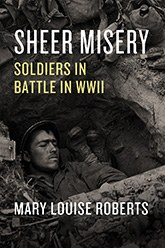
Sheer Misery Soldiers in Battle in WWII
Mary Lou Roberts. Sheer Misery Soldiers in Battle in WWII. University of Chicago Press, 2021.
Marching across occupied France in 1944, American GI Leroy Stewart had neither death nor glory on his mind: he was worried about his underwear, which was engaged in a relentless crawl of its own. Similar complaints of physical discomfort pervade infantrymen’s memories of the European theater, whether the soldiers were British, American, German, or French. Wet, freezing misery with no end in sight—this was life for millions of enlisted men during World War II. Sheer Misery trains a humane and unsparing eye on the corporeal experiences of the soldiers who fought in Belgium, France, and Italy during the last two years of the war. In the horrendously unhygienic and often lethal conditions of the front line, their bodies broke down, stubbornly declaring their needs for warmth, rest, and good nutrition. Feet became too swollen to march, fingers too frozen to pull triggers; stomachs cramped, and diarrhea stained underwear and pants. Turning away from the accounts of high-level military strategy that dominate many WWII chronicles, acclaimed historian Mary Louise Roberts instead relies on diaries and letters to bring to life visceral sense memories like the moans of the “screaming meemies,” the acrid smell of cordite, and the shockingly mundane sight of rotting corpses. As Roberts writes, “For soldiers who fought, the war was above all about their bodies.”
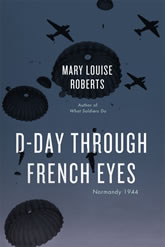
D-Day through French Eyes: Memoirs of Normandy 1944
Mary Lou Roberts. D-Day through French Eyes: Memoirs of Normandy 1944. University of Chicago Press, 2014.
“Like big black umbrellas, they rain down on the fields across the way, and then disappear behind the black line of the hedges.” Silent parachutes dotting the night sky—that’s how one woman in Normandy in June of 1944 learned that the D-Day invasion was under way. Though they yearned for liberation, the French in Normandy nonetheless had to steel themselves for war, knowing that their homes and land and fellow citizens would have to bear the brunt of the attack. Already battered by years of Nazi occupation, they knew they had one more trial to undergo even as freedom beckoned. With D-Day through French Eyes, Mary Louise Roberts turns the usual stories of D-Day around, taking readers across the Channel to view the invasion anew. Roberts builds her history from an impressive range of gripping first-person accounts of the invasion as seen by French citizens throughout the region. A farm family notices that cabbage is missing from their garden—then discovers that the guilty culprits are American paratroopers hiding in the cowshed. Fishermen rescue pilots from the wreck of their B-17, only to struggle to find clothes big enough to disguise them as civilians. A young man learns how to estimate the altitude of bombers and to determine whether a bomb was whistling overhead or silently headed straight for them. In small towns across Normandy, civilians hid wounded paratroopers, often at the risk of their own lives. When the allied infantry arrived, they guided soldiers to hidden paths and little-known bridges, giving them crucial advantages over the German occupiers. Through story after story, Roberts builds up an unprecedented picture of the face of battle as seen by grateful, if worried, civilians. As she did in her acclaimed account of GIs in postwar France, What Soldiers Do, Roberts here reinvigorates and reinvents a story we thought we knew. The result is a fresh perspective on the heroism, sacrifice, and achievement of D-Day.
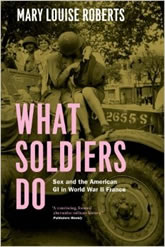
What Soldiers Do: Sex and the American GI in World War II France
Mary Lou Roberts. What Soldiers Do: Sex and the American GI in World War II France. University of Chicago Press, 2013.
How do you convince men to charge across heavily mined beaches into deadly machine-gun fire? Do you appeal to their bonds with their fellow soldiers, their patriotism, their desire to end tyranny and mass murder? Certainly—but if you’re the US Army in 1944, you also try another tack: you dangle the lure of beautiful French women, waiting just on the other side of the wire, ready to reward their liberators in oh so many ways. That’s not the picture of the Greatest Generation that we’ve been given, but it’s the one Mary Louise Roberts paints to devastating effect in What Soldiers Do. Drawing on an incredible range of sources, including news reports, propaganda and training materials, official planning documents, wartime diaries, and memoirs, Roberts tells the fascinating and troubling story of how the US military command systematically spread—and then exploited—the myth of French women as sexually experienced and available. The resulting chaos—ranging from flagrant public sex with prostitutes to outright rape and rampant venereal disease—horrified the war-weary and demoralized French population. The sexual predation, and the blithe response of the American military leadership, also caused serious friction between the two nations just as they were attempting to settle questions of long-term control over the liberated territories and the restoration of French sovereignty. While never denying the achievement of D-Day, or the bravery of the soldiers who took part, What Soldiers Do reminds us that history is always more useful—and more interesting—when it is most honest, and when it goes beyond the burnished beauty of nostalgia to grapple with the real lives and real mistakes of the people who lived it. A film, “Le Repos des guerriers,” based on What Soldiers Do, (MAHA Productions, France) was released in Spring 2015.
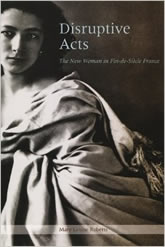
Disruptive Acts: The New Woman in Fin-de-Siecle France
Mary Lou Roberts. Disruptive Acts: The New Woman in Fin-De-Siecle France. University of Chicago Press, 2002.
In fin-de-siècle France, politics were in an uproar, and gender roles blurred as never before. Into this maelstrom stepped the “new women,” a group of primarily urban, middle-class French women who became the objects of intense public scrutiny. Some remained single, some entered nontraditional marriages, and some took up the professions of medicine and law, journalism and teaching. All of them challenged traditional notions of womanhood by living unconventional lives and doing supposedly “masculine” work outside the home. Mary Louise Roberts examines a constellation of famous new women active in journalism and the theater, including Marguerite Durand, founder of the women’s newspaper La Fronde; the journalists Séverine and Gyp; and the actress Sarah Bernhardt. Roberts demonstrates how the tolerance for playacting in both these arenas allowed new women to stage acts that profoundly disrupted accepted gender roles. The existence of La Fronde itself was such an act, because it demonstrated that women could write just as well about the same subjects as men—even about the volatile Dreyfus Affair. When female reporters for La Fronde put on disguises to get a scoop or wrote under a pseudonym, and when actresses played men on stage, they demonstrated that gender identities were not fixed or natural, but inherently unstable. Thanks to the adventures of new women like these, conventional domestic femininity was exposed as a choice, not a destiny. Lively, sophisticated, and persuasive, Disruptive Acts will be a major work not just for historians, but also for scholars of cultural studies, gender studies, and the theater.
Selected Publications
- “The Leroy Henry Case: Sexual Violence and Allied Relations in Great Britain, 1944”, Journal of the History of Sexuality, 26,3 (Fall 2017), 403-423.
- “Beyond Crisis in Understanding Gender Transformation,” in “Rethinking Key Concepts in Gender History,” 28,2 (August 2016), 358-366.
- “The Epinal Project,” H-France Salon, June 2015.
- A film, “Le Repos des guerriers,” based on What Soldiers Do, (MAHA Productions, France) was released in Spring 2015.
- “Forum on What Soldiers Do: Sex and the American G.I. in World War Two France, 1944-1946,” Journal of Women’s History, Fall 2014.
- “A Conversation about European Women’s History,” Journal of Women’s History,25, 4 (Winter 2013):288-308.
- “A nous les petites Havraises !” l’Histoire, les collections, July 2012
- Co-Editor with Paul Friedland, Special issue of French Historical Studies, “Theorized History,” March 2012.
- “Out of their Orbit: Celebrity and Eccentricity in Nineteenth Century France,” The Question of Gender: Joan W. Scott’s Critical Feminism, eds. Judith Butler and Elizabeth Weed, (Bloomington: Indiana University Press, 2011), 50-79.
- “The Price of Discretion: Prostitution, Venereal Disease and the American Military in France, 1944-1946,” American Historical Review, 115, no. 4 (October 2010):1002-1030.
- “Retinking Female Celebrity: The Eccentric Star in Nineteenth Century France,” Charisma, Fame, and Celebrity during the Long 19th Century, eds. Edward Berenson and Eva Giloi, (New York: Berghahn Books, 2010), 103-116.
- “The Silver Foxhole: Prostitution in Paris, 1944-1945,” French Historical Studies, 33: 1 (Winter 2010), 99-128.
Selected Awards
- George Louis Beer Prize, What Soldiers Do, Best Book in International History, American Historical Association, 2014
- Gilbert Chinard Prize, Society for French Historical Studies and the Institut Français d’Amerique, for What Soldiers Do, 2014
- Senior Fellowship, Institute for Research in the Humanities, 2010-2014
- Honorable Mention, Koren Prize, Society for French Historical Studies, 2011
- John Simon Guggenheim Fellowship, 2007-2008
- Chancellor’s Distinguished Teaching Award, 2008
Advisor To
History Courses
- History 120 – Europe & Modern World 1815-present
- History 200 – Twentieth Century as Lived Experience
- History 357 – The Second World War
- History 392 – Women in History
- History 600 – Women, Gender, & War in 20th Century
- History 891 – Rise & Fall of the Domestic Ideal
- History 891 – Gender & Race in European History
- History 891 – Sexuality Across National Boundaries