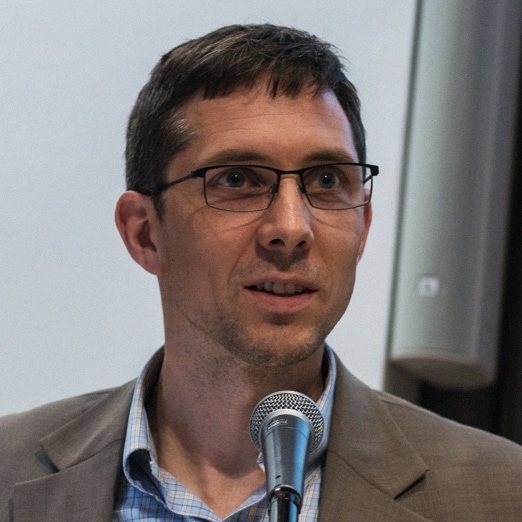
Patrick Iber
Director of Undergraduate Studies; Associate Professor of History
608.263.8931
Office: 2245 Levy Hall
Website
Office Hours: TBA
I am a historian of 20th century Latin America and U.S. foreign relations. My most recent book, Poverty of the Imagination: The Cold War and the Social Science of Development in Latin America, analyzes the social scientific frameworks for understanding poverty in Latin America. It incorporates a discussion of the key frameworks (modernization, dependency, marginality, the culture of poverty, and neoliberalism) into an examination of the Ford Foundation, cultural imperialism, and democratic loss and recovery.
My first book, Neither Peace nor Freedom: The Cultural Cold War in Latin America, examined how artists, writers, and intellectuals participated in and generated Cold War conflict. I describe how they worked with organizations sponsored by Cold War powers: the Soviet-backed World Peace Council, the CIA-sponsored Congress for Cultural Freedom, and Cuba’s Casa de las Américas. Neither Peace nor Freedom delves into the entwined histories of these groups and the aspirations and dilemmas of intellectuals who participated in them, from Diego Rivera and Pablo Neruda to Gabriel Garcia Marquez and Jorge Luis Borges, showing how difficult it was for them to achieve their visions of art in the service of justice in the context of the Cold War.
Beyond my academic work, I am a writer and editor. I am currently co-editor of Dissent magazine. Please note that I cannot respond to Dissent queries made to my wisc.edu email.
I am also a contributing editor at the New Republic, where I regularly contribute book reviews. In addition to those publications, I have written for The New York Times, Rolling Stone, The Nation, the Los Angeles Review of Books, The Chronicle of Higher Education, and The Baffler, among other places. In Spanish, I write regularly for Nueva Sociedad about U.S. politics.
At the University of Wisconsin, I teach a variety of courses for undergraduates and graduate students. These range from classes on Latin America to a course on humor as a historical source. Under current conditions, I am only able to consider graduate applications in Latin American history. I can serve on committees for students in other fields.
Education
Ph.D., University of Chicago
M.A., Stanford University
B.S., Stanford University
Books

Neither Peace nor Freedom: The Cultural Cold War in Latin America
Patrick Iber. Neither Peace nor Freedom: The Cultural Cold War in Latin America. Harvard University Press, 2015.
During the Cold War, left-wing Latin American artists, writers, and scholars worked as diplomats, advised rulers, opposed dictators, and even led nations. Their competing visions of social democracy and their pursuit of justice, peace, and freedom led them to organizations sponsored by the governments of the Cold War powers: the Soviet-backed World Peace Council, the U.S.-supported Congress for Cultural Freedom, and, after the 1959 Cuban Revolution, the homegrown Casa de las Américas. Neither Peace nor Freedom delves into the entwined histories of these organizations and the aspirations and dilemmas of intellectuals who participated in them, from Diego Rivera and Pablo Neruda to Gabriel Garcia Marquez and Jorge Luis Borges. Patrick Iber corrects the view that such individuals were merely pawns of the competing superpowers. Movements for democracy and social justice sprung up among pro-Communist and anti-Communist factions, and Casa de las Américas promoted a brand of revolutionary nationalism that was beholden to neither the Soviet Union nor the United States. But ultimately, intellectuals from Latin America could not break free from the Cold War’s rigid binaries. With the Soviet Union demanding fealty from Latin American communists, the United States zealously supporting their repression, and Fidel Castro pushing for regional armed revolution, advocates of social democracy found little room to promote their ideals without compromising them. Cold War politics had offered utopian dreams, but intellectuals could get neither the peace nor the freedom they sought.
Selected Publications
- “Building the Cold War Together: The Origins of the American Federation of Labor’s Cold War Diplomacy in Latin America,” Journal of Cold War Studies 26, no. 4 (Fall 2024): 3-32.
- “The Cost of Freedom: The Congress for Cultural Freedom in Latin America,” 88-115 in U.S. Public Diplomacy Strategies in Latin America During the Sixties: Time for Persuasion, edited by Francisco Javier Rodríguez Jiménez, Lorenzo Delgado Gómez-Escalonilla, and Benedetta Calandra (Routledge, 2024).
- “Socialdemocracia y Guerra fría: el Partido Liberación Nacional, el anticomunismo y la revista Combate (1958-1963),” with David Díaz Arias, in David Díaz Arias (ed.), Lucas y sombras: La socialdemocracia costarricense y la Guerra Fría, 1951-1976, (San José, Costa Rica: Centro de Investigaciones Históricas de América Central, 2024), 53-86.
- “The Cold War, 1945-1989,” in Jonathan Beck Monroe (ed.), Roberto Bolaño in Context, Cambridge University Press, 2023, 113-125.
- “From Peace to National Liberation: Mexico and the Tricontinental,” in Inventing the Third World: In Search of Freedom in the Global South, edited by Gyan Prakash and Jeremy Adelman, (Bloomsbury, 2022), 45-64.
- “La Guerra fría y sus impactos en Uruguay,” in La historia de los conservadores y las derechas en Uruguay, tomo II, edited by Magdalena Broquetas and Gerardo Caetano (Montevideo: Banda Oriental, 2022), 27-46.
- “Social Science, Cultural Imperialism, and the Ford Foundation in Latin America in the 1960s,” pp. 96-114, in The Global Sixties: Convention, Contest, and Counterculture, edited by Jadwiga Pieper-Mooney and Tamara Chaplin, Routledge, 2017.
- “Debating Political Economy: An Approach to Teaching the U.S. and the World,” Journal of American History 103, no. 4 (March 2017): 997-1003.
- “The Cold War Politics of Literature and the Centro Mexicano de Escritores,” Journal of Latin American Studies 48, no. 2 (May 2016): 247-272.
- “Who will Impose Democracy?: Sacha Volman and the Contradictions of CIA Support for the Anticommunist Left in Latin America,” Diplomatic History 37, no. 5 (November 2013): 995-1028.
- “El imperialismo de la libertad: el Congreso por la Libertad de la Cultura en América Latina,” 117-132 in La guerra fría cultural en América Latina: desafíos y límites para una nueva mirada de las relaciones interamericanas, edited by Benedetta Calandra and Marina Franco, Biblos, 2012.
- “Anti-Communist Entrepreneurs and the Origins of the Cultural Cold War in Latin America,” pp. 167-186, in De-centering Cold War History: Local and Global Change, edited by Jadwiga Pieper-Mooney and Fabio Lanza, Routledge, 2012.
Advisor To
Selected Awards
- Luciano Tomassini Latin American International Relations Book Award, 2017
- Andrew W. Mellon Fellowship of Scholars in the Humanities, Stanford University, 2011-2013
History Courses
- History 100 – History through Humor and Satire – Syllabus 2025 (pdf)
- History 102 – American History, Civil War Era to the Present – Syllabus 2020 (pdf)
- History 201 – The Historian’s Craft: The History of Now – Syllabus 2023 (pdf)
- History 242 – Modern Latin America, 1898 to the Present – Syllabus 2021 (pdf)
- History 260 – Latin America: An Introduction – Syllabus 2020 (pdf)
- History 434 – U.S. Foreign Policy since 1898 – Syllabus 2018 (pdf)
- History 500 – Latin American Revolutions – Syllabus 2018 (pdf)
- History 600 – Poverty and Inequality in the Americas
- History 680/690 – Thesis and Honor Thesis Colloquium – Syllabus 2026 (pdf)
- History 703 – History and Theory, and the Global South – Syllabus 2020 (pdf)
- History 730 – Proseminar in Latin American History: Cold War Latin America – Syllabus 2020 (pdf)