
Biography
Biography
My specializations are Medieval social & intellectual, Latin paleography, Medieval education. My Research and Teaching Interests include Medieval Intellectual History, incl. philosophy, theology, and political thought, esp. for the 12-14th centuries. Medieval Education and history of Universities. Monasticism.
Education
Ph.D., Harvard
S.T.B., Harvard
A.B., Vanderbilt
Books
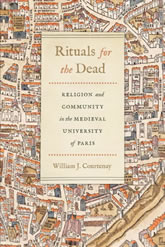
Rituals for the Dead: Religion and Community in the Medieval University of Paris
William J. Courtenay. Rituals for the Dead: Religion and Community in the Medieval University of Paris. University of Notrre Dame Press, 2019.
In his fascinating new book, based on the Conway Lectures he delivered at Notre Dame in 2016, William Courtenay examines aspects of the religious life of one medieval institution, the University of Paris, in the thirteenth and fourteenth centuries. In place of the traditional account of teaching programs and curriculum, however, the focus here is on religious observances and the important role that prayers for the dead played in the daily life of masters and students. Courtenay examines the university as a consortium of sub-units in which the academic and religious life of its members took place, and in which prayers for the dead were a major element. Throughout the book, Courtenay highlights reverence for the dead, which preserved their memory and was believed to reduce the time in purgatory for deceased colleagues and for founders of and donors to colleges. The book also explores the advantages for poor scholars of belonging to a confraternal institution that provided benefits to all members regardless of social background, the areas in which women contributed to the university community, including the founding of colleges, and the growth of Marian piety, seeking her blessing as patron of scholarship and as protector of scholars. Courtenay looks at attempts to offset the inequality between the status of masters and students, rich and poor, and college founders and fellows, in observances concerned with death as well as rewards and punishments in the afterlife. Rituals for the Dead is the first book-length study of religious life and remembrances for the dead at the medieval University of Paris. Scholars of medieval history will be an eager audience for this title.
Rotuli Parisienses (2 vols.) Supplications to the Pope from the University of Paris, Volume III: 1378-1394
William J. Courtenay (Editor), and Eric D. Goddard (Editor). Rotuli Parisienses (2 vols.) Supplications to the Pope from the University of Paris, Volume III: 1378-1394. Brill, 2013.
Series: Education and Society in the Middle Ages and Renaissance, Volume: 44 This volume continues the edition of the rotuli, or lists of benefice supplications, sent to the papacy by masters, bachelors, and students at the University of Paris in the fourteenth century. It specifically covers the pontificate of the Avignon pope Clement VII (1378-1394). It also contains letters of provision, in abbreviated form, that resulted from those petitions, along with a large number of supplications from individual Parisian scholars either submitted independently or, more frequently, through another sponsor. In contrast to earlier papal beneficial policy, Pope Clement responded favorably to many petitions from students in the faculty of arts at Paris, some of them in the beginning years of their undergraduate education. Thus, in addition to providing important information on Parisian scholars and papal beneficial policy in the early years of the Papal Schism, it documents a portion of the university community otherwise invisible, namely undergraduate students, and reveals the connections between Parisian scholars and social and ecclesiastical patrons at the end of the fourteenth century. The book concludes with an index of the names of scholars and patrons as well as a place-name index locating the parish and collegiate churches mentioned in the texts. Along with the two earlier volumes, this edition represents the largest body of new documentation for the pre-fifteenth century University to appear since the publication of the Chartularium Universitatis Parisiensis at the end of the nineteenth century.
Universities and Schooling in Medieval Society
William J. Courtenay (Editor), and J. Miethke (Editor). Universities and Schooling in Medieval Society. Brill, 2000.
Series: Education and Society in the Middle Ages and Renaissance, Volume: 10 The 10 papers in this volume examine university and pre-university education in the 14th to 16th centuries in Germany, Italy, France, and England. Topics covered include the recruitment and support of students, studying abroad, social status, careers of graduates, university rituals, the profession of schoolmaster, and the relation of the studia to the crown. Contributors include William J. Courtenay, Rainer Chr. Schwinges, Klaus Wriedt, Frank Rexroth, Darleen Pryds, Helmut G. Walther, Thomas Sullivan, O.S.B., Martin Kintzinger, Jo Ann Hoeppner Moran Cruz, and Jürgen Miethke.
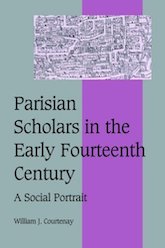
Parisian Scholars in the Early Fourteenth Century: A Social Portrait. Cambridge Studies in Medieval Life and Thought
William J. Courtenay. Parisian Scholars in the Early Fourteenth Century: A Social Portrait. Cambridge Studies in Medieval Life and Thought. Cambridge University Press , 1999.
This study of the social, geographical and disciplinary composition of the scholarly community at the University of Paris in the early fourteenth century is based on the reconstruction of a remarkable document: the financial record of tax levied on university members in the academic year 1329–1330. Containing the names, financial level and often addresses of the majority of the masters and most prominent students, it is the single richest source for the social history of a medieval university before the late fourteenth century. After a thorough examination of the financial account, the history of such collections, and the case (a rape by a student) that precipitated legal expenses and the need for a collection, the book explores residential patterns, the relationship of students, masters and tutors, social class and levels of wealth, interaction with the royal court and the geographical background of university scholars.
Capacity and Volition. A History of the Distinction of Absolute and Ordained Power
William J. Courtenay. Capacity and Volition. A History of the Distinction of Absolute and Ordained Power. Bergamo: Pierluigi Lubrina, 1990.
Quodlibet: Richerche e strumenti di filosofia medievale, 8. [Milan lectures]
History Courses Taught
- History 200 – Historical Studies
- History 215 – Life in the Middle Ages: An Inter-Departmental Course
- History 311 – Schools and Learning in the Medieval World
- History 312 – The Medieval Church
- History 316 – Latin Paleography
- History 317 – Medieval Social and Intellectual History, 400-1200
- History 318 – Medieval Social and Intellectual History, 1200-1450
- History 366 – Medieval Monasticism
- History 550 – Advanced Interdisciplinary Studies in Medieval Civilization
- History 600 – Advanced Seminar in History – Topics: “12th Century Renaissance”
- History 719 – Proseminar in Medieval History
- History 805 – Seminar: Medieval History – Topics: “Medieval Intellectual History”