
Biography
Biography
My interests are India and the Indian Ocean area in the medieval and early modern age.
Education
Ph.D., University of Leiden 1984
M.A., University of Leiden
B.A., University of Leiden
Books
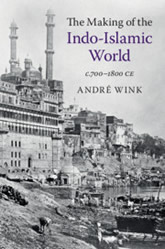
The Making of the Indo-Islamic World c.700–1800 CE
André Wink. The Making of the Indo-Islamic World c.700–1800 CE. Cambridge University Press, 2020.
In a new accessible narrative, Andre Wink presents his major reinterpretation of the long-term history of India and the Indian Ocean region from the perspective of world history and geography. Situating the history of the Indianized territories of South Asia and Southeast Asia within the wider history of the Islamic world, he argues that the long-term development and transformation of Indo-Islamic history is best understood as the outcome of a major shift in the relationship between the sedentary peasant societies of the river plains, the nomads of the great Saharasian arid zone and the seafaring populations of the Indian Ocean. This revisionist work redraws the Asian past as the outcome of the fusion of these different types of settled and mobile societies, placing geography and environment at the centre of human history. Provides a world-historical perspective on the history of South and Southeast Asia. Introduces an environmental and geographical dimension to Indian history. Situates the history of the Indianized territories of South Asia and Southeast Asia within the wider history of the Islamic world.
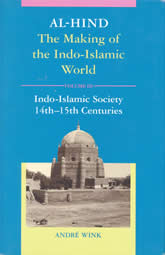
Al-Hind, Volume 3 Indo-Islamic Society, 14th- 15th Centuries
André Wink. Al-Hind, Volume 3 Indo-Islamic Society, 14th- 15th Centuries. Brill, 2003.
This third volume of Andre Wink’s acclaimed and pioneering Al-Hind:The Making of the Indo-Islamic World takes the reader from the late Mongol invasions to the end of the medieval period and the beginnings of early modern times in the late fifteenth and early sixteenth century. It breaks new ground by focusing attention on the role of geography, and more specifically on the interplay of nomadic, settled and maritime societies. In doing so, it presents a picture of the world of India and the Indian Ocean on the eve of the Portuguese discovery of the searoute: a world without stable parameters, of pervasive geophysical change, inchoate and instable urbanism, highly volatile and itinerant elites of nomadic origin, far-flung merchant diasporas, and a famine- and disease-prone peasantry whose life was a gamble on the monsoon.
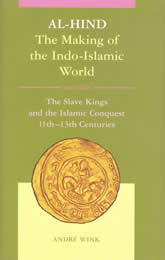
Al-Hind: The Making of the Indo-Islamic World, Volume II
André Wink. Al-Hind: The Making of the Indo-Islamic World, Volume II. Brill, 1997.
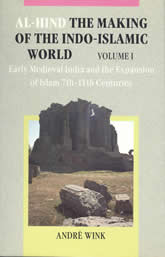
Al-Hind, Volume 1 Early medieval India and the expansion of Islam 7th-11th centuries
André Wink. Al-Hind, Volume 1 Early Medieval India and the Expansion of Islam 7th-11th centuries. Brill, 1991.
This book is the first of a projected series of five which aims to analyze the process of momentous and long-term change which came with the Islamization of the regions which the Arabs called al-Hind, that is India and large parts of its Indianized hinterland. The series is set up in a chronological order, starting with the early expansion of the caliphate in the seventh and eight centuries and ending with the beginnings of European colonization. In this millennium of Islamic expansion five successive stages are distinguished, taking into account the world-historical context. Each stage will be covered by a separate volume. The present volumes covers the period of the seventh to eleventh centuries, the early medieval period in which the Islamic Middle East acquires economic supremacy while establishing new links between the Mediterranean and the Indian Ocean.
Land and Sovereignty in India: Agrarian Society and Politics under the Eighteenth-Century Maratha Svarajya
André Wink. Land and Sovereignty in India: Agrarian Society and Politics under the Eighteenth-Century Maratha Svarajya. Cambridge, 1986.
This original contribution to Indian history, focusing on contemporary and largely indigenous documents, introduces a set of concepts for the analysis of late Mughal rule. More specifically it examines the origins and development of the Maratha svardjya or ‘self-rule’ within the context of declining Muslim power. It traces the expansion of Maratha dominion to a process of fitna, a policy of ‘shifting alliances’ which was recurrent in the wake of Muslim expansion throughout its history. The book gives an interesting perspective on Hindu-Muslim relationships in the pre-British period as well as on the nature of the Indo-Muslim state and its most important successor polity, on its capacity for change and development in the intermediate sections of society, the land-tenurial system, the monetization of the economy, and on the fiscal system.
History Lecture Courses
- History 130 – An Introduction to World History – Syllabus 2018 (pdf)
- History 142 – History of South Asia to the Present – Syllabus 2013 (pdf)
- History 463 – Topics in South Asian History – “Empires of the East” – Syllabus 2018 (pdf)
- History 621 – Buddhism in the History of South and Southeast Asia
- History 600 – Advanced Seminar in History
- History 757 – Pro-seminar in Indian History
- History 857 – Empires of the East – Syllabus 2018 (pdf)