
Biography
Biography
I am a historian of early modern Britain, and of the History of Political Thought in Europe between the Middle Ages and the Enlightenment. I have written books on politics and political ideas in early seventeenth-century England, and on Thomas Hobbes and his historical context, and have edited the political writings of King James VI and I and Sir Robert Filmer (for the series Cambridge Texts in the History of Political Thought). I’ve also written articles and book chapters on topics including John Selden, John Donne, divine right episcopacy, literature and national identity, the history of lying, natural law, and Catholic political theory. My research interests include: Intellectual history and the history of political thought between the late Middle Ages and the Enlightenment; Thomas Hobbes; English political, social and economic history to 1688; early modern Europe.
Education
Ph.D., Cambridge
M.A., Cambridge
B.A., Cambridge
Books
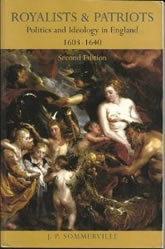
Royalists and Patriots: Politics and Ideology in England 1603-1640
Johann Sommerville. Royalists and Patriots: Politics and Ideology in England 1603-1640. Addison Wesley/ Longman, 1999.
The early Stuart age was critical to England’s political and constitutional development, and has been the subject of passionate debate among historians. Some argue that the Civil War had few long-term origins; others discern deeper roots. But how did the men and women of the time see contemporary politics? What were the issues and the principles that mattered to them? And how did this ideological dimension contribute to the turbulent years before 1640? Strangely neglected amidst all the cut-and-thrust of modern historiographical controversy, this is the territory that Johann Sommerville explored in his widely-respected study (first published in 1986 as Politics and Ideology in England 1603-1640), which now appears in this major Second Edition. The result is not only an important contribution for historians; it also throws a vivid light on the political climate and preoccupation of Shakespeare and his contemporaries. As before, the first part offers a notably clear account of the main political theories current at the time, each located and discussed within its wider historical contexts. These include the Divine Right of Knights, the theory of the ancient constitution, and the idea that government is founded upon the consent of the governed. But political thought is rarely isolated from political practice: ideas have to come to terms with events, and theories are developed to justify concrete positions. In the seconded part, therefore, Johann Sommerville goes on to examine how these major theories were applied in practice to the burning issues of the day. To these ends, he analyses a large body of early seventeenth-century political literature – setting the work of famous theorists like Hobbes, Locke and Hooker against the backcloth of more humble writers, to clarify what was original in their work and what was the common currency of the age. He is then able to unravel the ideas and attitudes that contemporaries brought to such key topics as taxation without consent, the powers of arbitrary arrest, and the government of the Church. He shows how differences in political outlook influenced political practice and fueled the mutual distrust between the king and many of his powerful subjects. Civil War was not inevitable in England; but by dissecting the neglected ideological dimension of politics, Johann Sommerville reveals a major cause of the eventual breakdown of the peace. The Second Edition has been revised throughout to take account of recent research, and it contains an extensive new section reviewing the current state of historiographical debate. The suggestions for Further Reading have been updated; there is a useful new Chronology; and the entire text has been reset in a more readable format.
King James VI and I: Political Writings
Johann Sommerville (Editor). King James VI and I: Political Writings. Cambridge University Press, 1994.
James VI and I united the crowns of England and Scotland. His books are fundamental sources of the principles that underlay the union and among the most influential writings of their period. James’ political philosophy was a moderated absolutism, shedding light on the political climate of Shakespeare’s England and the intellectual background to the civil wars of the mid-seventeenth century. This edition is the first to draw on all the early texts of James’ books, with an introduction setting them in their historical context.
Thomas Hobbes: Political Ideas in Historical Context
Johann Sommerville. Thomas Hobbes: Political Ideas in Historical Context. London, Macmillan; New York, St Martin’s Press, 1992.
Thomas Hobbes was the greatest British political theorist. His Leviathan is a major classic of political philosophy. Since the Second World War there has been a dramatic growth of interest in Hobbes’ theories, largely because his ideas are of central relevance to modern political problems. Hobbes had much to say that bears directly on the questions of rights of the individuals and minorities, the limits of state power, the legitimacy of civil disobedience, and the nature of international relations. By rigorous argument from the first principles, he tried to show that human survival necessities absolute state power but that rules should not use their power to suppress unorthodox opinions. Too often commentators on Hobbes have failed to grasp his meaning because they have ignored the historical context in which he wrote. Drawing on much recent scholarship and many little-known seventeenth-century sources, Dr. Sommerville sets Hobbes’s teachings on the ‘state of nature’, the origins of government, the powers of rulers, the nature of the family, and other key issues against a backcloth of contemporary discussions. Indeed, Sommerville argues that a great deal of what Hobbes had to say cannot properly be understood unless it is seen in the context of seventeenth-century political and religious debates – debates which helped to bring civil war to England in the 1640s, and which fuelled warfare on the European continent for much of the seventeenth century. Adopting an innovative approach to political theory, this book will become a classic text for the Hobbes student. Dr. Sommerville’s clear and readable analysis also takes full account of the often neglected second half of Leviathan, which deals with religious questions. Here, Hobbes’ ideas on religion and church-state relations are thoroughly examined, and are shown to be an integral part of his overall theory.
Sir Robert Filmer: ‘Patriarcha’ and Other Writings
Johann Sommerville (Editor). Sir Robert Filmer: ‘Patriarcha’ And Other Writings. Vol. xlvi, no. 327, Cambridge University Press, 1991.
This volume contains the political writings of Sir Robert Filmer (1588-1653), an acute defender of absolute monarchy and perhaps the most important patriarchal political theorist of the seventeenth century. The recent explosion of interest in women’s history and the history of the family has greatly enhanced the audience for Filmer’s work, and in this new edition Johann Sommerville provides accurate and accessible texts of his principal writings, accompanied by all the standard series features, including a concise introduction, chronology, guide to further reading and notes on Filmer’s own text.
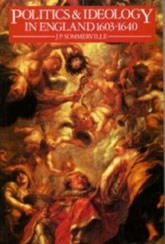
Politics and Ideology in England 1603-1640
Johann Sommerville. Politics and Ideology in England 1603-1640. Longman, London and New York, 1986.
The years before the Civil War were a critical period in England’s political and constitutional development, and have been the subject of vigorous debate. Some historians argue that the Civil War had few long-term origins, while others discern deeper roots. Dr Sommerville here looks at the contemporary view of politics and at the ideologies, both in theory and in action, which contributed to the turbulent years before 1640.
Selected Publications
- “Hobbes, Selden, Erastianism, and the History of the Jews,” in G. A. J. Rogers and Tom Sorell, Hobbes and History, Routledge, London and New York, 2000, 160-88.
- “Selden, Grotius, and the Seventeenth-Century Intellectual Revolution in Moral and Political Theory,” in Victoria Kahn and Lorna Hutson, eds., Rhetoric and Law in Early Modern Europe, New Haven, Yale University Press, 2001, 318-44.
- “King James VI and I and John Selden: Two Voices on History and the Constitution,” in Daniel Fischlin and Mark Fortier, eds., Royal Subjects: Essays on the Writings of James VI and I, Detroit, Wayne State University Press, 2002, 290-322.
- “An emergent Britain? Literature and national identity in Early Stuart England,” in D. Loewenstein and J. Mueller, eds., The Cambridge History of Early Modern English Literature, Cambridge 2003, 459-86.
- “John Donne the controversialist: the poet as political thinker,” in David Colclough, ed., John Donne’s Professional Lives, D. S. Brewer, Cambridge, England, 2003, 73-95.
- “The modern contexts of George Mosse’s Early Modern Scholarship,” in What History Tells: George Mosse and the Culture of Modern Europe, ed. Stanley G. Payne, David J. Sorkin and John S. Tortorice, The University of Wisconsin Press, 2003, 25-38.
- “Hobbes, Behemoth, Church-State Relations, and Political Obligation,” in Filozofski vestnik 24/2(2003), 205-222.
- “Hobbes and Independency,” in Rivista di storia della filosofia 21(2004), 155-73.
- “Conscience, Law, and Things Indifferent: Arguments on Toleration from the Vestiarian Controversy to Hobbes and Locke,” in Harald Braun and Edward Vallance, eds., Contexts of Conscience in Early Modern Europe, 1500-1700, Houndmills, Palgrave Macmillan, 2004, 166-79, and notes at 222-6.
- “Papalist Political Thought and the Controversy over the Jacobean Oath of Allegiance,” in Ethan H. Shagan, ed., Catholics and the Protestant Nation, Manchester and New York, Manchester University Press, 2005, 162-84.
- “Thomas Hobbes’ Leviathan and its Anglican context,” in Patricia Springborg, ed., The Cambridge Companion to Hobbes’ Leviathan; Cambridge University Press; 2007), 358-74.
- “English and Roman Liberty in the Monarchical Republic of early Stuart England,” in John McDiarmid, ed., The Monarchical Republic of early Modern England, Ashgate, Aldesrhot, UK, 2007, 201-16.
- “Behemoth, Church-State Relations, and Political Obligation” in Tomaž Mastnak, ed., Hobbes’s “Behemoth”: Religion and Democracy, Exeter and Charlottesville: Imprint Academic, 2009, 93-110.
- “The Social Contract (Contract of Government)” in The Oxford Handbook of the History of Political Philosophy, ed. George Klosko, Oxford University Press, 2011, 573-85.
- “The Death of Robert Cecil: End of an Era” in The Oxford Handbook of John Donne, ed. Jeanne Shami et al., Oxford University Press, 2011, 495-505.
- “Early Modern Absolutism in Practice and Theory” in Monarchism and Absolutism in Early Modern Europe, ed. Cesare Cuttica and Glenn Burgess, London, Pickering and Chatto, 2012, 117-30; notes at 240-3.
- Review of The History of Parliament: the House of Commons 1604-1629 edited by Andrew Thrush and John P. Ferris, 6 vols., Cambridge, Cambridge University Press, 2010, in English Historical Review 127(2012), 1519-24.
- “Life and Times” in The Bloomsbury Companion to Hobbes, edited by S.A. Lloyd, London, Bloomsbury Academic, 2013, 1-28.
- “Thomas Hobbes” in Oxford Bibliographies Online, (subscription required to read the full text) (11,716 words)
- “Hobbes and Absolutism” in The Oxford Handbook of Hobbes
Selected Awards
- 2012: University Housing Honored Instructor Award.
- 2012: Undergraduate History Association, Best Professor Award for 2011-12.
- 2007: History Department, Karen F. Johnson Teaching Award.
- 1998-9: R. Stanton Avery Distinguished Fellow, Huntington Library, San Marino, CA.
- 1996-9: on Editorial Board of the Journal of Modern History.
- 1993: NEH long-term Fellowship at the Folger Shakespeare Library in Washington D.C.
- 1986- : Fellow of the Royal Historical Society.
- 1980-4: Fellow, St John’s College, Cambridge.
- 1976-7: Joseph Hodges Choate Memorial Fellow, Harvard University.
History Courses
- History 123 – English History to 1688
- History 283 – History of Political Thought from the Late Middle Ages to the Enlightenment
- History 351 – Seventeenth-Century Europe
- History 361 – The Emergence of Modern Britain 1485-1660
- History 367 – Society and Ideas in Shakespeare’s England
- History 600 – The Foundations of Modern Political Thought
- History 831 – Early Modern Britain
- History 867 – Social and Political Ideas in early Modern Europe