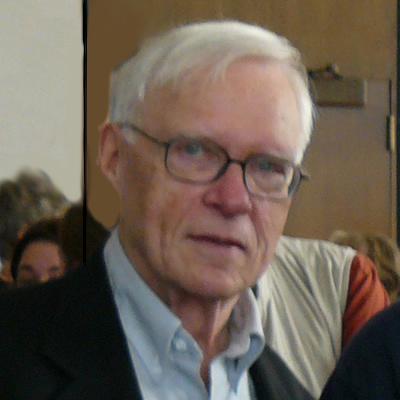
Biography
Education
Ph.D., Columbia University
M.A., Claremont Graduate School
B.A., Pacific Union College
Books
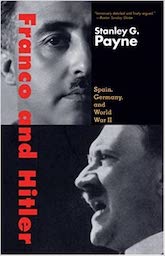
Franco and Hitler Spain, Germany, and World War II
Stanley Payne. Franco and Hitler Spain, Germany, and World War II. Yale University Press, 2008.
Was Franco sympathetic to Nazi Germany? Why didn’t Spain enter World War II? In what ways did Spain collaborate with the Third Reich? How much did Spain assist Jewish refugees? This is the first book in any language to answer these intriguing questions. Stanley Payne, a leading historian of modern Spain, explores the full range of Franco’s relationship with Hitler, from 1936 to the fall of the Reich in 1945. But as Payne brilliantly shows, relations between these two dictators were not only a matter of realpolitik. These two titanic egos engaged in an extraordinary tragicomic drama often verging on the dark absurdity of a Beckett or Ionesco play. Whereas Payne investigates the evolving relationship of the two regimes up to the conclusion of World War II, his principal concern is the enigma of Spain’s unique position during the war, as a semi-fascist country struggling to maintain a tortured neutrality. Why Spain did not enter the war as a German ally, joining with Hitler to seize Gibraltar and close the Mediterranean to the British navy, is at the center of Payne’s narrative. Franco’s only personal meeting with Hitler, in 1940 to discuss precisely this, is recounted here in groundbreaking detail that also sheds significant new light on the Spanish government’s vacillating policy toward Jewish refugees, on the Holocaust, and on Spain’s German connection throughout the duration of the war.
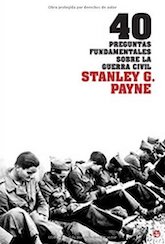
Cuarenta preguntas fundamentales sobre la Guerra Civil
Stanley Payne. Cuarenta Preguntas Fundamentales Sobre La Guerra Civil. La Esfera de los Libros, 2006.
En este nuevo libro, el historiador Stanley G. Payne, autor de El colapso de la República -publicado con gran éxito por esta editorial-, plantea cuarenta preguntas fundamentales para comprender la Guerra Civil, desde su estallido y desarrollo a sus consecuencias. En cada capítulo logra la visión más clara ofrecida hasta ahora sobre el conflicto bélico español, y lo sitúa en un amplio contexto que supera las limitadas perspectivas con las que se ha estudiado hasta ahora. Así da respuestas detalladas, profundas y didácticas a interrogantes que han generado muchísima controversia a lo largo de setenta años, como por ejemplo si realmente fue inevitable la contienda, o qué hubiera pasado en el país si los militares no se hubieran sublevado; cuáles eran los objetivos de Hitler, Mussolini y la URSS cuando se decidieron a intervenir; por qué las democracias occidentales no ayudaron a la República; qué pasó con el oro de Moscú; qué papel jugaron los nacionalismos; cuáles fueron las consecuencias inmediatas y a largo plazo… Y, finalmente, una cuestión que sigue viva en la actualidad política: ¿ha logrado España superar, en pleno siglo XXI, la Guerra Civil, o todavía queda un camino por recorrer? TRANSLATION: In this new book, the historian Stanley G. Payne, author of The Collapse of the Republic -published with great success by this editorial-, asks forty fundamental questions to understand the Civil War, from its outbreak and development to its consequences. In each chapter he achieves the clearest vision offered so far on the Spanish war conflict, and places it in a broad context that goes beyond the limited perspectives with which it has been studied so far. Thus, he gives detailed, profound and didactic answers to questions that have generated a great deal of controversy over seventy years, such as whether the conflict was really inevitable, or what would have happened in the country if the military had not risen in revolt; what were the objectives of Hitler, Mussolini and the USSR when they decided to intervene; why the western democracies did not help the Republic; what happened to the Moscow gold; what role did nationalisms play; What were the immediate and long-term consequences … And finally, a question that is still alive today in politics: has Spain managed to overcome, in the 21st century, the Civil War, or is there still a way to go?
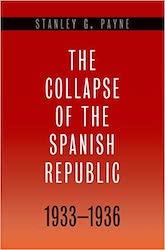
The Collapse of the Spanish Republic, 1933-1936: Origins of the Civil War
Stanley Payne. The Collapse of the Spanish Republic, 1933-1936: Origins of the Civil War. Yale University Press, 2004.
his book focuses on the short but crucial period that led to the collapse of the Spanish Republic and set the stage for the ensuing civil war. Stanley G. Payne, an internationally known scholar of modern Spanish history, details the political shifts that occurred from 1933 to 1936 and examines the actions and inactions of key actors during these years. Using their own memoirs, speeches, and declarations, he challenges previous perceptions of various major players, including President Alcalá Zamora. The breakdown of political coalitions and the internal rifts between Spain’s bourgeois and labor classes sparked many instances of violent dissent in the mid-1930s. The book addresses the election of 1933 and the destabilizing insurrection that followed, Alcalá Zamora’s failed attempts to control the major parties, and the backlash that resulted. The alliances of the socialist left with communism and the right with fascism are also explored, as is the role of forces outside Spain in spurring the violence that eventually exploded into war.
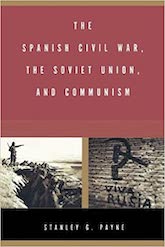
The Spanish Civil War, the Soviet Union, and Communism
Stanley Payne. The Spanish Civil War, the Soviet Union, and Communism. Yale University Press, 2004.
In this compelling book Stanley G. Payne offers the first comprehensive narrative of Soviet and Communist intervention in the revolution and civil war in Spain. He documents in unprecedented detail Soviet strategies, Comintern activities, and the role of the Communist party in Spain from the early 1930s to the end of the civil war in 1939. Drawing on a very broad range of Soviet and Spanish primary sources, including many only recently available, Payne changes our understanding of Soviet and Communist intentions in Spain, of Stalin’s decision to intervene in the Spanish war, of the widely accepted characterization of the conflict as the struggle of fascism against democracy, and of the claim that Spain’s war constituted the opening round of World War II. The author arrives at a new view of the Spanish Civil War and concludes not only that the Democratic Republic had many undemocratic components but also that the position of the Communist party was by no means counterrevolutionary.
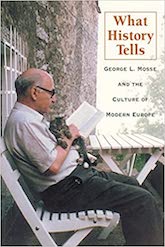
What History Tells: George L. Mosse and the Culture of Modern Europe
Stanley Payne (Editor), and David J. Sorkin (Editor). What History Tells: George L. Mosse and the Culture of Modern Europe. University of Wisconsin Press, 2003.
What History Tells presents an impressive collection of critical papers from the September 2001 conference “An Historian’s Legacy: George L. Mosse and Recent Research on Fascism, Society, and Culture.” This book examines his historiographical legacy first within the context of his own life and the internal development of his work, and secondly by tracing the many ways in which Mosse influenced the subsequent study of contemporary history, European cultural history and modern Jewish history. The contributors are Steven E. Aschheim, David Sabean, Johann Sommerville, Emilio Gentile, Roger Griffin, Saul Friedländer, Jay Winter, Rudy Koshar, Robert Nye, Janna Bourke, Shulamit Volkov, and Emmanuel Sivan.
Historia de España. 13: La época de Franco. La España del régimen 1939-1975
Stanley Payne. Historia De España. 13: La época De Franco. La España Del régimen 1939-1975. Espasa-Calpe, 2000.
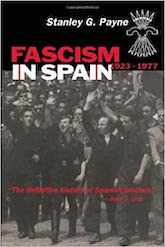
Fascism in Spain, 1923–1977
Stanley Payne. Fascism in Spain, 1923–1977. University of Wisconsin Press, 2000.
Fascism in Spain, 1923–1977, by celebrated historian Stanley G. Payne, is the most comprehensive history of Spanish fascism to appear in any language. This authoritative study offers treatment of all the major doctrines, personalities, and defining features of the Spanish fascist movement, from its beginnings until after the death of General Francisco Franco in 1975. Payne describes and analyzes the development of the Falangist party both prior to and during the Spanish Civil War, presenting a detailed analysis of its transformation into the state party of the Franco regime—Falange Española Tradicionalista—as well as its ultimate conversion into the pseudofascist Movimiento Nacional. Payne devotes particular attention to the crucial years 1939–1942, when the Falangists endeavored to expand their influence and convert the Franco regime into a fully Fascist system. Fascism in Spain helps us to understand the personality of Franco, the way in which he handled conflict within the regime, and the reasons for the long survival of his rule. Payne concludes with the first full inquiry into the process of “defascistization,” which began with the fall of Mussolini in 1943 and extended through the Franco regime’s later efforts to transform the party into a more viable political entity.
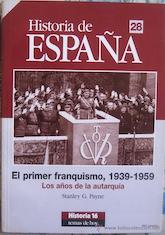
El Primer Franquismo, 1939-1959: Los Anos de la autarquia
Stanley Payne. El Primer Franquismo, 1939-1959: Los Anos De La autarquia. Temas de Hoy, 1997.
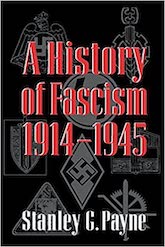
A History of Fascism, 1914–1945
Stanley Payne. A History of Fascism, 1914–1945. University of Wisconsin Press, 1996.
“A History of Fascism is an invaluable sourcebook, offering a rare combination of detailed information and thoughtful analysis. It is a masterpiece of comparative history, for the comparisons enhance our understanding of each part of the whole. The term ‘fascist,’ used so freely these days as a pejorative epithet that has nearly lost its meaning, is precisely defined, carefully applied and skillfully explained. The analysis effectively restores the dimension of evil.” —Susan Zuccotti, The Nation
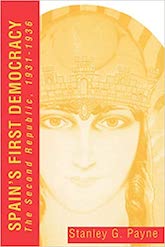
Spain’s First Democracy The Second Republic, 1931–1936
Stanley Payne. Spain’s First Democracy The Second Republic, 1931–1936. University of Wisconsin Press, 1993.
The significance of Spain’s Second Republic has been largely overshadowed by the cataclysmic Civil War that immediately followed it. Stanley Payne brings his immense knowledge of Spanish history to bear on the five-year span of the Second Republic as a historic entity in its own right. In Spain’s First Democracy, he argues that the Republic was one of the major national attempts at political democratization and reform in Europe between the World Wars and represented the most important effort to swim against the tide during Europe’s “era of fascism.” Payne’s detailed study places the Republic within the historical framework of Spanish liberalism and the rapid modernization of interwar Europe, which was unlike any other period in Spain’s history. Payne discusses the Republicans’ efforts to establish Spain’s first democratic political systems and to institute major reforms within the Republic. In highlighting reforms in politics and government, church-state relations, education and culture, public works, military affairs, and society as a whole, he assesses the successes and failures of these reforms as well as the reasons for their limitations. He also examines the economic and foreign policy issues of the period. Focusing particularly on political conflict and social cleavage, Payne brilliantly explores the sources and character of the political polarization that developed as a result of the assaults on the Republic from the Left and the Right. He identifies the main political actors in this schism and their role in the eventual breakdown of the Republic. Tracing the progressive collapse of the Republican polity in the first half of 1936, Payne stresses the importance of political violence in the democracy’s downfall. In restoring perspectives that have been ignored or bypassed, Payne presents a consistent and detailed interpretation of Spain’s Second Republic, demonstrating its striking parallels to the Weimar Republic in Germany.
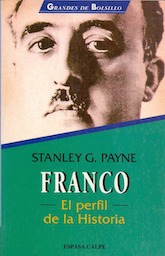
Franco: El perfil de la historia
Stanley Payne. Franco: El Perfil De La historia. Planeta-DeAgostini, 1992.
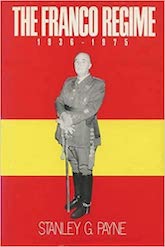
The Franco Regime, 1936-1975
Stanley Payne. The Franco Regime, 1936-1975. University of Wisconsin Press, 1988.
The history of modern Spain is dominated by the figure of Francisco Franco, who presided over one of the longest authoritarian regimes of the twentieth century. Between 1936 and the end of the regime in 1975, Franco’s Spain passed through several distinct phases of political, institutional, and economic development, moving from the original semi-fascist regime of 1936–45 to become the Catholic corporatist “organic democracy” under the monarchy from 1945 to 1957. Distinguished historian Stanley G. Payne offers deep insight into the career of this complex and formidable figure and the enormous changes that shaped Spanish history during his regime.
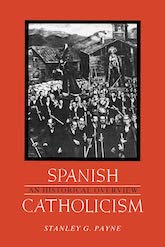
Spanish Catholicism: An Historical Overview
Stanley Payne. Spanish Catholicism: An Historical Overview. University of Wisconsin Press, 1984.
“This is the first complete history of Spanish Catholicism in English. The history of the Spanish church is rich, complex, and controversial, and this enormous undertaking by Stanley Payne is all the more praiseworthy in view of his determination not to limit his study to the church alone, but to investigate the relationship between the Catholic Church and Spanish culture and nationhood in general.” —Isaac Aviv, Mediterranean Historical Review
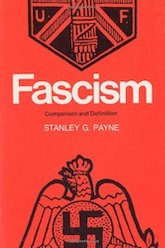
Fascism: Comparison and Definition
Stanley Payne. Fascism: Comparison and Definition. University of Wisconsin Press, 1980.
“An impressive review of reputed fascist movements, at once setting them apart from other authoritarian nationalist organizations and bringing them together within a qualified generic category. Running throughout the volume, and valuable to readers at every level, is a careful critique of the major debates that divide scholars on this most unintelligible ‘ism’ of them all. Payne precisely defines issues, cites the best literature in the major European languages, and offers with moderation and intelligence his own conclusions on the question.” —Gilbert Allardyce, American Historical Review
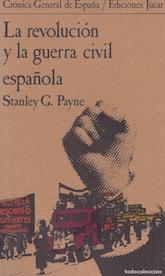
La revolución y la guerra civil española
Stanley Payne. La revolución Y La Guerra Civil española. Ediciones Júcar, 1976.
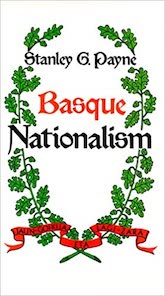
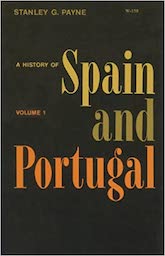
A History of Spain and Portugal
Stanley Payne. A History of Spain and Portugal. University of Wisconsin Press, 1973.
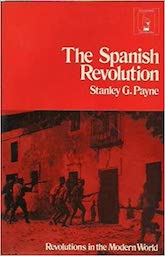
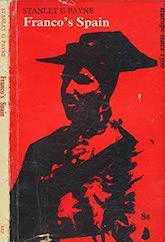
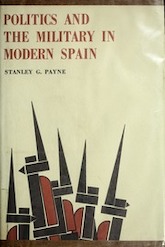
Politics and the Military in Modern Spain
Stanley Payne. Politics and the Military in Modern Spain. Stanford University Press, 1967.
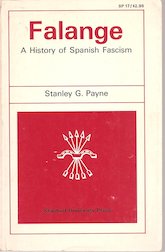
Falange: A History of Spanish Fascism
Stanley Payne. Falange: A History of Spanish Fascism. Stanford University Press, 1961.