
Biography
Biography
I study the history of biology in the nineteenth and twentieth centuries, mainly in Europe. I am especially interested in the history of investigation into the organization of living things, the social organization of the sciences that study them, and relations between elite and popular science. My current research examines the history of ideas about biological individuality, parts, and wholes in nineteenth-century Europe, and their relationship to broader cultural and political movements. Beyond my research, I’m interested in rethinking how the discipline of the history of science should situate itself in relation to other disciplines and within our larger culture.
Education
Ph.D., University of Pennsylvania, History and Sociology of Science, 1986
M.A., University of Pennsylvania, History and Sociology of Science, 1982
A.B., Princeton University, History/History and Philosophy of Science, 1979
Books
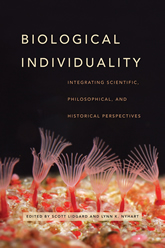
Biological Individuality: Integrating Scientific, Philosophical, and Historical Perspectives
Lidgard, Scott (Co-editor), and Lynn K. Nyhart (Co-editor). Biological Individuality: Integrating Scientific, Philosophical, and Historical Perspectives. University of Chicago Press, 2017.
Individuals are things that everybody knows—or thinks they do. Yet even scholars who practice or analyze the biological sciences often cannot agree on what an individual is and why. One reason for this disagreement is that the many important biological individuality concepts serve very different purposes—defining, classifying, or explaining living structure, function, interaction, persistence, or evolution. Indeed, as the contributors to Biological Individuality reveal, nature is too messy for simple definitions of this concept, organisms too quirky in the diverse ways they reproduce, function, and interact, and human ideas about individuality too fraught with philosophical and historical meaning. Bringing together biologists, historians, and philosophers, this book provides a multifaceted exploration of biological individuality that identifies leading and less familiar perceptions of individuality both past and present, what they are good for, and in what contexts. Biological practice and theory recognize individuals at myriad levels of organization, from genes to organisms to symbiotic systems. We depend on these notions of individuality to address theoretical questions about multilevel natural selection and Darwinian fitness; to illuminate empirical questions about development, function, and ecology; to ground philosophical questions about the nature of organisms and causation; and to probe historical and cultural circumstances that resonate with parallel questions about the nature of society. Charting an interdisciplinary research agenda that broadens the frameworks in which biological individuality is discussed, this book makes clear that in the realm of the individual, there is not and should not be a direct path from biological paradigms based on model organisms through to philosophical generalization and historical reification.
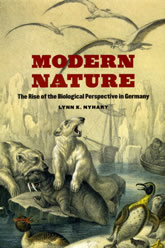
Modern Nature: The Rise of the Biological Perspective in Germany
Lynn K. Nyhart. Modern Nature: The Rise of the Biological Perspective in Germany. University of Chicago Press, 2009.
In Modern Nature,Lynn K. Nyhart traces the emergence of a “biological perspective” in late nineteenth-century Germany that emphasized the dynamic relationships among organisms, and between organisms and their environment. Examining this approach to nature in light of Germany’s fraught urbanization and industrialization, as well the opportunities presented by new and reforming institutions, she argues that rapid social change drew attention to the role of social relationships and physical environments in rendering a society—and nature—whole, functional, and healthy. This quintessentially modern view of nature, Nyhart shows, stood in stark contrast to the standard naturalist’s orientation toward classification. While this new biological perspective would eventually grow into the academic discipline of ecology, Modern Nature locates its roots outside the universities, in a vibrant realm of populist natural history inhabited by taxidermists and zookeepers, schoolteachers and museum reformers, amateur enthusiasts and nature protectionists. Probing the populist beginnings of animal ecology in Germany, Nyhart unites the history of popular natural history with that of elite science in a new way. In doing so, she brings to light a major orientation in late nineteenth-century biology that has long been eclipsed by Darwinism.
Science and Civil Society
Thomas H. Broman (Editor), and Lynn K. Nyhart (Editor). Science and Civil Society. University of Chicago Press, 2002.
This volume explores the varieties of relationships formed between science and civil society, at both the conceptual and institutional levels, since the late seventeenth century. It brings together general historians and historians of science with different national perspectives to confront the various ways sin which science and civil society have shaped one another in different times and places. How, when, and why did science become intertwined in the network of voluntary associations, professional groups and other institutions we understand as comprising “civil society”? How has science affected the ideology of civil society and thus the legitimacy of political authority in historical contexts as different as late eighteenth-century America, mid nineteenth-century Germany, and early twentieth-century China? How have scientists made use of the ideological links between science and civil political discourse to further their own professional ends? In contrast to much recent writing on civil society, this volume does not aim at making normative pronouncements about the role of civil society in promoting democratic polities, nor does it attempt to weigh the role of science in democracy. Instead, the essays examine how the fruitful interplay of beliefs concerning science and civil society has worked to legitimize the institutional forms of civil society and naturalize its ideologies, while at the same time giving to science its overwhelmingly powerful role in public life.
Biology Takes Form: Animal Morphology and the German Universities, 1800-1900
Lynn K. Nyhart. Biology Takes Form: Animal Morphology and the German Universities, 1800-1900. University of Chicago Press, 1995.
Morphology—the study of form—is often regarded as a failed science that made only limited contributions to our understanding of the living world. Challenging this view, Lynn Nyhart argues that morphology was integral to the life sciences of the nineteenth century. Biology Takes Form traces the development of morphological research in German universities and illuminates significant institutional and intellectual changes in nineteenth-century German biology. Although there were neither professors of morphology nor a morphologists’ society, morphologists achieved influence by “colonizing” niches in a variety of disciplines. Scientists in anatomy, zoology, natural history, and physiology considered their work morphological, and the term encompassed research that today might be classified as embryology, systematics, functional morphology, comparative physiology, ecology, behavior, evolutionary theory, or histology. Nyhart draws on research notes, correspondence, and other archival material to examine how these scientists responded to new ideas and to the work of colleagues. She examines the intertwined histories of morphology and the broader biological enterprise, demonstrating that the study of form was central to investigations of such issues as the relationships between an animal’s structure and function, between an organism and its environment, and between living species and their ancestors.
Selected Publication
- “The Political Organism: Carl Vogt on Animals and States in the 1840s and 50s,” Historical Studies in the Natural Sciences, in Special Issue: “Revolutionary Politics and Biological Organization in Nineteenth-Century Europe,” edited by Lynn K. Nyhart and Florence Vienne, forthcoming December 2017.
- Lynn K. Nyhart and Scott Lidgard: “Chapter 6: Alternation of Generations and Individuality, 1851,” in Biological Individuality, edited by Scott Lidgard and Lynn K. Nyhart. Chicago: University of Chicago Press, 2017.
- “Historiography of the History of Science,” in A Companion to the History of Science, ed. Bernard Lightman. Chichester, UK: John Wiley and Sons, 2016, pp. 7-22.
- “Wissenschaft and Kunde: The General and the Special in Modern Science” Osiris 27: When Clio Meets Science, ed. Kathryn Olesko and Robert E. Kohler. University of Chicago Press, 2012, pp. 250-275.
- “Voyaging and the Scientific Expedition Report, 1800-1940,” in Science in Print: Essays on the History of Science and the Culture of Print, ed. Greg Downey, Rima Apple, and Christine Pawley. Madison: University of Wisconsin Press, 2012, pp. 65-86.
- “Emigrants and Pioneers: Moritz Wagner’s ‘Law of Migration’ in Context.” In Knowing Global Environments: New Historical Perspectives in the Field Sciences, ed. Jeremy Vetter. New Brunswick, NJ: Rutgers University Press, 2010, pp. 39-58.
- “Civic and Economic Zoology in Nineteenth-Century Germany: The Living Communities of Karl Möbius.” Isis, December 1998, 89: 605-630.
Courses Taught
- History 500 – Reading Seminar in History: Science above Politics? An Inconvenient History – Syllabus 2022 (pdf)
- History of Science 132 – Bees, Trees, Germs, and Genes: A History of Biology – Syllabus 2023 (pdf)
- History of Science 286 – Science above Politics? An Inconvenient History – Syllabus 2019 (pdf)
- History of Science 333 – History of Modern Biology – Syllabus 2015 (pdf)
- History of Science 343 – The Darwinian Revolution – Syllabus 2020 (pdf)
- History of Science 555 – Making Visible (capstone) – Syllabus 2014 (pdf)
- History of Science 720 – Introduction to Historiography and Methods – Syllabus 2021 (pdf)
- History of Science 909 – Nationalism, Internationalism, and Transnationalism in the Modern Life Sciences
- History of Science 909 – The New History of Natural History – Syllabus 2017 (pdf)