Biography
Biography
My specializations are Revolutionary America, historical memory, the South to 1835, and slavery in the Atlantic world.
Education
Ph.D., University of Virginia
M.A., University of Nebraska
B.A., Carroll College
Books
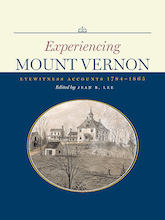
Experiencing Mount Vernon: Eyewitness Accounts, 1784–1865
Jean Lee. Experiencing Mount Vernon: Eyewitness Accounts, 1784–1865. University of Virginia Press, 2006.
George Washington, acutely aware of the accomplishments and potential of the American Revolution, used his Mount Vernon estate both to preserve the memory of events that had created a new nation and to forward his keen vision of what that nation might become. During the 1780s and 1790s, an era when neither public museums nor a national library existed, visitors to Mount Vernon viewed John Trumbull’s iconic image of the signing of the Declaration of Independence, Houdon’s famous bust of the countryís preeminent hero, and Washington’s voluminous wartime correspondence. More important, they listened as the Washingtons recalled the remarkable events that had forged independence and the unique American experiment in representative government. At Mount Vernon, too, Washington and his guests discussed how best to secure the success and well-being of the United States. Here was a place to contemplate “what the nation, at its best, might be.” Following George and Martha Washington’s deaths, the estate passed to four successive heirs, the last of whom deeded it to the Mount Vernon Ladies’ Association in 1860. While still in private hands, the property nonetheless attracted thousands of visitors each year, most of whom arrived after a fifteen-mile overland trek from Washington, D.C. With the establishment of regular steamboat access in the 1850s, the numbers swelled to ten thousand annually. The public claimed Mount Vernon as its own. In the words of a nineteenth-century Washington family member, “the Nation shares it with us.” In a remarkable display of civic religion that testified to the siteís enormous hold on the public imagination, Americans pronounced Mount Vernon sacred ground and made it the nationís most important site of revolutionary memory and inspiration. The sacred ground was, nonetheless, contested ground: visitors criticized the heirs’ management of the property; northerners abhorred the persistence of slavery at the estate. As pilgrims contemplated the highest ideals of the Revolution at Washington’s home and tomb, they often found their own society wanting. Amid escalating sectional strife in the 1850s, some argued that if Mount Vernon could be saved for the nation, the nation might be preserved from ruin. In letters and journals, newspaper and magazine articles, and public speeches, visitors recorded, often in detail and with intense emotion, their varied reactions to the site. Experiencing Mount Vernon presents the most informative of these accounts, as well as selected documents from the Washington owners (beginning with Washington himself, who in 1784 prematurely wrote Lafayette that, at his beloved home, he had “retired from all public employments”). Numerous maps, contemporary images, and annotations complement the texts. This book constitutes the only eyewitness chronicle we have of the Washington estate’s ascent to the status of national shrine, and it offers the closest possible evidence of Mount Vernonís singular role in helping forge American national identity.
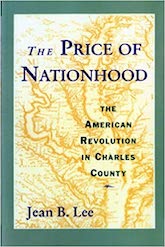
The Price of Nationhood: The American Revolution in Charles County
Jean Lee. The Price of Nationhood: The American Revolution in Charles County. W. W. Norton & Company, 1994.
‘A detailed portrait of colonial and revolutionary times that gradually becomes a convincing miniature.’ —Washington Post ‘An insightful study of the transforming power of revolution and war…. Meticulously organized and lucidly written,… it is from first to last a model of narrative history.’ —Journal of Military History ‘A vivid portrait of a country and a region at war, rich with detail of how the prologue to the war and the conduct of it changed the lives of everyone who lived within the country’s borders—men, women, slaves, merchants, farmers, financiers.’ —Wall Street Journal ‘The price of Nationhood offers us a richly textured portrait of a people struggling to preserve a familiar world even as they created a new one. It is local history as its best.’ —Journal of American History
Selected Publications
- “Historical Memory, Sectional Strife, and the American Mecca: Mount Vernon, 1783-1853,” Virginia Magazine of History and Biography (2001), awarded the Rachal Prize for best article in VMHB in 2001.
Awards
- American Association for State and Local History
- David Library of the American Revolution
- Danforth Foundation
- Institute of Early American History and Culture
- National Endowment for the Humanities
- Virginia Foundation for the Humanities and Public Policy
- Virginia Historical Society
- Winterthur Museum and Library
- UW–Madison (Chancellor’s Collaborative Teaching Award for Senior Faculty; Institute for Research in the Humanities; Vilas Associateship)
History Courses Taught
- History 101 – American History to Civil War Era
- History 200 – Historical Studies
- History 344 – American Revolution 1763-1789
- History 464 – Dimension of Material Culture
- History 500 – Reading Seminar in History
- History 600 – Advanced Seminar in History
- History 901 – Studies in American History
- History 902 – Research Seminar: Americna History