
Susan E. Lederer
Robert Turell Professor of Medical History and Bioethics
608.262.4195
Office: 1420 Medical Sciences Center
Office Hours: TBA
Joint Appointment: Medical History & Bioethics
My interests include Medicine and society in twentieth-century America; race, medicine, and public health; medicine and popular culture; research ethics; and history of medical ethics.
Education
Ph.D., University of Wisconsin–Madison, History of Science, 1987
M.A., University of Wisconsin–Madison, History of Science, 1979
B.A., Johns Hopkins University, History of Science, 1977
Books
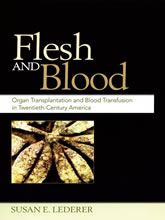
Flesh and Blood: Organ Transplantation and Blood Transfusion in 20th Century America
Susan E. Lederer. Flesh and Blood: Organ Transplantation and Blood Transfusion in 20th Century America. Oxford University Press, 2008.
Organ transplantation is one of the most dramatic interventions in modern medicine. Since the 1950s thousands of people have lived with ‘new’ hearts, kidneys, lungs, corneas, and other organs and tissues transplanted into their bodies. From the beginning, though, there was simply a problem: surgeons often encountered shortages of people willing and able to give their organs and tissues. To overcome this problem, they often brokered financial arrangements. Yet an ethic of gift exchange coexisted with the ‘commodification of the body’. The same duality characterized the field of blood transfusion, which was essential to the development of modern surgery.
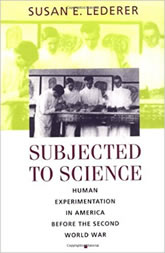
Subjected to Science: Human Experimentation in America before the Second World War
Susan E. Lederer. Subjected to Science: Human Experimentation in America before the Second World War. Johns Hopkins University Press, 1995.
Long before the U.S. government began conducting secret radiation and germ-warfare experiments, and long before the Tuskegee syphilis experiments, medical professionals had introduced—and hotly debated the ethics of—the use of human subjects in medical experiments. In Subjected to Science, Susan Lederer provides the first full-length history of biomedical research with human subjects in the earlier period, from 1890 to 1940. Lederer offers detailed accounts of experiments—benign and otherwise—conducted on both healthy and unhealthy men, women, and children, including the yellow fever experiments (which ultimately became the subject of a Broadway play and Hollywood film), Udo Wile’s “dental drill” experiments on insane patients, and Hideyo Noguchi’s syphilis experiments, which involved injecting a number of healthy children and adults with the syphilis germ, luetin.
Selected Publications
- “Dark Victory: Cancer and Popular Hollywood Film,” Bulletin of the History of Medicine 81 (2007), 94-115.
- “Experimentation on Human Beings,” Organization of American Historians Magazine of History 19:5 (2005), 20-22.
- “Banking on the Body: Historical Perspectives on the Sale of Flesh and Blood,” ISPS Journal 5 (2005), 67-76.
- “Children as Guinea Pigs: Historical Perspectives,” Accountability in Research 10 (2003), 1-16.
Advisor To
Courses Taught
- History of Science 523 – Race, American Medicine and Public Health – Syllabus 2020 (pdf)
- MHB 668 – Seminar: Fat and Thin: Making American Bodies