
Dana Landress
Assistant Professor of Medical History and Bioethics
Office: Room 1411, Medical Sciences Center
Office Hours: TBA
Joint Appointment: Medical History & Bioethics
Photo credit: Dr. Robert Streiffer
I am a historian of 19th and 20th century medicine and public health in the United States. My research examines the relationship between nutritional disease, community health work, and the political economy of capitalism in the U.S. South. Methodologically, my research blends the approaches and insights of social history, labor history, and oral history. I am especially interested in histories of structural racism, economic inequality, and community health activism as they pertain to patient encounters with medicine and public health. Additionally, I study histories of southern foodways, diasporic culinary traditions, and medicinal remedies of the rural South. Currently, I am at work on two projects. My first book (under contract with the University of Chicago Press) details the social history of pellagra, a nutritional deficiency disease, and its prevalence in the U.S. South across the early 20th century. I am also at work on an edited volume (under contract with the Vanderbilt University Press) which features the collaborative work of scholars, activists, and healthcare providers to document community healthcare interventions across the U.S. South in the wake of the Covid-19 pandemic.
My writing has been featured in The Journal of the History of Medicine and Allied Sciences, The Journal of the American Medical Association, Gastronomica: The Journal of Food Studies, and is forthcoming in the Journal of Southern History. I currently serve as an advisory editor for Isis: A Journal of the History of Science Society.
My research has been supported by grants from the American Association of University Women (AAUW), the Andrew W. Mellon Foundation, and the Council on Library and Information Resources.
Education
Ph.D., University of California, Berkeley
M.A., University of California, Berkeley
B.A., University of North Carolina at Chapel Hill
Book
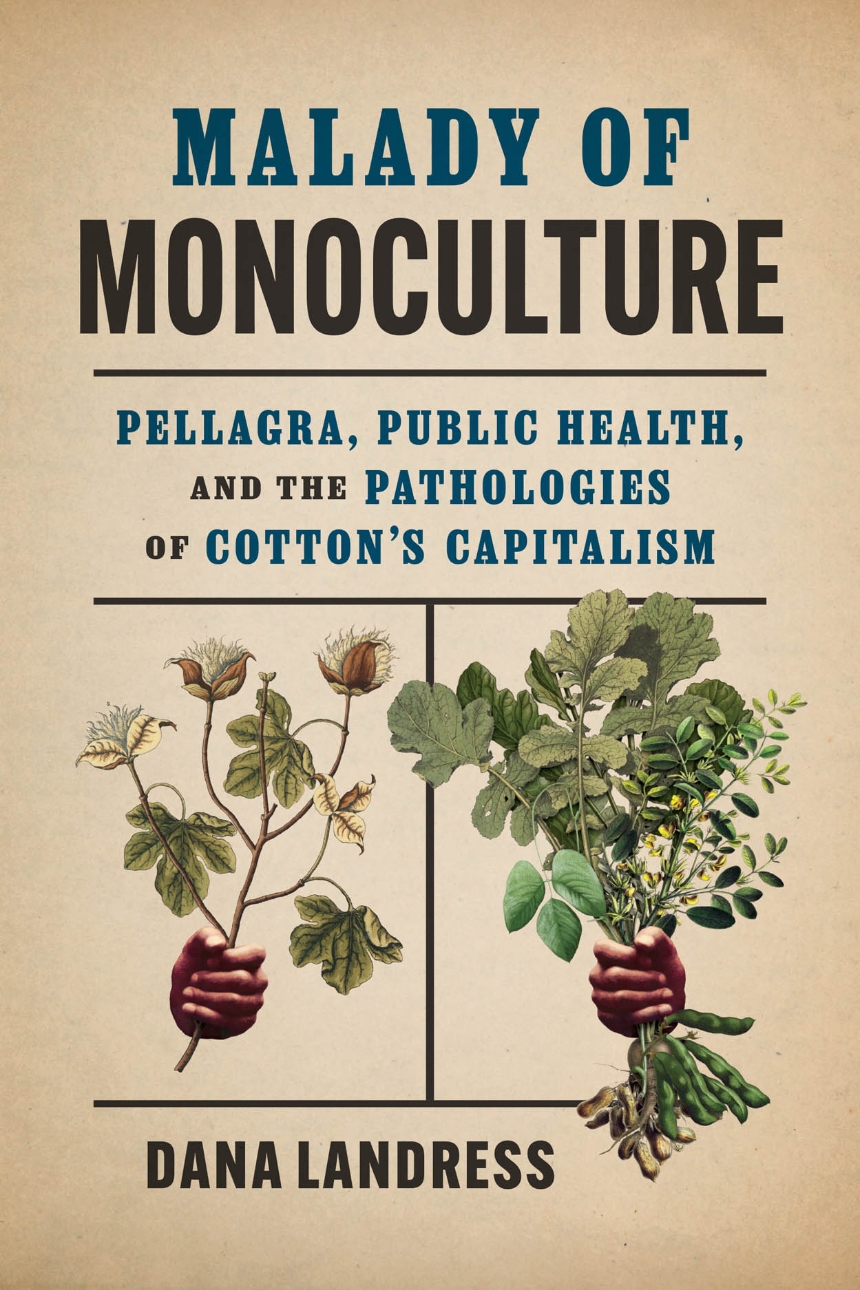
Malady of Monoculture
Pellagra, Public Health, and the Pathologies of Cotton’s Capitalism
In Malady of Monoculture, Dana Landress reveals how the unrelenting demands of the cotton economy during the Jim Crow South created a public health crisis in the form of pellagra. She carefully details a “closed food system” that restricted workers’ diets through employer-generated currency; the use of food as an instrument of labor compulsion; manufactured debt structures; alliances between government and private industry; and restrictions on foraging, gardening, and land use. Though official public health programs framed pellagra in personal and behavioral terms, those afflicted with the illness actively challenged the closed food system through union organizing, community health care, freedom farms, and collective action lawsuits. Excavating the landmark contributions of Black nutritionists to the field of public health, Landress spotlights the many constituencies that worked tirelessly to combat hunger and foregrounds their creativity, resilience, and determination.
https://press.uchicago.edu/ucp/books/book/chicago/M/bo279113788.html
Selected Publications
Academic
- Dana Landress, “Famished for Freedom: Pellagra and Medical Clemency at the Mississippi State Penitentiary” Journal of the History of Medicine and Allied Sciences (80, no. 02, Jan. 2025). https://doi.org/10.1093/jhmas/jrae048
- Dana Landress, “The Pellagra Portraits” Journal of the American Medical Association Vol. 331, no. 3 (January 12, 2024). https://jamanetwork.com/journals/jama/fullarticle/2814113
- Searching for Dr. Harris: The Life and Times of a Remarkable African American Physician By Margaret Humphreys (UNC Press, 2024), Book Review forthcoming in the Journal of Southern History, https://www.thesha.org/contents
- Dana Landress, (Book Review in Gastronomica: The Journal for Food Studies) Violent Appetites: Hunger in the Early Northeast, Carla Cevasco, New Haven, CT: Yale University Press 2022, 256 pp. $50.00 (hardcover); (eBook). https://online.ucpress.edu/gastronomica/article/23/2/105/196229/Review-Violent-Appetites-Hunger-in-the-Early
Public-Facing
- Listen to my interview on the James Beard nominated podcast, “Eat This!” https://podcasts.apple.com/us/podcast/pellagra/id612994662?i=1000714175085https://doi.org/10.1093/jhmas/jrae048
- Connecting Through Literature, Media, and the Museum – AAHM Webinar Series https://www.youtube.com/watch?v=fsw3FGiYqhk
- CBS 58 – Milwaukee CBS Interview, “Discovered Documents Reveal More About Milwaukee County Insane Asylum”
- Channel 3000 News, “UW Study Focuses on Recruiting Black Participants to Make Alzheimer’s Research More Inclusive”
Advisor To
- Kayleigh Larsen
Selected Awards
- First Book Award, UW Madison Center for the Humanities, 2025
- Partnership Program in Graduate Excellence, UW Office of the Vice Chancellor, 2024
- American Association of University Women Fellowship, 2021-2022
- Andrew W. Mellon and Council on Library and Information Resources Fellowship, 2019-2020
- U.C. Berkeley School of Public Health Research Award, 2019
- Southern Historical Collection Dissertation Research Fellowship, 2019
History Courses Taught
- History of Science 360 – Health Inequalities in the Long 20th Century
- History of Science/MedHist 509 – The Development of Public Health in America – Syllabus 2023 (pdf)