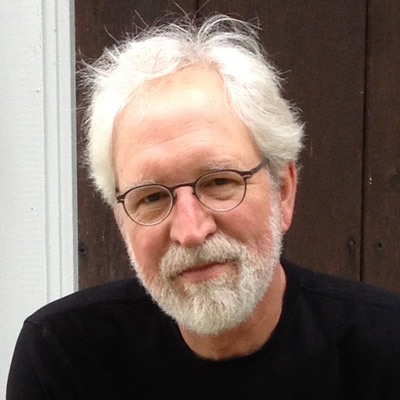
Biography
Biography
Rudy Koshar retired in May 2018 after thirty-eight years of teaching (twenty-seven at UW–Madison and eleven at the University of Southern California). He was the George L. Mosse / Wisconsin Alumni Research Foundation Professor of History, German, and Religious Studies. During his career he wrote on a variety of subjects, including the social roots of Nazism, German memory and historic environments, and the history of automobility and mass leisure in modern Europe and Germany. His books include Social Life, Local Politics, and Nazism (North Carolina, 1986); Germany’s Transient Pasts (North Carolina, 1998); From Monuments to Traces (California, 2000); and German Travel Cultures (Berg, 2000). He has received national and international fellowships from the Guggenheim Foundation; American Council of Learned Societies; German Academic Exchange Service; German Marshall Fund; Max Planck Institute for History in Göttingen, Germany; and the European University Institute in Florence, Italy. At UW–Madison, he has held a number of fellowships, including a senior fellowship at the Institute for Research in the Humanities (1998-2003), and a Wisconsin Alumni Research Foundation Fellowship. In 2008 he won a Chancellor’s Distinguished Teaching Award. In 2010, he began writing literary and historical fiction, and has since published forty-five short stories. His short fiction has been recognized with several awards, including second place in the Wisconsin Academy of Sciences, Arts & Letters Annual Fiction Prize competition (2013); a Pushcart Prize nomination (2015); and a Notable Story award in storySouth’s Million Writers’ competition (2016).
Education
Ph.D., University of Michigan
M.A., University of Michigan
B.A., Michigan State
Books
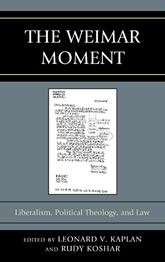
The Weimar Moment Liberalism, Political Theology, and Law
Rudy J. Koshar (Editor). The Weimar Moment Liberalism, Political Theology, and Law. Lexington Books, 2012.
The Weimar Moment’s evocative assault on closure and political reaction, its offering of democracy against the politics of narrow self-interest cloaked in nationalist appeals to Volk and “community”—or, as would be the case in Nazi Germany, “race”—cannot but appeal to us today. This appeal—its historical grounding and content, its complexities and tensions, its variegated expressions across the networks of power and thought—is the essential context of the present volume, whose basic premise is unhappiness with Hegel’s remark that we learn no more from history than we cannot learn from it. The challenge of the papers in this volume is to provide the material to confront the present effectively drawing from what we can and do understand.
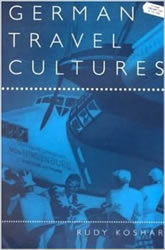
German Travel Cultures
Rudy J. Koshar. German Travel Cultures. Oxford, 2000.
Travel guidebooks are an important part of contemporary culture, but we know relatively little about their history and importance to the evolution of tourism. Germany not only produced the first international standard for travel handbooks, the Baedeker, but also became a major tourist destination early in the twentieth century. This is the first comprehensive discussion of the history of tourist guidebooks for any modern nation.Selecting representative texts – the first Baedeker to unified Germany, guides to Berlin sex life and sites of Nazi martyrdom, a tour guide for the German worker and American tourbooks to West Germany – this fascinating study relates the history of tourist literature to the formation of distinct ‘travel cultures’ oriented to specific audiences, tastes and ideologies.
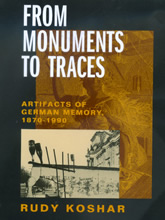
From Monuments to Traces: Artifacts of German Memory, 1870-1990
Rudy J. Koshar. From Monuments to Traces: Artifacts of German Memory, 1870-1990. University of California Press, 2000.
Rudy Koshar constructs a powerful framework in which to examine the subject of German collective memory, which for more than a half century has been shaped by the experience of Nazism, World War II, and the Holocaust. Finding the assumptions of many writers and scholars shortsighted, Koshar surveys the evidence of postwar German memory in the context of previous traditions. From Monuments to Traces follows the evolution of German “memory landscapes” all the way from national unification in 1870-71 through the world wars and political division to reunification in 1990. The memory landscapes of any society may incorporate monuments, historical buildings, memorials and cemeteries, battlefields, streets, or natural environments that foster shared memories of important events or personalities. They may also be designed to divert public attention from embarrassing or traumatic histories. Koshar argues that in Germany, memory landscapes have taken shape according to four separate paradigms–the national monument, the ruin, the reconstruction, and the trace–which he analyzes in relation to the changing political agendas that have guided them over time. Despite the massive ruptures of Germany’s history, we see that significant continuities have served to counterbalance the traumas of the German past.
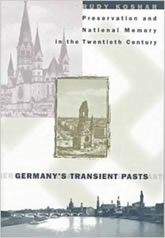
Germany’s Transient Pasts: Historical Preservation and National Memory in Twentieth Century Germany
Rudy J. Koshar. Germany’s Transient Pasts: Historical Preservation and National Memory in Twentieth Century Germany. Chapel Hill: University of North Carolina Press, 1998.
Over the course of the twentieth century, Germans have venerated and maintained a variety of historical buildings–from medieval fortresses and cathedrals to urban districts and nineteenth-century working-class housing. But the practice of historic preservation has sometimes proven controversial, as different groups of Germans have sought to use historical architecture to represent competing versions of their nation’s history. Transient Pasts is the first book to examine the role that the historic preservation movement has played in German cultural history and memory from the end of the nineteenth century to the early 1970s. Focusing on key public debates over historic preservation, Rudy Koshar charts a trajectory of cultural politics in which historical architecture both facilitated and limited Germans’ efforts to identify as a nation. He demonstrates that historical buildings and monuments have served as enduring symbols of national history in a country scarred by the traumas of two world wars, Nazism, the Holocaust, and political division. His findings challenge both the widely accepted argument that Germans have constantly repressed their past and the contention that Germany’s intense public engagement with history since reunification is unprecedented.
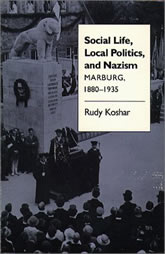
Social Life, Local Politics, and Nazism: Marburg, 1880-1935
Rudy J. Koshar. Social Life, Local Politics, and Nazism: Marburg, 1880-1935. Chapel Hill: University of North Carolina Press, 1986.
Focusing on Marburg, a contentious university town where voters demonstrated strong electoral support for Adolf Hitler’s National Socialist party, this imaginative study discusses the political role of small-town organizational life and painstakingly reconstructs the full range of Nazi sympathizers’ cross-affiliations with local voluntary groups.
Selected Awards
- Second Place, Wisconsin Academy of Sciences, Arts & Letters 2013 Fiction Contest
- Chancellor’s Distinguished Teaching Award, UW–Madison, 2008-09
- John Simon Guggenheim Memorial Foundation Fellowship
- German Marshall Fund of the United States Research Fellowship
- Jean Monnet Research Fellowship, European University Institute, Florence, Italy
- American Council of Learned Socieities Fellowship
- Wisconsin Alumni Research Foundation Professorship
History Courses Taught
- History 120 – Europe and the Modern World 1815-Present
- History 200 – Historical Studies – Topics: “Modern European Political Novels” – Syllabus 2013 (pdf)
- History 410 – Modern Germany 1871-present – Syllabus 2015 (pdf)
- History 415 – History of National Socialism
- History 470 – Religious Thought in Modern Europe – Syllabus 2009 (pdf)
- History 474 – European Social History, 1830-1914 – Syllabus 2013 (pdf)
- History 475 – European Social History, 1914 to Present – Syllabus 2017 (pdf)
- History 513 – European Cultural History, 1815-1870
- History 514 – European Cultural History 1870-present – Syllabus 2013 (pdf)
- History 600 – Christianity and Culture in Modern Europe
- History 600 – European Lives in the Twentieth Century
- History 600 – Religion and Politics in Modern Europe – Syllabus 2010 (pdf)
- History 600 – Fiction and Power in Modern Europe – Syllabus 2012 (pdf)
- History 600 – Modern European Political Novels – Syllabus 2013 (pdf)
- History 600 – Weimar Culture and the Rise of Nazism” – Syllabus 2015 (pdf)
- History 845 – Whither German Histories? – Syllabus 2017 (pdf)
- History 866 – Seminar in Social History of Modern Europe
- History 867 – Seminar in European Social and Intellectual History
- History 891 – Proseminar in Modern European History: Central Europe