
Biography
Biography
Susan Lee Johnson retired from UW–Madison in 2019 and currently holds the inaugural Harry Reid Endowed Chair for the History of the Intermountain West at the University of Nevada. Las Vegas. In 2021-22, Johnson was President of the Western History Association. A historian of western North America and its borderlands, Johnson specializes in the study of gender; of race, ethnicity, and indigeneity; and of desire and embodiment. Johnson works primarily in the nineteenth and twentieth centuries, but teaches and takes interest in the seventeenth and eighteenth centuries as well. Johnson’s scholarship has focused on relations of power in the North American West both as a place of lived experience and as an imagined space, exploring these themes in three book projects: Writing Kit Carson: Fallen Heroes in a Changing West (University of North Carolina Press 2020), Roaring Camp: The Social World of the California Gold Rush (Norton 2000), and a new project, tentatively titled “The Trail the Slaves Made,” a place-based history of how the Santa Fe Trail connected slaveries and emancipations in nineteenth-century North America: chattel slavery and its demise in the East, and, in the West, captive-taking and coerced labor, which died a different death. Johnson works with graduate students interested in multiracial histories; gender histories; U.S. western, borderlands, Pacific, and other place-based histories; Latinx, African American, American Indian, and Asian American histories; histories of sexual minorities and majorities; histories of whiteness; and social and cultural histories broadly defined. Johnson is committed to the intellectual projects of both gender/sexuality studies and ethnic/race/indigenous studies, seeing them as connected to the political project of social justice, and thus is energized by academic work that that reaches beyond the boundaries of the university.
Education
Ph.D., Yale
M.A., Arizona State University
B.A., Carthage College
Books
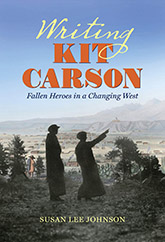
Writing Kit Carson Fallen Heroes in a Changing West
Susan Lee Johnson. Writing Kit Carson Fallen Heroes in a Changing West. University of North Carolina Press, 2020.
In this critical biography, Susan Lee Johnson braids together lives over time and space, telling tales of two white women who, in the 1960s, wrote books about the fabled frontiersman Christopher “Kit” Carson: Quantrille McClung, a Denver librarian who compiled the Carson-Bent-Boggs Genealogy, and Kansas-born but Washington, D.C.- and Chicago-based Bernice Blackwelder, a singer on stage and radio, a CIA employee, and the author of Great Westerner: The Story of Kit Carson. In the 1970s, as once-celebrated figures like Carson were falling headlong from grace, these two amateur historians kept weaving stories of western white men, including those who married American Indian and Spanish Mexican women, just as Carson had wed Singing Grass, Making Out Road, and Josefa Jaramillo.Johnson’s multilayered biography reveals the nature of relationships between women historians and male historical subjects and between history buffs and professional historians. It explores the practice of history in the context of everyday life, the seductions of gender in the context of racialized power, and the strange contours of twentieth-century relationships predicated on nineteenth-century pasts. On the surface, it tells a story of lives tangled across generation and geography. Underneath run probing questions about how we know about the past and how that knowledge is shaped by the conditions of our knowing. Published in association with the William P. Clements Center for Southwest Studies at Southern Methodist University in Dallas, Texas
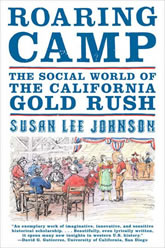
Roaring Camp: The Social World of the California Gold Rush
Susan Lee Johnson. Roaring Camp: The Social World of the California Gold Rush. W. W. Norton & Company, 2000.
Historical insight is the alchemy that transforms the familiar story of the Gold Rush into something sparkling and new. The world of the Gold Rush that comes down to us through fiction and film—of unshaven men named Stumpy and Kentuck raising hell and panning for gold—is one of half-truths. In this brilliant work of social history, Susan Johnson enters the well-worked diggings of Gold Rush history and strikes a rich lode. She finds a dynamic social world in which the conventions of identity—ethnic, national, and sexual—were reshaped in surprising ways. She gives us the all-male households of the diggings, the mines where the men worked, and the fandango houses where they played. With a keen eye for character and story, Johnson restores the particular social world that issued in the Gold Rush myths we still cherish.