
I am a historian of cross-cultural encounter, above all in West Africa, and above all at the level of religion, which is the realm of life in which Africans have been most successful at dictating the terms of their relationships with others. My 2020 book examines a mid-nineteenth century refugee crisis in a small mountain kingdom in today’s Ghana. I find that locals, who over three hundred years of encounter with Europeans on the coast had shown nearly no interest in Christianity, began to reconfigure that religion as an indigenous tool for assimilating refugees into existing social structures.
The best part about historical research is finding ways to tell stories that enlighten and astonish at the same time. I am currently working on two new book projects: a story of Ghanaian everyday life at the time of European imperial conquest, through the life story of one very fascinating individual, and a story of religious change in the early twentieth century in the borderlands of Ghana and Burkina Faso, where Christianity, Islam, and indigenous religions inform one another in constantly surprising ways.
The best part about being a historian is meeting students and hearing their stories. My favorite teaching moments have come when students begin to believe me on this matter: I want to hear all about who you are and where you have been!
Education
Ph.D, University of Wisconsin–Madison
Books
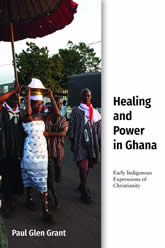
Healing and Power in Ghana: Early Indigenous Expressions of Christianity
Paul Grant. Healing and Power in Ghana: Early Indigenous Expressions of Christianity. Baylor University Press, 2020.
In nineteenth-century Ghana, regional warfare rooted in profound social and economic transformations led thousands of displaced people to seek refuge in the small mountain kingdom of Akuapem. There they encountered missionaries from Germany whose message of sin and forgiveness struck many of these newcomers as irrelevant to their needs. However, together with Akuapem’s natives, these newcomers began reformulating Christianity as a ritual tool for social and physical healing, as well as power, in a dangerous spiritual and human world. The result was Ghana’s oldest African-initiated variant of Christianity: a homegrown expression of unbroken moral, political, and religious priorities. Focusing on the southeastern Gold Coast in the middle of the nineteenth century, Healing and Power in Ghana identifies patterns of indigenous reception, rejection, and reformulation of what had initially arrived, centuries earlier, as a European trade religion. Paul Grant draws on a mixture of European and indigenous sources in several languages, building on recent scholarship in world Christianity to address the question of conversion through the lens of the indigenous moral imagination. This approach considers, among other things, the conditions in which Akuapem locals and newly arrived displaced persons might find Christianity useful or applicable to their needs. This is no traditional history of the European-African religious encounter. Ghanaian Christians identified the missionaries according to preexisting political and religious categories—as a new class of shrine priests. They resolved their own social crises in ways the missionaries were unable to understand. In effect, Christianity became an indigenous religion years before indigenous people converted in any appreciable numbers. By foregrounding the sacrificial idiom shared by locals, missionaries, and native thinkers, Healing and Power in Ghana presents a new model of scholarship for both West African history and world Christianity.
Selected Publications
- “Long Listening: Historical Creativity and Archival Endurance,” in E. Sasu Kwame Sewordor and Anne Beutter (eds.), African History Between Ghana and Switzerland (Basel: Basler Afrika Bibliographien, 2024), 68-80.
- “Continental Protestant Missions and the Evangelization of Africa (1800–1880),” in Andrew E. Barnes, and Toyin Falola (eds), The Palgrave Handbook of Christianity in Africa from Apostolic Times to the Present (Cham, Switzerland: Palgrave Macmillan, 2024), 239-253.
- “Forgiving the Missionaries: African Moral Imagination and Postcolonial Germans,” in Adam Blackler, David Pizzo, and Sara Pugach (eds.), After the Imperialist Imagination: Two Decades of Research on Global Germany and its Legacies (Oxford: Peter Lang, 2020).
- “The Effervescence of Individual Life: David Kwasi Cornelius Badu, 1849-1905 Gold Coast and Nigeria,” in Klaas van Walraven (ed.), The Individual in African History (African Dynamics 18) (Leiden: Brill, March 2020), 117-147.
- “Strangers and Neighbors in Precolonial Ghana,” Fides et Historia 50:2 (2019), 94-107
- “Ghanaian Cocoa and Global Christianity, 1900-1930,” in Alison Howell (ed.), Cocoa and Social and Religious Change in Ghana (Akropong, Ghana: Regnum Africa, 2018)
- “Biography as Counter-Narrative to Rupture: Intact Lives as Moral Problem,” in Dana Robert (ed.), African Christian Biography (Pietermaritzburg, South Africa: Cluster Publications, 2018)
- “Dying German in Ghana: Death, Belonging, and ‘Heimat’ in the Basel Mission in 19th Century Gold Coast”, Studies in World Christianity 20:01 (April 2014)
Selected Awards
- Research Fellow, Catholic University Leuven (Belgium), 2021-2022
- American Historical Association Bernadotte Schmitt research grant (Cameroon), 2021
- University of Wisconsin-Platteville, Faculty Development Grant (Mexico), 2019
- Central European History Society, Research Travel Grant (Switzerland), 2017
- African Studies Association Travel Award, 2016
- Kaplan Award in the History of Social Justice, University of Wisconsin, 2016
- Doris Quinn Dissertation Writing Fellowship, 2015-2016
- Duke University, John Hope Franklin Research Grant, 2015
- Yale Divinity School, David M. Stowe Fellowship for Mission Research, 2013
Professional Affiliations
- African Studies Association
- Ghana Studies Association
- Yale-Edinburgh Group on the History of World Christianity
History Courses
- History 105 – Africa since 1870 – Syllabus 2022 (pdf)
- History 120 – Europe since 1815 – Syllabus 2021 (pdf)
- History 130 – Introduction to World History – Syllabus 2025 (pdf)
- History 201 – The Historian’s Craft: Migration in World History – Syllabus 2026 (pdf)
- History 201 – The Historian’s Craft: Global Christianities – Syllabus 2026 (pdf)
- History 229 – Explorations in Transnational/Comparative History
- History 401 – Public History Workshop: International Student Biography – Syllabus 2026 (pdf)
- History 500 – Reading Seminar in History: Life Stories of the Undefeated – Syllabus 2024 (pdf)
- History 500 – Reading Seminar in History: Biography—Methods, Ethics, and Theory – Syllabus 2025 (pdf)