
Biography
Biography
My general field of study is early modern Europe, with a focus on early modern France and the French Revolution. My research and teaching interests include popular politics and political activism, especially during the French revolutionary and Napoleonic era; gender; family; the Enlightenment; the transnational circulation of ideas, people, and practices; early modern European popular culture and religion; historical methods and social theory. My current book project examines the October Days uprising of 1789 during the French Revolution.
Education
Ph.D., University of California – Berkeley
M.A., University of California – Berkeley
B.A., Princeton University
Books
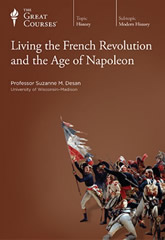
Video and Audio Course: Living the French Revolution and the Age of Napoleon
Suzanne Desan. Video and Audio Course: Living the French Revolution and the Age of Napoleon. The Great Courses, 2013.
In one of the most pivotal and exciting eras of European history, the French Revolution and Napoleonic Empire stunned the world and wrenched Europe toward modernity. The Revolution overthrew the monarchy to create a republic, leveled the aristocracy, replaced Catholicism with goddesses of liberty, set up Sister Republics in Europe, and sparked slave revolt in the French Caribbean. This radical experiment in democracy also unleashed the Terror and launched Napoleon Bonaparte, the brilliant politician and general who built an astonishing European Empire. Tracing events from the Old Regime court at Versailles to Napoleon’s fall at Waterloo, this course weaves together political and social analysis with personal stories: Marie-Antoinette, Robespierre, and Napoleon rub shoulders with workers storming the Bastille, women rioting for bread, and soldiers crossing Russia. The lectures also address big questions: Why did the ideals of “liberty and equality” become mired in Terror? How did the Revolution and Napoleonic Empire lay the foundations of modern politics, lead to the restructuring of Europe, and create repercussions from Haiti to India?
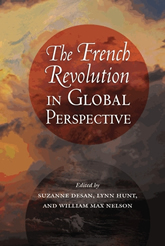
The French Revolution in Global Perspective
Suzanne Desan (Co-editor), Lynn Hunt (Co-editor), and William Max Nelson (Co-editor). The French Revolution in Global Perspective. Cornell University Press, 2013.
Situating the French Revolution in the context of early modern globalization for the first time, this book offers a new approach to understanding its international origins and worldwide effects. A distinguished group of contributors shows that the political culture of the Revolution emerged out of a long history of global commerce, imperial competition, and the movement of people and ideas in places as far flung as India, Egypt, Guiana, and the Caribbean. This international approach helps to explain how the Revolution fused immense idealism with territorial ambition and combined the drive for human rights with various forms of exclusion. The essays examine topics including the role of smuggling and free trade in the origins of the French Revolution, the entwined nature of feminism and abolitionism, and the influence of the French revolutionary wars on the shape of American empire. The French Revolution in Global Perspective illuminates the dense connections among the cultural, social, and economic aspects of the French Revolution, revealing how new political forms—at once democratic and imperial, anticolonial and centralizing—were generated in and through continual transnational exchanges and dialogues.
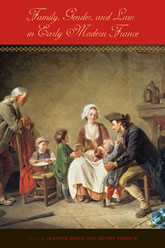
Family, Gender, and Law in Early Modern France
Suzanne Desan (Co-editor), and Jeffrey Merrick (Co-editor). Family, Gender, and Law in Early Modern France. Penn State University Press, 2009.
The essays in Family, Gender, and Law in Early Modern France explore how ordinary men and women negotiated power within early modern French households and continually reinvented their families in response to external forces. Larger processes, such as state building, religious reform, changing understandings of gender roles, and economic developments, influenced family practices in the areas of marriage, separation, guardianship, and illegitimacy. Relatives, gender, community, and the law imposed limits upon families but also provided opportunities for agency. Contributors investigate patterns of courtship and decisions about marriage; the financial power exercised by wives; marital conflict and related controversies about gender, sexuality, and social order; death and guardianship; and the legitimization of children born out of wedlock. While addressing a variety of topics, this volume focuses on family members as individuals with complicated agendas and strategies of their own.
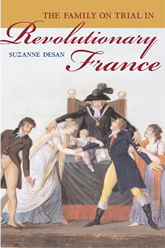
The Family on Trial in Revolutionary France
Suzanne Desan. The Family on Trial in Revolutionary France. University of California Press, 2004.
In a groundbreaking book that challenges many assumptions about gender and politics in the French Revolution, Suzanne Desan offers an insightful analysis of the ways the Revolution radically redefined the family and its internal dynamics. She shows how revolutionary politics and laws brought about a social revolution within households and created space for thousands of French women and men to reimagine their most intimate relationships. Families negotiated new social practices, including divorce, the reduction of paternal authority, egalitarian inheritance for sons and daughters alike, and the granting of civil rights to illegitimate children. Contrary to arguments that claim the Revolution bound women within a domestic sphere, The Family on Trial maintains that the new civil laws and gender politics offered many women unexpected opportunities to gain power, property, or independence. The family became a political arena, a practical terrain for creating the Republic in day-to-day life. From 1789, citizens across France—sons and daughters, unhappily married spouses and illegitimate children, pamphleteers and moralists, deputies and judges—all disputed how the family should be reformed to remake the new France. They debated how revolutionary ideals and institutions should transform the emotional bonds, gender dynamics, legal customs, and economic arrangements that structured the family. They asked how to bring the principles of liberty, equality, and regeneration into the home. And as French citizens confronted each other in the home, in court, and in print, they gradually negotiated new domestic practices that balanced Old Regime customs with revolutionary innovations in law and culture. In a narrative that combines national-level analysis with a case study of family contestation in Normandy, Desan explores these struggles to bring politics into households and to envision and put into practice a new set of familial relationships.
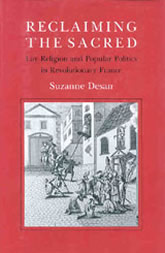
Reclaiming the Sacred: Lay Religion and Popular Politics in Revolutionary France
Suzanne Desan. Reclaiming the Sacred: Lay Religion and Popular Politics in Revolutionary France. Cornell University Press, 1990.
Reclaiming the Sacred examines the ways in which the new secular political culture of lay people. Focusing on the Yonne, a pro-revolutionary department in Burgundy, Suzann Desan analyzes how the region’s laity responded to the revolutionaries’ attempts to dechristianize France and to replace Christianity with new revolutionary cults. The Revolution, she shows, was a fertile and dynamic period for lay religiosity. Paradoxically, the breakdown of the institutional Church allowed the laity to seize greater initiative in defining and creating the sacred. In the absence of the clergy, lay believers transformed their religious expression and invented new rituals such as lay-led masses. Women in particular often gained new spiritual and communal power as leaders of local religious activism. Desan explores why women were usually the leaders of religious violence and illustrates how, in her view, their activism helped to stake out religion as women’s domain over the longer term. Yet her book is also about the surprisingly revolutionary means by which lay Catholics demanded the right to practice. Desan challenges the traditional assumption that Catholics were necessarily counterrevolutionary by analyzing how religious activists in a republican region assimilated the rhetoric of the Revolution and fused traditional and revolutionary forms of violent collective action. Her book thus sheds light on both the popular uses of revolutionary politics and the nature of French religious practice at this critical turning point in modern history. Reclaiming the Sacred will be of interest to historians of early modern and modern Europe, especially those who work on the French Revolution, popular religion, and the history of women. Desan’s work will also be read by students of political science, and anthropology, historical sociology, and religious studies.
Advisor To
History Courses
- History 119 – The Making of Modern Europe 1500-1815 – Syllabus 2022 (pdf)
- History 201 – The Historian’s Craft: “Identity and Culture in Eighteenth-Century Europe & Colonies” – Syllabus 2019 (pdf)
- History 201 – The Historian’s Craft: “The French Revolution” – Syllabus 2023 (pdf)
- History 223 – Freshmen Seminar: “Society and Gender in Early Modern Europe”
- History 283 – Studies in History: French Culture, 1500-1800
- History 283 – European Enlightenment
- History 283 – Bodies, Rights, and Human Difference in the Enlightenment – Syllabus 2017 (pdf)
- History 320 – Early Modern France 1500-1715 – Syllabus 2015 (pdf)
- History 352 – Eighteenth Century Europe – Syllabus 2011 (pdf)
- History 358 – The Old Regime and French Revolution – Syllabus 2014 (pdf)
- History 572 – Studies in European History
- History 600 – Women and Gender in the French Revolution – Syllabus 2021 (pdf)
- History 600 – Identity & Autobiography in Eighteenth-Century Europe – Syllabus 2019 (pdf)
- History 600 – Napoleon – 2021 Fall – Desan – “Napoleon”
- History 600 – Americans in Paris – Syllabus 2015 (pdf)
- History 600 – Marie-Antoinette & the French Revolution – Syllabus 2015 (pdf)
- History 600 – Empire in the French Revolutionary Era – Syllabus 2011 (pdf)
- History 680/690 – Honors Thesis Colloquium
- History 703 – History and Theory: Recent Approaches to Cultural and Social History – Syllabus 2016 (pdf)
- History 707 – Old Regime and French Revolution – Syllabus 2020 (pdf)
- History 707 – Society and Popular Culture in Early Modern Europe
- History 710 – Professional Development Seminar: “Dissertation Writing Workshop” – Syllabus 2020 (pdf)
- History 952 – Seminar in Comparative History: Gender, Race, and the Politics of Empire in the Transatlantic World, 1750-1850