
Biography
Biography
My teaching and research specializations focus principally on the environmental history, landscape history, and historical geography of North America, concentrating mainly on the United States with a secondary interest in Canada. I am committed to history that makes the past come alive for public audiences, both in the form of written storytelling and the many new media that have become available in this digital age. My current projects include a book on The Making of the American Landscape and a history of Portage, Wisconsin since the last Ice Age.
Education
Ph.D., Yale
D.Phil., Oxford
M.A., Yale
B.A., University of Wisconsin – Madison
Books
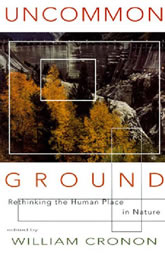
Uncommon Ground: Rethinking the Human Place in Nature
William Cronon. Uncommon Ground: Rethinking the Human Place in Nature. W. W. Norton & Co., 1996.
A controversial, timely reassessment of the environmentalist agenda by outstanding historians, scientists, and critics. In a lead essay that powerfully states the broad argument of the book, William Cronon writes that the environmentalist goal of wilderness preservation is conceptually and politically wrongheaded. Among the ironies and entanglements resulting from this goal are the sale of nature in our malls through the Nature Company, and the disputes between working people and environmentalists over spotted owls and other objects of species preservation. The problem is that we haven’t learned to live responsibly in nature. The environmentalist aim of legislating humans out of the wilderness is no solution. People, Cronon argues, are inextricably tied to nature, whether they live in cities or countryside. Rather than attempt to exclude humans, environmental advocates should help us learn to live in some sustainable relationship with nature. It is our home.
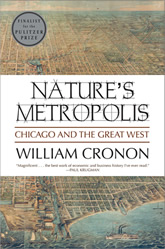
Nature’s Metropolis: Chicago and the Great West
William Cronon. Nature’S Metropolis: Chicago and the Great West. W. W. Norton & Co., 1991.
In this groundbreaking work, William Cronon gives us an environmental perspective on the history of nineteenth-century America. By exploring the ecological and economic changes that made Chicago America’s most dynamic city and the Great West its hinterland, Mr. Cronon opens a new window onto our national past. This is the story of city and country becoming ever more tightly bound in a system so powerful that it reshaped the American landscape and transformed American culture. The world that emerged is our own.
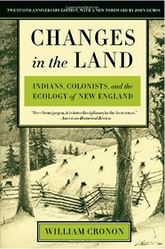
Changes in the Land: Indians, Colonists, and the Ecology of New England
William Cronon. Changes in the Land: Indians, Colonists, and the Ecology of New England. New York: Hill & Wang, 1983.
In this landmark work of environmental history, William Cronon offers an original and profound explanation of the effects European colonists’ sense of property and their pursuit of capitalism had upon the ecosystems of New England. Reissued here with an updated afterword by the author and a new preface by the distinguished colonialist John Demos, Changes in the Land, provides a brilliant inter-disciplinary interpretation of how land and people influence one another. With its chilling closing line, “The people of plenty were a people of waste,” Cronon’s enduring and thought-provoking book is ethno-ecological history at its best.
Selected Publications
- “Storytelling” (AHA Presidential Address), American Historical Review 118:1 (February 2013), 1-19.
History Courses
- History/Geography/Environmental Studies 460 – American Environmental History – Course Webpage
- History/Geography/Environmental Studies 469 – The Making of the American Landscape – Course Webpage
- History/Geography 932 – Topics in American Environmental History – Course Webpage