Biography
Biography
Current interests include science and medicine in the Enlightenment; the role of science in the public sphere; 18th-century German intellectual and cultural history.
Education
Ph.D., Princeton University, History, 1987
M.A., Princeton University, History, 1983
M.S., University of Illinois at Urbana-Champaign, Agronomy, 1980
A.B., Ripon College, Biology and Chemistry, 1976
Books
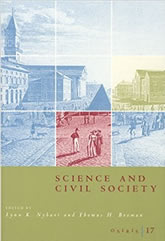
Science and Civil Society
Thomas H. Broman (Editor), and Lynn K. Nyhart (Editor). Science and Civil Society. Vol. Osiris, Volume 17, University of Chicago Press, 2002.
This volume explores the varieties of relationships formed between science and civil society, at both the conceptual and institutional levels, since the late seventeenth century. It brings together general historians and historians of science with different national perspectives to confront the various ways sin which science and civil society have shaped one another in different times and places. How, when, and why did science become intertwined in the network of voluntary associations, professional groups and other institutions we understand as comprising “civil society”? How has science affected the ideology of civil society and thus the legitimacy of political authority in historical contexts as different as late eighteenth-century America, mid nineteenth-century Germany, and early twentieth-century China? How have scientists made use of the ideological links between science and civil political discourse to further their own professional ends? In contrast to much recent writing on civil society, this volume does not aim at making normative pronouncements about the role of civil society in promoting democratic polities, nor does it attempt to weigh the role of science in democracy. Instead, the essays examine how the fruitful interplay of beliefs concerning science and civil society has worked to legitimize the institutional forms of civil society and naturalize its ideologies, while at the same time giving to science its overwhelmingly powerful role in public life.
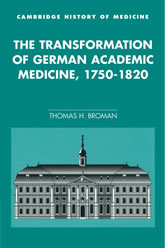
The Transformation of German Academic Medicine, 1750-1820
Thomas H. Broman. The Transformation of German Academic Medicine, 1750-1820. University of Chicago Press, 1996.
By examining German university medicine between 1750 and 1820, this book presents a new interpretation of the emergence of modern medical science. It demonstrates that the development of modern medicine as a profession linking theory and practice did not emerge suddenly from the revolutionary transformation of Europe at the opening of the nineteenth century, as Foucault and others have argued. Instead, Thomas H. Broman points to cultural and institutional changes occurring during the second half of the eighteenth century as reshaping both medical theory and physician’s professional identity. Among the most important of these factors was the emergence of a literary public sphere in Germany between 1750 and 1800, a development that exposed medical writing to new discourses such as Jena Romanticism and created the stage on which would be played out the bitter medical controversies of the 1790s.
Selected Publications
- Thomas Broman, “Metaphysics for an Enlightened Public: The Controversy over Monads in Germany, 1746-1748,” Isis 103:1 (2012), 1-23.
- Thomas Broman, “The Semblance of Transparency: Expertise as a Social Good and an Ideology in Enlightened Societies,” Osiris 27 (2012), 188-208.
- Thomas H. Broman, “The Habermasian Public Sphere and ‘Science in the Enlightenment,'” History of Science 36 (1998), 123-149.
- Thomas H. Broman, “Rethinking Professionalization: Theory, Practice, and Professional Ideology in Eighteenth-Century German Medicine,” The Journal of Modern History 67 (1995), 835-872.