Faculty Books

Coding Capitalism: Computers and the Remaking of the Postwar US Economy
Devin Kennedy. Coding Capitalism: Computers and the Remaking of the Postwar US Economy. Columbia University Press, 2026.
Long before Google, Amazon, or Microsoft, computer technology shaped how people worked, how markets operated, and how businesses became big. After World War II, military officials and their partners in industry looked to the newly invented electronic computer as they sought to cut costs, speed up labor, manage supply chains, and—they hoped—bring stability to the postwar economy. Their efforts would shape early computer science and the first applications of computer technology in manufacturing and business, with profound consequences for workers and managers alike. By the 1960s, practices originally developed to improve industrial efficiency were being used by Wall Street, influencing how markets worked and even how traders thought. Digital technology became central to finance, tying together far-flung trading floors and automating decision making—with alarming consequences, including the 1987 Black Monday crash. Devin Kennedy offers a new history of the digital economy, showing how the computer emerged from—and transformed—capitalism in the United States. He traces how computer science and technology were made by industry, which molded computation to manage factories, financial markets, and entire firms. Drawing on the archives of businesses, computer researchers, regulators, and financial institutions, Coding Capitalism retells the story of the postwar economy and the computer, revealing how midcentury business laid the foundations of the digital world. Bridging business and economic history with the history of science and technology, this book uncovers the prehistory of big tech and demonstrates how capitalism has shaped computing since its invention.
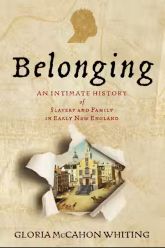
Belonging: An Intimate History of Slavery and Family in Early New England
Gloria Whiting. Belonging: An Intimate History of Slavery and Family in Early New England. Penn Press, 2024.
*Winner of the 2025 John Winthrop Prize from the Colonial Society of Massachusetts for the best book on the seventeenth century published in 2024. *Winner of the 2025 Frances Richardson Keller-Sierra Prize from the Western Association of Women Historians for the best single-authored historical monograph published in 2024. Explores how Black New Englanders maintained a sense of belonging among their kin in the face of slavery. As winter turned to spring in the year 1699, Sebastian and Jane embarked on a campaign of persuasion. The two wished to marry, and they sought the backing of their community in Boston. Nothing, however, could induce Jane’s enslaver to consent. Only after her death did Sebastian and Jane manage to wed, forming a long-lasting union even though husband and wife were not always able to live in the same household. New England is often considered a cradle of liberty in American history, but this snippet of Jane and Sebastian’s story reminds us that it was also a cradle of slavery. From the earliest years of colonization, New Englanders bought and sold people, most of whom were of African descent. In Belonging, Gloria McCahon Whiting tells the region’s early history from the perspective of the people, like Jane and Sebastian, who belonged to others and who struggled to maintain a sense of belonging among their kin. Through a series of meticulously reconstructed family narratives, Whiting traces the contours of enslaved people’s intimate lives in early New England, where they often lived with those who bound them but apart from kin. Enslaved spouses rarely were able to cohabit; fathers and their offspring routinely were separated by inheritance practices; children could be removed from their mothers at an enslaver’s whim; and people in bondage had only partial control of their movement through the region, which made more difficult the task of maintaining distant relationships. But Belonging does more than lay bare the obstacles to family stability for those in bondage. Whiting also charts Afro-New Englanders’ persistent demands for intimacy throughout the century and a half stretching from New England’s founding to the American Revolution. And she shows how the work of making and maintaining relationships influenced the region’s law, religion, society, and politics. Ultimately, the actions taken by people in bondage to fortify their families played a pivotal role in bringing about the collapse of slavery in New England’s most populous state, Massachusetts.

Cold War on Five Continents: A Global History of Empire and Espionage
Alfred W. McCoy. Cold War on Five Continents: A Global History of Empire and Espionage. Haymarket Books, 2025.
A provocative analysis of the deadly conflicts that devastated countries and communities far from Moscow and Washington. Transforming battlegrounds in Africa, Asia, and Latin America into veritable wastelands, surrogate wars in the Cold War era left behind a legacy of collective trauma and social conflict that have persisted into the present. In this ambitious work, Alfred W. McCoy uses a bottom-up, outside-in approach to offer a new perspective on the longest, most consequential conflict in modern world history. McCoy offers an intimate portrait of covert operatives and young antiwar protesters, humanizing the history of the Cold War—a history that has too often been told in terms of economic growth, nuclear arsenals, or diplomatic ententes. By showing how otherwise ordinary individuals helped end a global conflict that threatened nuclear holocaust, McCoy offers important lessons for a younger generation facing climate change even as the great powers devote humanity’s scarce resources to a “new cold war.”

Banished Citizens: A History of the Mexican American Women Who Endured Repatriation
Marla A. Ramírez. Banished Citizens: A History of the Mexican American Women Who Endured Repatriation. Harvard University Press, 2025.
A moving portrait of a grim period in American immigration history, when approximately one million ethnic Mexicans—mostly women and children who were US citizens—were forced to relocate across the southern border. From 1921 to 1944, approximately one million ethnic Mexicans living in the United States were removed across the border to Mexico. What officials called “repatriation” was in fact banishment: 60 percent of those expelled were US citizens, mainly working-class women and children whose husbands and fathers were Mexican immigrants. Drawing on oral histories, transnational archival sources, and private collections, Marla A. Ramírez illuminates the lasting effects of coerced mass removal on three generations of ethnic Mexicans.

Uneasy Allies: Sino-American Relations at the Grassroots, 1937–1949
Zach Fredman (Co-editor), and Judd Kinzley (Co-editor). Uneasy Allies: Sino-American Relations at the Grassroots, 1937–1949. Cambridge University Press, 2024.
This timely collection of essays examines Sino-American relations during the Second World War, the Chinese Civil War and the opening of the Cold War. Drawing on new sources uncovered in China, Taiwan, the UK and the US, the authors demonstrate how ‘grassroots’ engagements – not just elite diplomacy – established the trans-Pacific networks that both shaped the postwar order in Asia, and continue to influence Sino-US relations today. In these crucial years, servicemen, scientists, students, businesspeople, activists, bureaucrats and many others travelled between the US and China. In every chapter, this innovative volume’s approach uncovers their stories using both Chinese and English language sources. By examining interactions among various Chinese and American actors in the dynamic wartime environment, Uneasy Allies reveals a new perspective on the foundations of American power, the brittle nature of the Sino-American relationship, and the early formation of the institutions that shaped the Cold War Pacific.
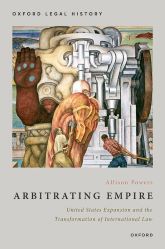
Arbitrating Empire: United States Expansion and the Transformation of International Law
Allison Powers Useche. Arbitrating Empire: United States Expansion and the Transformation of International Law. Oxford University Press, 2024.
Traces how ordinary people used international law to hold the United States accountable for state violence during the first decades of the twentieth century Shows how key transformations in the legal architecture of the early twentieth-century United States Empire were the product of efforts to insulate the US government from international scrutiny Rethinks histories of the Monroe and Calvo Doctrines in the Americas Offers a new way of understanding formations of modern international law through attention to erasure in legal archives

Citizens of a Stolen Land: A Ho-Chunk History of the Nineteenth-Century United States
Stephen Kantrowitz. Citizens of a Stolen Land: A Ho-Chunk History of the Nineteenth-Century United States. The University of North Carolina Press, 2023.
This concise and revealing history reconsiders the Civil War era by centering one Native American tribe’s encounter with citizenship. In 1837, eleven years before Wisconsin’s admission as a state, representatives of the Ho-Chunk people yielded under immense duress and signed a treaty that ceded their remaining ancestral lands to the U.S. government. Over the four decades that followed, as “free soil” settlement repeatedly demanded their further expulsion, many Ho-Chunk people lived under the U.S. government’s policies of “civilization,” allotment, and citizenship. Others lived as outlaws, evading military campaigns to expel them and adapting their ways of life to new circumstances. After the Civil War, as Reconstruction’s vision of nonracial, national, birthright citizenship excluded most Native Americans, the Ho-Chunk who remained in their Wisconsin homeland understood and exploited this contradiction. Professing eagerness to participate in the postwar nation, they gained the right to remain in Wisconsin as landowners and voters while retaining their language, culture, and identity as a people. This history of Ho-Chunk sovereignty and citizenship offer a bracing new perspective on citizenship’s perils and promises, the way the broader nineteenth-century conflict between “free soil” and slaveholding expansion shaped Indigenous life, and the continuing impact of Native people’s struggles and claims on U.S. politics and society.

American Intellectual History: A Very Short Introduction
Jennifer Ratner-Rosenhagen. American Intellectual History: A Very Short Introduction. Oxford University Press, 2021.
Long before the United States was a nation, it was a set of ideas, projected onto the New World by European explorers with centuries of belief and thought in tow. From this foundation of expectation and experience, America and American thought grew in turn, enriched by the bounties of the Enlightenment, the philosophies of liberty and individuality, the tenets of religion, and the doctrines of republicanism and democracy. Crucial to this development were the thinkers who nurtured it, from Thomas Jefferson to Ralph Waldo Emerson, W.E.B. Du Bois to Jane Addams, and Betty Friedan to Richard Rorty. This addition to Oxford’s Very Short Introductions series traces how Americans have addressed the issues and events of their time and place, whether it is the Civil War, the Great Depression, or the culture wars of today. Spanning a variety of disciplines, from religion, philosophy, and political thought, to cultural criticism, social theory, and the arts, Jennifer Ratner-Rosenhagen shows how ideas have been major forces in American history, driving movements such as transcendentalism, Social Darwinism, conservatism, and postmodernism. In engaging and accessible prose, this introduction to American thought considers how notions about freedom and belonging, the market and morality – and even truth – have commanded generations of Americans and been the cause of fierce debate.
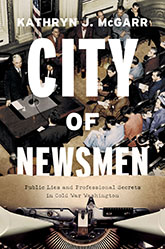
City of Newsmen: Public Lies and Professional Secrets in Cold War Washington
Kathryn McGarr. City of Newsmen: Public Lies and Professional Secrets in Cold War Washington. University of Chicago Press , 2022.
An inside look at how midcentury DC journalists silenced their own skepticism and shaped public perceptions of the Cold War. Americans’ current trust in journalists is at a dismayingly low ebb, particularly on the subject of national and international politics. For some, it might be tempting to look back to the mid-twentieth century, when the nation’s press corps was a seemingly venerable and monolithic institution that conveyed the official line from Washington with nary a glint of anti-patriotic cynicism. As Kathryn McGarr’s City of Newsmen shows, however, the real story of what Cold War–era journalists did and how they did it wasn’t exactly the one you’d find in the morning papers. City of Newsmen explores foreign policy journalism in Washington during and after World War II—a time supposedly defined by the press’s blind patriotism and groupthink. McGarr reveals, though, that DC reporters then were deeply cynical about government sources and their motives, but kept their doubts to themselves for professional, social, and ideological reasons. The alliance and rivalries among these reporters constituted a world of debts and loyalties: shared memories of harrowing wartime experiences, shared frustrations with government censorship and information programs, shared antagonisms, and shared mentors. McGarr ventures into the back hallways and private clubs of the 1940s and 1950s to show how white male reporters suppressed their skepticism to build one of the most powerful and enduring constructed realities in recent US history—the Washington Cold War consensus. Though by the 1960s, this set of reporters was seen as unduly complicit with the government—failing to openly critique the decisions and worldviews that led to disasters like the Vietnam War—McGarr shows how self-aware these reporters were as they negotiated for access, prominence, and, yes, the truth—even as they denied those things to their readers.
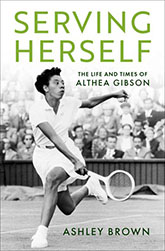
Serving Herself: The Life and Times of Althea Gibson
Ashley Brown. Serving Herself: The Life and Times of Althea Gibson. Oxford University Press, 2023.
A compelling narrative of the trials and triumphs of tennis champion Althea Gibson, a key figure in the integration of American sports and, for a time, one of the most famous women in the world. From her start playing paddle tennis on the streets of Harlem as a young teenager to her eleven Grand Slam tennis wins to her professional golf career, Althea Gibson became the most famous black sportswoman of the mid-twentieth century. In her unprecedented athletic career, she was the first African American to win titles at the French Open, Wimbledon, and the US Open. In this comprehensive biography, Ashley Brown narrates the public career and private struggles of Althea Gibson (1927-2003). Based on extensive archival work and oral histories, Serving Herself sets Gibson’s life and choices against the backdrop of the Great Migration, Jim Crow racism, the integration of American sports, the civil rights movement, the Cold War, and second wave feminism. Throughout her life Gibson continuously negotiated the expectations of her supporters and adversaries, including her patrons in the black-led American Tennis Association, the white-led United States Lawn Tennis Association, and the media, particularly the Black press and community’s expectations that she selflessly serve as a representative of her race. An incredibly talented, ultra-competitive, and not always likeable athlete, Gibson wanted to be treated as an individual first and foremost, not as a member of a specific race or gender. She was reluctant to speak openly about the indignities and prejudices she navigated as an African American woman, though she faced numerous institutional and societal barriers in achieving her goals. She frequently bucked conventional norms of femininity and put her career ahead of romantic relationships, making her personal life the subject of constant scrutiny and rumors. Despite her major wins and international recognition, including a ticker tape parade in New York City and the covers of Sports Illustrated and Time, Gibson endeavored to find commercial sponsorship and permanent economic stability. Committed to self-sufficiency, she pivoted from the elite amateur tennis circuit to State Department-sponsored goodwill tours, attempts to find success as a singer and Hollywood actress, the professional golf circuit, a tour with the Harlem Globetrotters and her own professional tennis tour, coaching, teaching children at tennis clinics, and a stint as New Jersey Athletics Commissioner. As she struggled to support herself in old age, she was left with disappointment, recounting her past achievements decades before female tennis players were able to garner substantial earnings. A compelling life and times portrait, Serving Herself offers a revealing look at the rise and fall of a fiercely independent trailblazer who satisfied her own needs and simultaneously set a pathbreaking course for Black athletes.
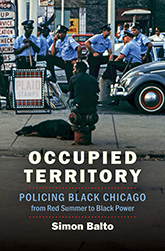
Occupied Territory: Policing Black Chicago from Red Summer to Black Power
Simon Balto. Occupied Territory: Policing Black Chicago from Red Summer to Black Power. University of North Carolina Press, 2019.
In July 1919, an explosive race riot forever changed Chicago. For years, black southerners had been leaving the South as part of the Great Migration. Their arrival in Chicago drew the ire and scorn of many local whites, including members of the city’s political leadership and police department, who generally sympathized with white Chicagoans and viewed black migrants as a problem population. During Chicago’s Red Summer riot, patterns of extraordinary brutality, negligence, and discriminatory policing emerged to shocking effect. Those patterns shifted in subsequent decades, but the overall realities of a racially discriminatory police system persisted. In this history of Chicago from 1919 to the rise and fall of Black Power in the 1960s and 1970s, Simon Balto narrates the evolution of racially repressive policing in black neighborhoods as well as how black citizen-activists challenged that repression. Balto demonstrates that punitive practices by and inadequate protection from the police were central to black Chicagoans’ lives long before the late-century “wars” on crime and drugs. By exploring the deeper origins of this toxic system, Balto reveals how modern mass incarceration, built upon racialized police practices, emerged as a fully formed machine of profoundly antiblack subjugation.

The Interrogation Rooms of the Korean War: The Untold History
Monica Kim. The Interrogation Rooms of the Korean War: The Untold History. Princeton University Press, 2019.
Traditional histories of the Korean War have long focused on violations of the thirty-eighth parallel, the line drawn by American and Soviet officials in 1945 dividing the Korean peninsula. But The Interrogation Rooms of the Korean War presents an entirely new narrative, shifting the perspective from the boundaries of the battlefield to inside the interrogation room. Upending conventional notions of what we think of as geographies of military conflict, Monica Kim demonstrates how the Korean War evolved from a fight over territory to one over human interiority and the individual human subject, forging the template for the US wars of intervention that would predominate during the latter half of the twentieth century and beyond. Kim looks at how, during the armistice negotiations, the United States and their allies proposed a new kind of interrogation room: one in which POWs could exercise their “free will” and choose which country they would go to after the ceasefire. The global controversy that erupted exposed how interrogation rooms had become a flashpoint for the struggles between the ambitions of empire and the demands for decolonization, as the aim of interrogation was to produce subjects who attested to a nation’s right to govern. The complex web of interrogators and prisoners—Japanese-American interrogators, Indian military personnel, Korean POWs and interrogators, and American POWs—that Kim uncovers contradicts the simple story in US popular memory of “brainwashing” during the Korean War. Bringing together a vast range of sources that track two generations of people moving between three continents, The Interrogation Rooms of the Korean War delves into an essential yet overlooked aspect of modern warfare in the twentieth century.

The Ideas That Made America: A Brief History
Jennifer Ratner-Rosenhagen. The Ideas That Made America: A Brief History. Oxford University Press, 2019.
Long before the United States was a nation, it was a set of ideas, projected onto the New World by European explorers with centuries of belief and thought in tow. From this foundation of expectation and experience, America and American thought grew in turn, enriched by the bounties of the Enlightenment, the philosophies of liberty and individuality, the tenets of religion, and the doctrines of republicanism and democracy. Crucial to this development were the thinkers who nurtured it, from Thomas Jefferson to Ralph Waldo Emerson, W.E.B. DuBois to Jane Addams, and Betty Friedan to Richard Rorty. The Ideas That Made America: A Brief History traces how Americans have addressed the issues and events of their time and place, whether the Civil War, the Great Depression, or the culture wars of today. Spanning a variety of disciplines, from religion, philosophy, and political thought, to cultural criticism, social theory, and the arts, Jennifer Ratner-Rosenhagen shows how ideas have been major forces in American history, driving movements such as transcendentalism, Social Darwinism, conservatism, and postmodernism. In engaging and accessible prose, this introduction to American thought considers how notions about freedom and belonging, the market and morality — and even truth — have commanded generations of Americans and been the cause of fierce debate.
The Cambridge History of Judaism: Volume 8. The Modern World, 1815–2000
Tony Michels (Co-editor), and Mitchell B. Hart (Co-editor). The Cambridge History of Judaism: Volume 8. The Modern World, 1815–2000. Cambridge University Press, 2017.
The eighth and final volume of The Cambridge History of Judaism covers the period from roughly 1815–2000. Exploring the breadth and depth of Jewish societies and their manifold engagements with aspects of the modern world, it offers overviews of modern Jewish history, as well as more focused essays on political, social, economic, intellectual and cultural developments. The first part presents a series of interlocking surveys that address the history of diverse areas of Jewish settlement. The second part is organized around the emancipation. Here, chapter themes are grouped around the challenges posed by and to this elemental feature of Jewish life in the modern period. The third part adopts a thematic approach organized around the category ‘culture’, with the goal of casting a wide net in terms of perspectives, concepts and topics. The final part then focuses on the twentieth century, offering readers a sense of the dynamic nature of Judaism and Jewish identities and affiliations.

The Worlds of American Intellectual History
Jennifer Ratner-Rosenhagen (Co-editor), Joel Isaac (Co-editor), James T. Kloppenberg (Co-editor), and Michael O’Brien (Co-editor). The Worlds of American Intellectual History. Oxford Universiity Press, 2016.
The essays in this book demonstrate the breadth and vitality of American intellectual history. Their core theme is the diversity of both American intellectual life and of the frameworks that we must use to make sense of that diversity. The Worlds of American Intellectual History has at its heart studies of American thinkers. Yet it follows these thinkers and their ideas as they have crossed national, institutional, and intellectual boundaries. The volume explores ways in which American ideas have circulated in different cultures. It also examines the multiple sites–from social movements, museums, and courtrooms to popular and scholarly books and periodicals–in which people have articulated and deployed ideas within and beyond the borders of the United States. At these cultural frontiers, the authors demonstrate, multiple interactions have occurred – some friendly and mutually enriching, others laden with tension, misunderstandings, and conflict. The same holds for other kinds of borders, such as those within and between scholarly disciplines, or between American history and the histories of other cultures. The richness of contemporary American intellectual history springs from the variety of worlds with which it must engage. Intellectual historians have always relished being able to move back and forth between close readings of particular texts and efforts to make sense of broader cultural dispositions. That range is on display in this volume, which includes essays by scholars as fully at home in the disciplines of philosophy, literature, economics, sociology, political science, education, science, religion, and law as they are in history. It includes essays by prominent historians of European thought, attuned to the transatlantic conversations in which Europeans and Americans have been engaged since the seventeenth century, and American historians whose work has carried them not only to different regions in North America but across the North Atlantic to Europe, across the South Atlantic to Africa, and across the Pacific to South Asia.
The Routledge Handbook of Asian American Studies
Cindy I-Fen Cheng (Editor). The Routledge Handbook of Asian American Studies. Routledge, 2016.
The Routledge Handbook of Asian American Studies brings together leading scholars and scholarship to capture the state of the field of Asian American Studies, as a generation of researchers have expanded the field with new paradigms and methodological tools. Inviting readers to consider new understandings of the historical work done in the past decades and the place of Asian Americans in a larger global context, this ground-breaking volume illuminates how research in the field of Asian American Studies has progressed. Previous work in the field has focused on establishing a place for Asian Americans within American history. This volume engages more contemporary research, which draws on new archives, art, literature, film, and music, to examine how Asian Americans are redefining their national identities, and to show how race interacts with gender, sexuality, class, and the built environment, to reveal the diversity of the United States. Organized into five parts, and addressing a multitude of interdisciplinary areas of interest to Asian American scholars, it covers: a reframing of key themes such as transnationality, postcolonialism, and critical race theory U.S. imperialism and its impact on Asian Americans war and displacement the garment industry Asian Americans and sports race and the built environment social change and political participation and many more themes. Exploring people, practice, politics, and places, this cutting-edge volume brings together the best themes current in Asian American Studies today, and is a vital reference for all researchers in the field.

Riotous Flesh: Women, Physiology, and the Solitary Vice in Nineteenth-Century America
April Haynes. Riotous Flesh: Women, Physiology, and the Solitary Vice in Nineteenth-Century America. University of Chicago Press, 2015.
Nineteenth-century America saw numerous campaigns against masturbation, which was said to cause illness, insanity, and even death. Riotous Flesh explores women’s leadership of those movements, with a specific focus on their rhetorical, social, and political effects, showing how a desire to transform the politics of sex created unexpected alliances between groups that otherwise had very different goals. As April R. Haynes shows, the crusade against female masturbation was rooted in a generally shared agreement on some major points: that girls and women were as susceptible to masturbation as boys and men; that “self-abuse” was rooted in a lack of sexual information; and that sex education could empower women and girls to master their own bodies. Yet the groups who made this education their goal ranged widely, from “ultra” utopians and nascent feminists to black abolitionists. Riotous Flesh explains how and why diverse women came together to popularize, then institutionalize, the condemnation of masturbation, well before the advent of sexology or the professionalization of medicine.

Protest on the Page: Essays on Print and the Culture of Dissent since 1865
Jennifer Ratner-Rosenhagen (Co-editor), James L. Baughman (Co-editor), and James P. Danky (Co-editor). Protest on the Page: Essays on Print and the Culture of Dissent since 1865. University of Wisconsin Press, 2015.
The use of print to challenge prevailing ideas and conventions has a long history in American public life. As dissenters in America sought social change, they used print to document, articulate, and disseminate their ideas to others. Protest always begins on the margins, but print is the medium that allows it to reach a larger audience. In Protest on the Page, scholars in multiple disciplines offer ten original essays that examine protest print culture in America since 1865. They explore the surprising range of dissidents who enlisted print in their causes—from vegetarians and anarchists at the advent of the twentieth century, to midcentury evangelicals and tween comic book readers, to GIs and feminists in the 1970s–’80s. Together they demonstrate that print has never been a neutral medium, but rather has been instrumental in shaping the substance of protest and its audiences.
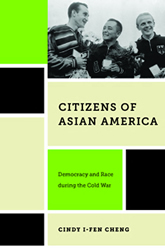
Citizens of Asian America: Democracy and Race during the Cold War
Cindy I-Fen Cheng. Citizens of Asian America: Democracy and Race During the Cold War. NYU Press, 2014.
During the Cold War, Soviet propaganda highlighted U.S. racism in order to undermine the credibility of U.S. democracy. In response, incorporating racial and ethnic minorities in order to affirm that America worked to ensure the rights of all and was superior to communist countries became a national imperative. In Citizens of Asian America , Cindy I-Fen Cheng explores how Asian Americans figured in this effort to shape the credibility of American democracy, even while the perceived “foreignness” of Asian Americans cast them as likely alien subversives whose activities needed monitoring following the communist revolution in China and the outbreak of the Korean War. While histories of international politics and U.S. race relations during the Cold War have largely overlooked the significance of Asian Americans, Cheng challenges the black-white focus of the existing historiography. She highlights how Asian Americans made use of the government’s desire to be leader of the “free world” by advocating for civil rights reforms, such as housing integration, increased professional opportunities, and freedom from political persecution. Further, Cheng examines the liberalization of immigration policies, which worked not only to increase the civil rights of Asian Americans but also to improve the nation’s ties with Asian countries, providing an opportunity for the U.S. government to broadcast, on a global scale, the freedom and opportunity that American society could offer.

Testing Wars in the Public Schools: A Forgotten History
William Reese. Testing Wars in the Public Schools: A Forgotten History. Harvard University Press, 2013.
Written tests to evaluate students were a radical and controversial innovation when American educators began adopting them in the 1800s. Testing quickly became a key factor in the political battles during this period that gave birth to America’s modern public school system. William J. Reese offers a richly detailed history of an educational revolution that has so far been only partially told. Single-classroom schools were the norm throughout the United States at the turn of the nineteenth century. Pupils demonstrated their knowledge by rote recitation of lessons and were often assessed according to criteria of behavior and discipline having little to do with academics. Convinced of the inadequacy of this system, the reformer Horace Mann and allies on the Boston School Committee crafted America’s first written exam and administered it as a surprise in local schools in 1845. The embarrassingly poor results became front-page news and led to the first serious consideration of tests as a useful pedagogic tool and objective measure of student achievement. A generation after Mann’s experiment, testing had become widespread. Despite critics’ ongoing claims that exams narrowed the curriculum, ruined children’s health, and turned teachers into automatons, once tests took root in American schools their legitimacy was never seriously challenged. Testing Wars in the Public Schools puts contemporary battles over scholastic standards and benchmarks into perspective by showcasing the historic successes and limitations of the pencil-and-paper exam.

All Men Free and Brethren: Essays on the History of African American Freemasonry
Stephen Kantrowitz. All Men Free and Brethren: Essays on the History of African American Freemasonry. Cornell University Press, 2013.
In early March 1775, an Irish soldier initiated a dozen or more black Bostonian men into a lodge of Freemasons, making them probably the first people of African descent formally admitted into Freemasonry in the Atlantic world. Prince Hall, a freedman, would emerge as the leader of this group as they worked together to establish a tradition of African American Freemasonry that has persisted ever since—a tradition that still carries his name. All Men Free and Brethren is the first in-depth historical consideration of Prince Hall freemasonry from the Revolutionary era to the early decades of the twentieth century. Through a growing network of lodges, African American Masons together promoted fellowship, Christianity, and social respectability, while standing against slavery and white supremacy. The contributors to this book examine key aspects in the history of the Prince Hall Masons, from accounts of specific lodges and leaders to broader themes in African American history: abolitionist activism, the limits of freedom during Reconstruction, political oration, the role of women in the black community, and relationships between Masonry and African American churches. Also included are several appendixes containing key texts from Prince Hall Masonry, a glossary of Masonic terms, and lists of archival repositories and contact information for present-day lodges. Edited by Peter P. Hinks and Stephen Kantrowitz, All Men Free and Brethren is a major contribution of the history of Freemasonry, African American history, and the broader history of race, citizenship, and community in the United States.

American Nietzsche: A History of an Icon and His Ideas
Jennifer Ratner-Rosenhagen. American Nietzsche: A History of an Icon and His Ideas. University of Chicago Press, 2012.
If you were looking for a philosopher likely to appeal to Americans, Friedrich Nietzsche would be far from your first choice. After all, in his blazing career, Nietzsche took aim at nearly all the foundations of modern American life: Christian morality, the Enlightenment faith in reason, and the idea of human equality. Despite that, for more than a century Nietzsche has been a hugely popular—and surprisingly influential—figure in American thought and culture. In American Nietzsche, Jennifer Ratner-Rosenhagen delves deeply into Nietzsche’s philosophy, and America’s reception of it, to tell the story of his curious appeal. Beginning her account with Ralph Waldo Emerson, whom the seventeen-year-old Nietzsche read fervently, she shows how Nietzsche’s ideas first burst on American shores at the turn of the twentieth century, and how they continued alternately to invigorate and to shock Americans for the century to come. She also delineates the broader intellectual and cultural contexts within which a wide array of commentators—academic and armchair philosophers, theologians and atheists, romantic poets and hard-nosed empiricists, and political ideologues and apostates from the Left and the Right—drew insight and inspiration from Nietzsche’s claims for the death of God, his challenge to universal truth, and his insistence on the interpretive nature of all human thought and beliefs. At the same time, she explores how his image as an iconoclastic immoralist was put to work in American popular culture, making Nietzsche an unlikely posthumous celebrity capable of inspiring both teenagers and scholars alike. A penetrating examination of a powerful but little-explored undercurrent of twentieth-century American thought and culture, American Nietzsche dramatically recasts our understanding of American intellectual life—and puts Nietzsche squarely at its heart.

More Than Freedom: Fighting for Black Citizenship in a White Republic
Stephen Kantrowitz. More Than Freedom: Fighting for Black Citizenship in a White Republic. Penguin Press, 2012.
Abraham Lincoln’s Emancipation Proclamation is generally understood as the moment African Americans became free, and Reconstruction as the ultimately unsuccessful effort to extend that victory by establishing equal citizenship. In More Than Freedom, award-winning historian Stephen Kantrowitz boldly redefines our understanding of this entire era by showing that the fight to abolish slavery was always part of a much broader campaign to establish full citizenship for African Americans and find a place to belong in a white republic. More Than Freedom chronicles this epic struggle through the lived experiences of black and white activists in and around Boston, including both famous reformers such as Frederick Douglass and Charles Sumner and lesser-known but equally important figures like the journalist William Cooper Nell and the ex-slaves Lewis and Harriet Hayden. While these freedom fighters have traditionally been called abolitionists, their goals and achievements went far beyond emancipation. They mobilized long before they had white allies to rely on and remained militant long after the Civil War ended. These black freedmen called themselves “colored citizens” and fought to establish themselves in American public life, both by building their own networks and institutions and by fiercely, often violently, challenging proslavery and inegalitarian laws and prejudice. But as Kantrowitz explains, they also knew that until the white majority recognized them as equal participants in common projects they would remain a suspect class. Equal citizenship meant something far beyond freedom: not only full legal and political rights, but also acceptance, inclusion and respect across the color line. Even though these reformers ultimately failed to remake the nation in the way they hoped, their struggle catalyzed the arrival of Civil War and left the social and political landscape of the Union forever altered. Without their efforts, war and Reconstruction could hardly have begun. Bringing a bold new perspective to one of our nation’s defining moments, More Than Freedom helps to explain the extent and the limits of the so-called freedom achieved in 1865 and the legacy that endures today.
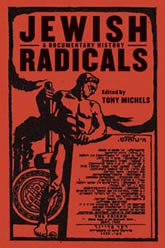
Jewish Radicals: A Documentary History
Tony Michels. Jewish Radicals: A Documentary History. NYU Press, 2012.
Jewish Radicals explores the intertwined histories of Jews and the American Left through a rich variety of primary documents. Written in English and Yiddish, these documents reflect the entire spectrum of radical opinion, from anarchism to social democracy, Communism to socialist-Zionism. Rank-and-file activists, organizational leaders, intellectuals, and commentators, from within the Jewish community and beyond, all have their say. Their stories crisscross the Atlantic, spanning from the United States to Europe and British-ruled Palestine. The documents illuminate in fascinating detail the efforts of large numbers of Jews to refashion themselves as they confronted major problems of the twentieth century: poverty, anti-semitism, the meaning of American national identity, war, and totalitarianism. In this comprehensive sourcebook, the story of Jewish radicals over seven decades is told for the first time in their own words.

Transfeminist Perspectives in and beyond Transgender and Gender Studies
Finn Enke. Transfeminist Perspectives in and Beyond Transgender and Gender Studies. Temple University Press, 2012.
If feminist studies and transgender studies are so intimately connected, why are they not more deeply integrated? Offering multidisciplinary models for this assimilation, the vibrant essays in Transfeminist Perspectives in and beyond Transgender and Gender Studies suggest timely and necessary changes for institutions of higher learning. Responding to the more visible presence of transgender persons as well as gender theories, the contributing essayists focus on how gender is practiced in academia, health care, social services, and even national border patrols. Working from the premise that transgender is both material and cultural, the contributors address such aspects of the university as administration, sports, curriculum, pedagogy, and the appropriate location for transgender studies. Combining feminist theory, transgender studies, and activism centered on social diversity and justice, these essays examine how institutions as lived contexts shape everyday life.

Uncommon Defense: Indian Allies in the Black Hawk War
John W. Hall. Uncommon Defense: Indian Allies in the Black Hawk War. Harvard University Press, 2009.
In the spring of 1832, when the Indian warrior Black Hawk and a thousand followers marched into Illinois to reoccupy lands earlier ceded to American settlers, the U.S. Army turned to rival tribes for military support. Elements of the Menominee, Dakota, Potawatomi, and Ho Chunk tribes willingly allied themselves with the United States government against their fellow Native Americans in an uncommon defense of their diverse interests. As the Black Hawk War came only two years after the passage of the Indian Removal Act and is widely viewed as a land grab by ravenous settlers, the military participation of these tribes seems bizarre. What explains this alliance? In order to grasp Indian motives, John Hall explores their alliances in earlier wars with colonial powers as well as in intertribal antagonisms and conflicts. In the crisis of 1832, Indians acted as they had traditionally, leveraging their relationship with a powerful ally to strike tribal enemies, fulfill important male warrior expectations, and pursue political advantage and material gain. However, times had changed and, although the Indians achieved short-term objectives, they helped create conditions that permanently changed their world. Providing a rare view of Indian attitudes and strategies in war and peace, Hall deepens our understanding of Native Americans and the complex roles they played in the nation’s history. More broadly, he demonstrates the risks and lessons of small wars that entail an “uncommon defense” by unlikely allies in pursuit of diverse, even conflicting, goals.

History, Education, and the Schools
William Reese. History, Education, and the Schools. Palgrave Macmillan, 2007.
This book grapples with two basic questions. What is history? And How can history help illuminate contemporary concerns about the nature and character of America’s schools? From antiquity to the postmodern present, history has served multiple purposes, including a basic human need to learn from what came before. Americans have long invested considerable time, energy, and emotion in their schools, both private and public, and a knowledge of history helps explain why.

Rethinking the History of American Education
William Reese. Rethinking the History of American Education. Palgrave Macmillan, 2007.
This collection of original essays examines the history of American education as it has developed as a field since the 1970s and moves into a post-revisionist era and looks forward to possible new directions for the future. Contributors take a comprehensive approach, beginning with colonial education and spanning to modern day, while also looking at various aspects of education, from higher education, to curriculum, to the manifestation of social inequality in education. The essays speak to historians, educational researchers, policy makers and others seeking fresh perspectives on questions related to the historical development of schooling in the United States.

Finding the Movement: Sexuality, Contested Space, and Feminist Activism
Finn Enke. Finding the Movement: Sexuality, Contested Space, and Feminist Activism. Duke University Press, 2007.
In Finding the Movement, Anne Enke reveals that diverse women’s engagement with public spaces gave rise to and profoundly shaped second-wave feminism. Focusing on women’s activism in Detroit, Chicago, and Minneapolis-St. Paul during the 1960s and 1970s, Enke describes how women across race and class created a massive groundswell of feminist activism by directly intervening in the urban landscape. They secured illicit meeting spaces and gained access to public athletic fields. They fought to open bars to women and abolish gendered dress codes and prohibitions against lesbian congregation. They created alternative spaces, such as coffeehouses, where women could socialize and organize. They opened women-oriented bookstores, restaurants, cafes, and clubs, and they took it upon themselves to establish women’s shelters, health clinics, and credit unions in order to support women’s bodily autonomy. By considering the development of feminism through an analysis of public space, Enke expands and revises the historiography of second-wave feminism. She suggests that the movement was so widespread because it was built by people who did not identify themselves as feminists as well as by those who did. Her focus on claims to public space helps to explain why sexuality, lesbianism, and gender expression were so central to feminist activism. Her spatial analysis also sheds light on hierarchies within the movement. As women turned commercial, civic, and institutional spaces into sites of activism, they produced, as well as resisted, exclusionary dynamics.

America's Public Schools: From the Common School to ‘No Child Left Behind’
William Reese. America'S Public Schools: From the Common School to ‘No Child Left Behind’. The Johns Hopkins University Press, 2005.
In this update to his landmark publication, William J. Reese offers a comprehensive examination of the trends, theories, and practices that have shaped America’s public schools over the last two centuries. Reese approaches this subject along two main lines of inquiry—education as a means for reforming society and ongoing reform within the schools themselves. He explores the roots of contemporary educational policies and places modern battles over curriculum, pedagogy, race relations, and academic standards in historical perspective. A thoroughly revised epilogue outlines the significant challenges to public school education within the last five years. Reese analyzes the shortcomings of “No Child Left Behind” and the continued disjuncture between actual school performance and the expectations of government officials. He discusses the intrusive role of corporations, economic models for enticing better teacher performance, the continued impact of conservatism, and the growth of home schooling and charter schools. Informed by a breadth of historical scholarship and based squarely on primary sources, this volume remains the standard text for future teachers and scholars of education.
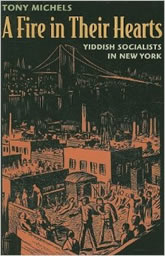
A Fire in Their Hearts: Yiddish Socialists in New York
Tony Michels. A Fire in Their Hearts: Yiddish Socialists in New York. Harvard University Press, 2005.
In a compelling history of the Jewish community in New York during four decades of mass immigration, Tony Michels examines the defining role of the Yiddish socialist movement in the American Jewish experience. The movement, founded in the 1880s, was dominated by Russian-speaking intellectuals, including Abraham Cahan, Mikhail Zametkin, and Chaim Zhitlovsky. Socialist leaders quickly found Yiddish essential to convey their message to the Jewish immigrant community, and they developed a remarkable public culture through lectures and social events, workers’ education societies, Yiddish schools, and a press that found its strongest voice in the mass-circulation newspaper Forverts. Arguing against the view that socialism and Yiddish culture arrived as Old World holdovers, Michels demonstrates that they arose in New York in response to local conditions and thrived not despite Americanization, but because of it. And the influence of the movement swirled far beyond the Lower East Side, to a transnational culture in which individuals, ideas, and institutions crossed the Atlantic. New York Jews, in the beginning, exported Yiddish socialism to Russia, not the other way around. The Yiddish socialist movement shaped Jewish communities across the United States well into the twentieth century and left an important political legacy that extends to the rise of neoconservatism. A story of hopeful successes and bitter disappointments, A Fire in Their Hearts brings to vivid life this formative period for American Jews and the American left.

Ben Tillman and the Reconstruction of White Supremacy
Stephen Kantrowitz. Ben Tillman and the Reconstruction of White Supremacy. UNC Press, 2000.
Through the life of Benjamin Ryan Tillman (1847-1918), South Carolina’s self-styled agrarian rebel, this book traces the history of white male supremacy and its discontents from the era of plantation slavery to the age of Jim Crow. As an anti-Reconstruction guerrilla, Democratic activist, South Carolina governor, and U.S. senator, Tillman offered a vision of reform that was proudly white supremacist. In the name of white male militance, productivity, and solidarity, he justified lynching and disfranchised most of his state’s black voters. His arguments and accomplishments rested on the premise that only productive and virtuous white men should govern and that federal power could never be trusted. Over the course of his career, Tillman faced down opponents ranging from agrarian radicals to aristocratic conservatives, from woman suffragists to black Republicans. His vision and his voice shaped the understandings of millions and helped create the violent, repressive world of the Jim Crow South. Friend and foe alike–and generations of historians–interpreted Tillman’s physical and rhetorical violence in defense of white supremacy as a matter of racial and gender instinct. This book instead reveals that Tillman’s white supremacy was a political program and social argument whose legacies continue to shape American life.

Hoosier Schools: Past and Present
William Reese. Hoosier Schools: Past and Present. Indiana University Press, 1998.
Since the 1980s the U.S. has been preoccupied by school reform. Demands by parents, reformers, and politicians have included a return to basics, a longer school year, accountability through statewide testing, more effective vocational training, and workforce preparation for a more global, technological economy. Activists sometimes forget that schools are a product of history, that many proposed reforms have been tried before with mixed results, and that understanding the past offers a valuable perspective on current efforts to improve schools. Indian turned to public schools in the mid-nineteenth century to help solve a host of social, political, and economic problems. Despite conservative critics’ fears of ‘creeping federalism,’ public schools remain largely a state and local responsibility. This volume presents a series of original studies of school reform in Indiana, from the crucial decades before the Civil War to the most recent efforts to reshape local schools for a postmodern society.

The Origins of the American High School
William Reese. The Origins of the American High School. Yale University Press, 1995.
This engrossing book tells the story of American high schools in the nineteenth century. William Reese analyzes the social changes and political debates that shaped these institutions across the nation—from the first public high school, established in Massachusetts in 1821, to the 1880s, by which time a majority of secondary students in the North were enrolled in high schools. Reese also explores in generous detail the experience of going to school. Drawing on the writings of local educators and school administrators as well as on student newspapers, diaries, and memoirs, he brings to life the high schools of a century ago, revealing what students studied and how they behaved, what teachers expected of them and how they taught, and how boys and girls, whites and blacks, and children in different parts of the nation perceived their schools. America’s earliest public high schools were built in major cities along the eastern seaboard, and they became an important factor in the building of free public school systems, bringing a broad range of middle-class citizens into their orbit. Reese shows that although high schools were condemned by critics as elite institutions of classical learning, they were in fact largely dedicated to offering talented, mostly middle-class youth a quality education in modern, practical subjects.

The Social History of American Education
William Reese. The Social History of American Education. University of Illinois Press, 1988.
For over twenty-five years, the History of Education Quarterly has served as the meeting ground for a generation of the leading experts in educational and social history. For scholars and students alike, Edward McClellan and William Reese bring together the major ideas of some of its most prominent contributors. Bridging the span of American education history from the colonial era to the present, these essays offer extensive coverage of such topics as women’s education, the education of minority groups, and the social dimensions of educational reform.

Power and the Promise of School Reform: Grassroots Movements During the Progressive Era
William Reese. Power and the Promise of School Reform: Grassroots Movements During the Progressive Era. Rev. edition, Teachers College Press, 1986.
This book is a comparative analysis of the tensions, compromises and conflicts over school reform in four urban school systems in the United States. In examining the contradictory forces that shaped urban education in the U.S., it illuminates how grassroots movements operated during the early twentieth century. Unlike many of the standard histories of American education, which focus on New England and Eastern cities, this study analyzes schooling in Rochester, New York; Toledo, Ohio; Milwaukee, Wisconsin; and Kansas City, Missouri. It explores the ways in which diverse community groups struggled to make local schools responsive institutions in a time of dramatic change. School reform was a dominant motif of the Progressive era, but community organizations from local Socialists to parent-teacher associations fought against the contemporary trend toward centralization and elitist politics. This book focuses on the social movements and people instrumental in the struggle for reforms, describing how organized women, labor, and urban radicals became dynamic, resourceful and successful participants in movements to improve schools in local communities.