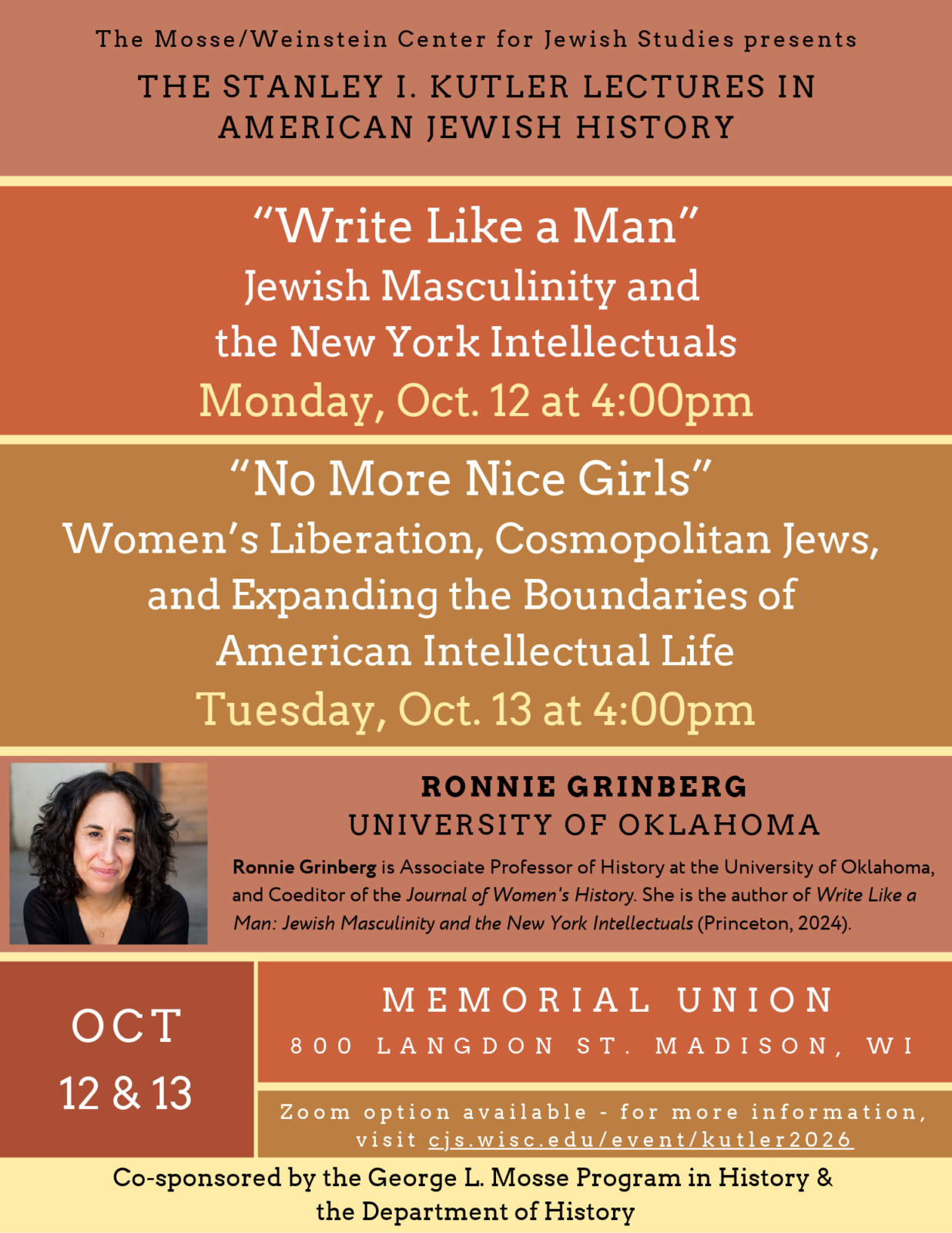
“Write Like a Man: Jewish Masculinity and The New York Intellectuals” | 2026 Stanley I. Kutler Lectures in American Jewish History
Ronnie Grinberg (University of Oklahoma)
Memorial Union (Check “Today in the Union” screens for exact room)
Also available on Zoom – Register Here: https://uwmadison.zoom.us/meeting/register/MG-BXxgeRfuktd_ITDMdPg#/registration
“Write Like a Man: Jewish Masculinity and The New York Intellectuals”
In the years following World War II, a group of mostly male and Jewish writers—raised in the immigrant ghettos of Manhattan, Brooklyn, and the Bronx—became some of the most renowned critics and writers in the country. Known as the New York intellectuals, this group also included a handful of non-Jews and women. This talk explores how gender and Jewishness intersected to shape their understanding of, and approach to, the life of the mind. Men and women, Jews and non-Jews alike embraced a uniquely American conception of Jewish masculinity—one that prized verbal confrontation, polemical aggression, and an unflinching style of argument—with profound implications for American intellectual life and politics in the second half of the twentieth century.
About the speaker:
Ronnie Grinberg is Associate Professor of History at the University of Oklahoma and Coeditor of the Journal of Women’s History. She is the author of Write Like a Man: Jewish Masculinity and the New York Intellectuals (Princeton University Press, 2024; paperback 2026), which was longlisted for a National Book Critics Circle (NBCC) award, was a finalist in two categories for the National Jewish Book Award, and received honorable mention for the Saul Viener Book Prize from the American Jewish Historical Society Academic Council. The book also received wide critical acclaim in venues including The New York Times, The Wall Street Journal, The Washington Post, and The Times Literary Supplement. She is currently co-editing a volume on the subject of an American Jewish intellectual tradition(s), to be published by Rutgers University Press, and is working on a new project examining the intersection of secular Jewishness and second-wave feminism.
Sponsored by Mosse/Weinstein Center for Jewish Studies, George L. Mosse Program in History, and Department of History