“The Return of the Tupinambá Cloak: Indigenous Art, Memory, and Politics”
Elisa Frühauf Garcia (Fluminense Federal University – Brazil (UFF))
This event has passed.
Auditorium, Chazen Museum of Art
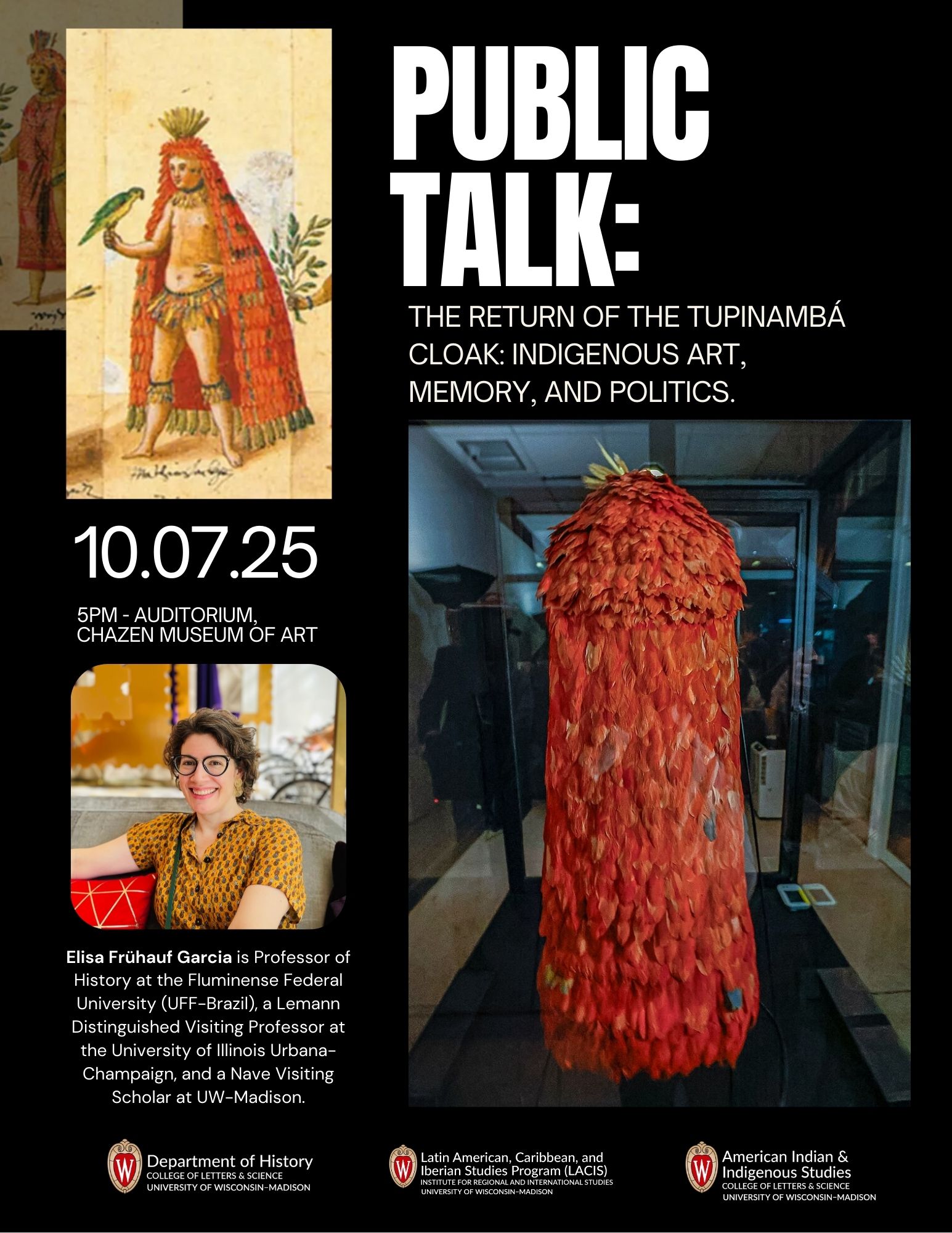 This talk will explore the recent return of the Tupinambá cloak to Brazil and the broader questions it raises around Indigenous identity, cultural repatriation, and historical memory. Prof. Frühauf Garcia is an expert on the Indigenous peoples of Brazil. Her current research focuses on the relationships between Native women and European men in the sixteenth and early seventeenth centuries. This work connects history, cultural heritage, and different uses of the past.
This talk will explore the recent return of the Tupinambá cloak to Brazil and the broader questions it raises around Indigenous identity, cultural repatriation, and historical memory.
Free and open to all. RSVPs appreciated, walk-ins welcome.
Contact: 608-263-2246, events@chazen.wisc.edu
Professor Elisa Frühauf Garcia is professor of history at the Fluminense Federal University – Brazil (UFF), where she received her PhD in history. She has completed postdoctoral research at the State University of Campinas (Unicamp) and at the Spanish National Research Council (CSIC) in Madrid (Spain). Currently, she is the Lemann Distinguished Visiting Professor at the University of Illinois Urbana-Champaign, where she teaches History of Brazil and Transnational Feminisms.
Garcia is an expert on the Indigenous peoples of Brazil. Her current research focuses on the relationships between Native women and European men in the sixteenth and early seventeenth centuries. Adopting a long-term perspective, her work connects history, cultural heritage, and different uses of the past.
Garcia’s visit at UW–Madison is co-sponsored by the Department of History, the Latin American, Caribbean and Iberian Studies (LACIS), the American Indian & Indigenous Studies Program, and the Chazen Museum of Art.
This talk will explore the recent return of the Tupinambá cloak to Brazil and the broader questions it raises around Indigenous identity, cultural repatriation, and historical memory. Prof. Frühauf Garcia is an expert on the Indigenous peoples of Brazil. Her current research focuses on the relationships between Native women and European men in the sixteenth and early seventeenth centuries. This work connects history, cultural heritage, and different uses of the past.
This talk will explore the recent return of the Tupinambá cloak to Brazil and the broader questions it raises around Indigenous identity, cultural repatriation, and historical memory.
Free and open to all. RSVPs appreciated, walk-ins welcome.
Contact: 608-263-2246, events@chazen.wisc.edu
Professor Elisa Frühauf Garcia is professor of history at the Fluminense Federal University – Brazil (UFF), where she received her PhD in history. She has completed postdoctoral research at the State University of Campinas (Unicamp) and at the Spanish National Research Council (CSIC) in Madrid (Spain). Currently, she is the Lemann Distinguished Visiting Professor at the University of Illinois Urbana-Champaign, where she teaches History of Brazil and Transnational Feminisms.
Garcia is an expert on the Indigenous peoples of Brazil. Her current research focuses on the relationships between Native women and European men in the sixteenth and early seventeenth centuries. Adopting a long-term perspective, her work connects history, cultural heritage, and different uses of the past.
Garcia’s visit at UW–Madison is co-sponsored by the Department of History, the Latin American, Caribbean and Iberian Studies (LACIS), the American Indian & Indigenous Studies Program, and the Chazen Museum of Art.