“Race, Immigration, and Mass Removals”
Marla A. Ramírez (UW-Madison), Kevin R. Johnson (UC Davis), Elliott Young (Lewis and Clark College)
This event has passed.
UW Memorial Library, 126
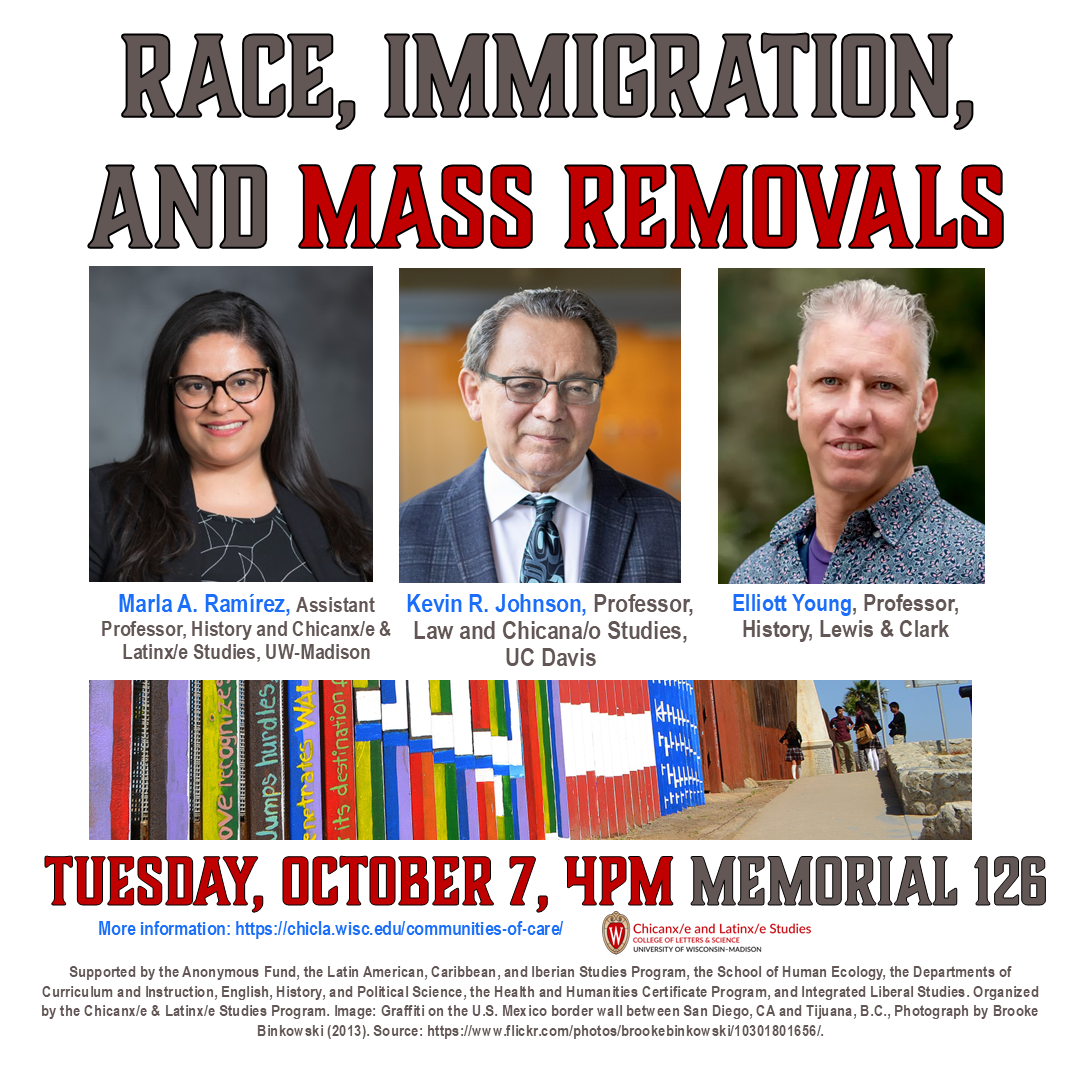 This panel explores the history of diverse immigrant communities in the United States, including Asian and Latinx/e experiences. The panelists provide a historical overview of immigration and exclusion across racial and ethnic lines. Combined, these presentations illuminate the drastic effects of immigration policies on historically marginalized communities. Despite their marginalization, as the panelists have shown, immigrant communities have created a sense of home in the United States and found creative ways to function as transnational families across national borders.
Want to join the event remotely? Register online to receive a link.
Speakers:
Marla Ramírez is a historian of the US –Mexico borderlands. She investigates how processes of mass immigration removals have imposed notions of illegality on citizens in their own native countries.
Kevin R. Johnson is a Distinguished Professor of Law, Mabie-Apallas Professor of Public Interest Law and Martin Luther King Jr. Professor of Law, and professor of Chicana/o studies at UC-Davis.
Elliott Young is a professor in the History Department at Lewis and Clark College. Professor Young is the author of Forever Prisoners: How the United States Made the World’s Largest Immigrant Detention System (Oxford, 2021).
The Chicanx/e & Latinx/e Studies Program is proud to announce its 2025-2026 speaker series, titled “Building Communities of Care and Resilience in Times of Crisis.” As the Program prepares to celebrate its 50th anniversary, it is organizing four panels about Latinx resistance to injustice. Speakers will examine the practices, histories, and social movements that cultivate care and resilience. The series explores not only exclusion and marginalization but also long histories of struggle for enduring change, freedom, and social justice, with a focus on alternative communities of care, alternative models of sociality, and innovative visions of relationality that emerge among Latinx communities in times of crisis and conflict. There will be ample opportunities for students, faculty, staff, and members of the community to exchange ideas with our presenters. The series is made possible by the Anonymous Fund and several campus partners.
This panel explores the history of diverse immigrant communities in the United States, including Asian and Latinx/e experiences. The panelists provide a historical overview of immigration and exclusion across racial and ethnic lines. Combined, these presentations illuminate the drastic effects of immigration policies on historically marginalized communities. Despite their marginalization, as the panelists have shown, immigrant communities have created a sense of home in the United States and found creative ways to function as transnational families across national borders.
Want to join the event remotely? Register online to receive a link.
Speakers:
Marla Ramírez is a historian of the US –Mexico borderlands. She investigates how processes of mass immigration removals have imposed notions of illegality on citizens in their own native countries.
Kevin R. Johnson is a Distinguished Professor of Law, Mabie-Apallas Professor of Public Interest Law and Martin Luther King Jr. Professor of Law, and professor of Chicana/o studies at UC-Davis.
Elliott Young is a professor in the History Department at Lewis and Clark College. Professor Young is the author of Forever Prisoners: How the United States Made the World’s Largest Immigrant Detention System (Oxford, 2021).
The Chicanx/e & Latinx/e Studies Program is proud to announce its 2025-2026 speaker series, titled “Building Communities of Care and Resilience in Times of Crisis.” As the Program prepares to celebrate its 50th anniversary, it is organizing four panels about Latinx resistance to injustice. Speakers will examine the practices, histories, and social movements that cultivate care and resilience. The series explores not only exclusion and marginalization but also long histories of struggle for enduring change, freedom, and social justice, with a focus on alternative communities of care, alternative models of sociality, and innovative visions of relationality that emerge among Latinx communities in times of crisis and conflict. There will be ample opportunities for students, faculty, staff, and members of the community to exchange ideas with our presenters. The series is made possible by the Anonymous Fund and several campus partners.