“Politics of the Sword: Ideology and the Martial in Early Modern Japan”
Michael Wert (Marquette University)
This event has passed.
Curti Lounge (5233 Mosse Humanities)
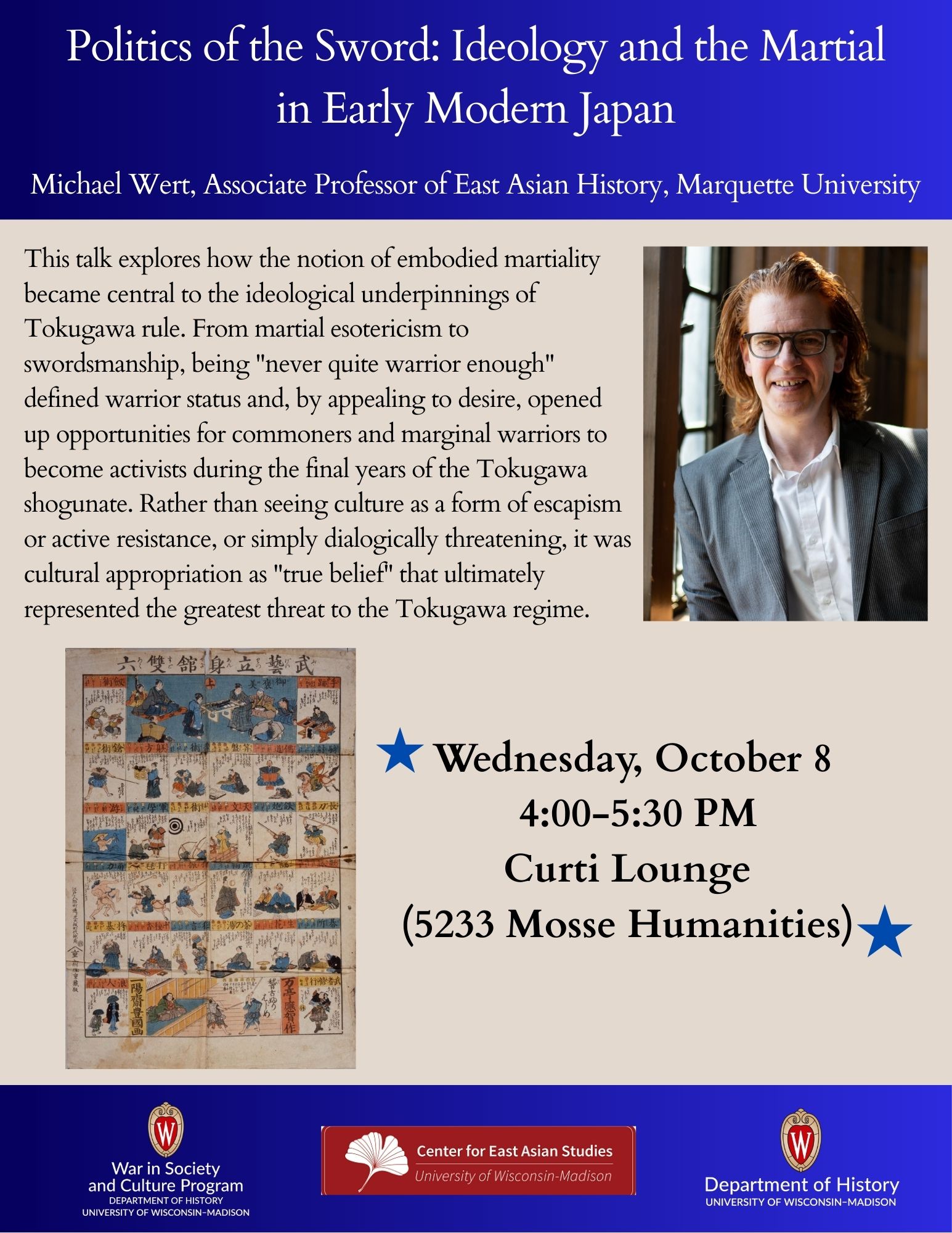 This talk explores how the notion of embodied martiality became central to the ideological underpinnings of Tokugawa rule. From martial esotericism to swordsmanship, being “never quite warrior enough” defined warrior status and, by appealing to desire, opened up opportunities for commoners and marginal warriors to become activists during the final years of the Tokugawa shogunate. Rather than seeing culture as a form of escapism or active resistance, or simply dialogically threatening, it was cultural appropriation as “true belief” that ultimately represented the greatest threat to the Tokugawa regime.
Sponsored by the War in Society and Culture Program, Center for East Asian Studies, and Department of History
This talk explores how the notion of embodied martiality became central to the ideological underpinnings of Tokugawa rule. From martial esotericism to swordsmanship, being “never quite warrior enough” defined warrior status and, by appealing to desire, opened up opportunities for commoners and marginal warriors to become activists during the final years of the Tokugawa shogunate. Rather than seeing culture as a form of escapism or active resistance, or simply dialogically threatening, it was cultural appropriation as “true belief” that ultimately represented the greatest threat to the Tokugawa regime.
Sponsored by the War in Society and Culture Program, Center for East Asian Studies, and Department of History