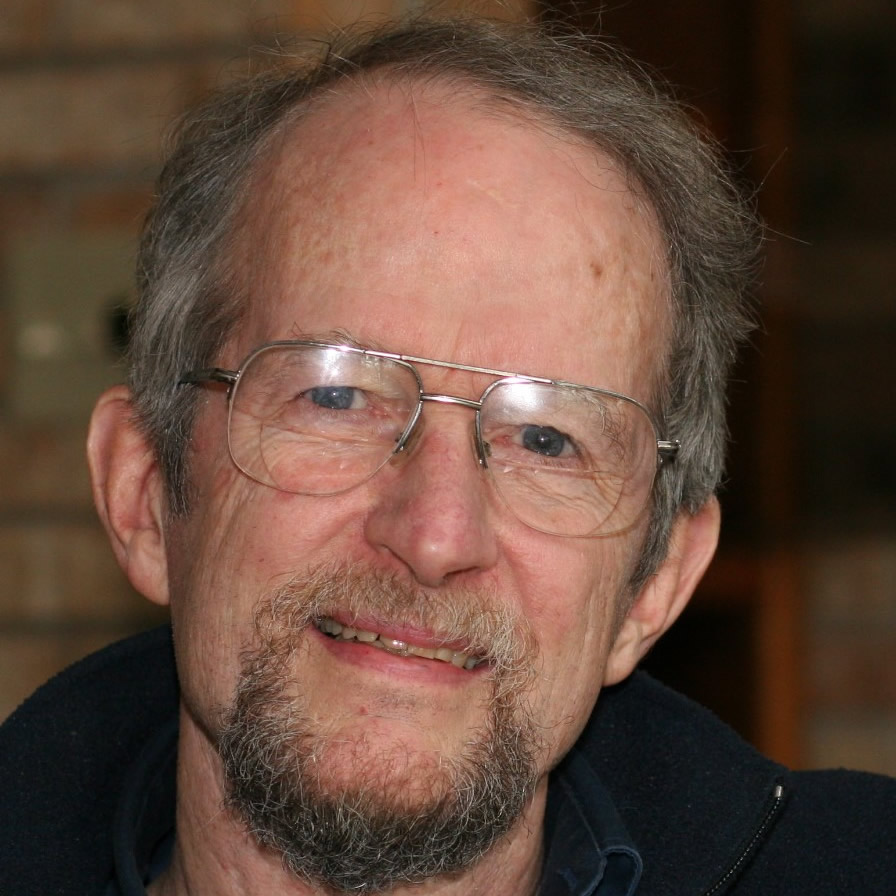
Biography
Biography
While serving in the Peace Corps in Tanzania, I became fascinated with exploring the little known history of Africa and Africans. In pursuit of this, I have conducted extensive fieldwork in Kenya and Tanzania and written widely on pre-colonial history and the methods historians employ to recover, reconstruct, and interpret it. I have taught at Latrobe University in Australia, Williams College, and the University of Wisconsin, where I also served as Director of the African Studies Program and Chair of the History Department. I have served as editor of the Journal of African History, founding editor-in-chief of Oxford Bibliographies: African Studies, 2011-2017, and founding editor-in-chief of Oxford Research Encyclopedia of African History, 2015-present. I have received grants and fellowships from the Guggenheim Foundation, the National Endowment for the Humanities, the Social Science Research Council, and the American Council of Learned Societies, among others, for my research, and received the Waldo G. Leland Prize in 2021 from the American Historical Association for the most outstanding reference work in the past five years, for The Oxford Encyclopedia of African Historiography: Methods and Sources.
Research Interests: Pre-colonial African History, East African History, Southern African history, and historical methods and theory.
Education
Ph.D., University of Wisconsin–Madison
M.A., University of Wisconsin–Madison
B.A., Williams College
Books
The Oxford Encyclopedia of African Historiography: Methods and Sources
Thomas Spear. The Oxford Encyclopedia of African Historiography: Methods and Sources. Oxford University Press, 2019.
The difficulties of exploring African history, especially for earlier periods, have spurred the development of a wide range of methodologies and approaches, such that Wyatt McGaffey once termed it “the decathlon of the social sciences.” Historians have long utilized archaeology, ethnography, historical linguistics, and oral traditions in their study of the continent, but are only beginning to explore the possibilities of genetics or many of the techniques used by modern archaeology and other emerging sciences. And as digital sources-from historical documents and statistics to cartographic, climatic, demographic, and environmental modeling-proliferate, so do the problems in using them. The Oxford Encyclopedia of African Historiography: Methods and Sources examines how these developments have influenced the scholarship that historians produce. Such methods continue to evolve, demanding that historians develop basic understandings of them. Thus, the two-volume Encyclopedia builds a theoretical foundation for the field, expanding the ways that Africa can be studied, and recovering the histories of the continent that often appear outside of the documentary record.
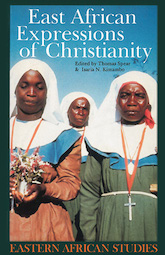
East African Expressions: Of Christianity
Isaria N. Kimambo (Editor), and Thomas Spear (Editor). East African Expressions: Of Christianity. Ohio University Press, 1999.
Christianity has been spread in Africa by Africans. It is the story of peoples seizing control of their own spiritual destinies—rather than the commonplace notion that the continent’s Christian churches represent colonial and capitalist powers that helped subdue Africans to European domination. In short, once introduced, Christianity took on a powerful life of its own and spun out of the control of those who would retain ownership of doctrine and practice. East African Expressions of Christianity examines the experiences of African Christians as they explored the new faith, interpreted it in the context of their own values, appropriated it for themselves, and forged their own distinctive churches. Prominent Tanzanian and American historians, anthropologists, political scientists, and church people examine the translation of religious meanings across cultural boundaries; the religious and social appeal of the new faith; and the vital roles played by African evangelists, teachers, and translators in the spread of Christianity and the development of an African church.
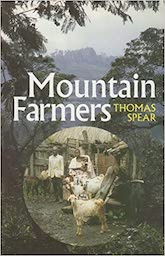
Mountain Farmers: Moral Economies of Land and Agricultural Development in Arusha and Meru
Thomas Spear. Mountain Farmers: Moral Economies of Land and Agricultural Development in Arusha and Meru. University of California Press, 1997.
This work examines the struggle between the Meru and Arusha peoples and their German and British rulers over the issue of land and agricultural development on Mount Meru in northern Tanzania. It shows how the Meru and Arashi, faced with an iron ring of land alienated by European settlers successfully intensified their own irrigated agriculture to bring about what has been termed an indigenous agricultural revolution.
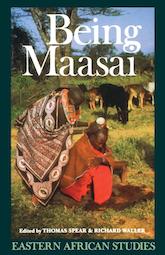
Being Maasai: Ethnicity and Identity in East Africa
Thomas Spear (Editor), and Richard Waller (Editor). Being Maasai: Ethnicity and Identity in East Africa. Ohio University Press, 1993.
Everyone “knows” the Maasai as proud pastoralists who once dominated the Rift Valley from northern Kenya to central Tanzania. But many people who identity themselves as Maasai, or who speak Maa, are not pastoralist at all, but farmers and hunters. Over time many different people have “become” something else. And what it means to be Maasai has changed radically over the past several centuries and is still changing today. This collection by historians, archaeologists, anthropologists and linguists examines how Maasai identity has been created, evoked, contested, and transformed from the time of their earliest settlement in Kenya to the present, as well as raising questions about the nature of ethnicity generally.
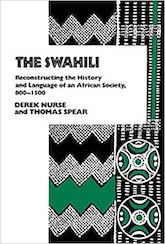
The Swahili: Reconstructing the History and Language of an African Society, 800-1500
Derek Nurse, and Thomas Spear. The Swahili: Reconstructing the History and Language of an African Society, 800-1500. University of Pennsylvania Press, 1985.
“The authors, respectively a linguist specializing in Swahili and related Bantu languages and a historian specializing in the history of East Africa, have assembled an impressive array of evidence—linguistic, archaeological, documentary, and oral-traditional—in support of the argument that Swahili culture, often regarded as an Arabian transplant on the East African coast, is actually ‘a dynamic synthesis of African and Arabian ideas within an African historical and cultural context.'”—American Anthropologist “A fine achievement, mixing original material, fresh insights, generally excellent use of sources, conciseness, and a highly readable style. As an introduction to how the history of an African society can be reconstructed from largely nonliterate sources, and to the Swahili in particular, it is almost a model work.”—International Journal of African Historical Studies
Kenya’s Past: An Introduction to Historical Methods in Africa
Thomas Spear. Kenya’S Past: An Introduction to Historical Methods in Africa. Addison-Wesley Longman, 1981.
The Kaya Complex: A History of the Mijikenda Peoples of the Kenya Coast to 1900
Thomas Spear. The Kaya Complex: A History of the Mijikenda Peoples of the Kenya Coast to 1900. Kenya Literature Bureau, 1978.
Selected Publications
- “Methods and Sources,” Journal of African History, 47(2006), 305-319.
- “Neo-Traditionalism and the Limits of Invention in British Colonial Africa,” Journal of African History, 44(2003), 1-26.
- “Early Swahili History Reconsidered,” International Journal of African Historical Studies, 33(2000), 256-288.
- “‘A Town of Strangers’ or ‘A Model East African Town’: Arusha and the Arusha” in D. A. Anderson & R. Rathbone (eds.), Africa’s Urban Past (Oxford: James Currey; Portsmouth: Heinemann, 2000), 109-125.
- “Mutesa, the Missionaries, and Christian Conversion in Buganda” (with Jean Brierley), International Journal of African Historical Studies, 21(1988), 601-618.
- “Oral Traditions: Whose History?” History in Africa, 8(1981), 163-179. Revised and reprinted in Journal of Pacific History, 16(1981), 133-148.
Awards
- The Waldo G. Leland Prize from the American Historical Association for the most outstanding reference work in the past five years, for The Oxford Encyclopedia of African Historiography: Methods and Sources, 2021.
- John Simon Guggenheim Foundation Fellowship, 1995-96
- University of Wisconsin: Vilas Associate, 1995-97
- Charles R. Keller Professor of History, Williams College, 1992
- Robert Gaudino Scholar, Williams College, 1989-91
- National Endowment for the Humanities: Fellowship for College Teachers, 1987-88
- Melville J. Herskovits Prize in African Studies: Finalist, 1986, for The Swahili (with Derek Nurse).
- Social Science Research Council/American Council of Learned Societies Foreign Area Fellowship, 1970-72
- A.C. Jordan Prize: Best Essay in African Studies, University of Wisconsin, 1972
History Courses Taught
- History 377: History of Africa: 1500-1880
- History 378: History of Africa from 1880
- History 444: History of East Africa
- History 446: History of Southern Africa
- Africa and the Diaspora: Theory and Practice
- African Christianity
- African Environmental History
- Historical Methods for Pre-Literate Societies
- ‘Mau Mau’ and Colonialism in Kenya
- Religion and Resistance
- The Zulu State & the Mfecane