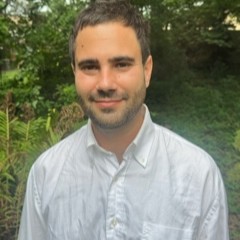
Oliver Lazarus
Assistant Professor of History
Office: 3279 Levy Hall
Office Hours: TBA
I am an environmental historian of the modern United States, specializing in histories of science and capitalism. I am particularly interested in how the production of knowledge about and the manipulation of the nonhuman world have shaped, and have been shaped by, U.S. state formation and capital accumulation.
My first book project, tentatively titled Domesticating Empire: American Power and the Industrialization of Life, asks how the animal agriculture industry became the largest user of land in the world, with roughly 100 billion farmed animals occupying or consuming the resources of nearly 40 percent of global habitable land. Foregrounding the role of the USDA and public agricultural science, I argue that the state-led scientific management of domestic animal life was at once a central pillar of modern U.S. state formation and a key force in the global expansion of industrial animal agriculture. The project traces this history from the animal disease crises of the 1870s and 1880s, which prompted the creation of the first permanent federal regulatory agency, through the colonization of the Philippines, to Cold War technical assistance programs that disseminated American breeds, crops, and veterinary regimes around the world. Drawing on archival research and fieldwork in the U.S., the Philippines, and Brazil, Domesticating Empire positions domestic animals, and the institutions and environments needed to support them, as key vectors of American power at home and abroad, showing how the governance of animal life has been inseparable from that of humans.
My previous research has examined the relationship between urban development and animal life, focusing in particular on the Great Epizootic of 1872, a horse influenza that effectively halted daily life in New York City for weeks. This work revealed how the construction of industrial urban capitalism was carried out by and through a concomitant industrialization of nonhuman life, and the limits of both. A second project in early development turns from the animals American state apparatuses have cultivated to those deemed hazardous, examining the history of federal wildlife management and how environments are reshaped in the absence of animals marked for elimination.
My teaching areas include U.S. environmental history, agricultural history, animal history, the history of capitalism, and the history of science.
Education
Ph.D., Harvard University
M.A., New York University
B.A., Washington University in St. Louis
Selected Presentations
- “The Pen and the Plow: American Agricultural Science and the Infrastructures of Domestication,” STS Circle at Harvard (Cambridge, MA, November 2025).
- “The Progressive Animal: Agricultural Science, the State, and the Making of Modern Animal Life,” History of Science Society (New Orleans, LA, November 2025).
- “Lands of Competition: Domestic Animals, Colonization, and Early U.S. Cold War Aid,” New Perspectives on Animal Agriculture Workshop, Center for History and Economics, Harvard University (Cambridge, MA, March 2025).
Selected Awards and Funding
- Affiliate, “University Ecologies and the Question of the Commons,” Tufts University (2025–2026)
- Center for American Political Studies Dissertation Research Fellowship (Spring 2024)
- Society for Historians of American Foreign Relations W. Stull Holt Dissertation Fellowship (Winter 2024)
History Courses
- History 201 – Local Fields, Global Forces: Wisconsin Agriculture and Environmental Change
- History 460 – American Environmental History