Faculty Books
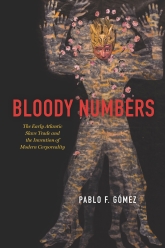
Bloody Numbers: The Early Atlantic Slave and the Invention of the Modern Corporeality
Pablo F. Gómez. Bloody Numbers: The Early Atlantic Slave and the Invention of the Modern Corporeality. University of Chicago Press, 2026.
Bloody Numbers is a provocative account of the violent world of the sixteenth and early seventeenth-century South Atlantic slave-trading societies, where traders, officials, notaries, and ship captains began thinking about human bodies as aggregate populations understood through numbers: measurements, averages, and calculations of risk and value assessed through the tabulation of heights, weights, tumors, scars, and other characteristics. Pablo F. Gómez explores how figures within the Spanish, Portuguese, and African slave trades used this model for understanding human bodies to generalize about behavior and disease in ways that foreshadowed the work of modern epidemiologists and public health officials—though they employed their probabilities with the brutal aim of protecting their financial interests rather than caring for enslaved people. The ruthlessness inherent in these practices became ingrained in the modern corporeal mathematics that emerged from the early slave trade and diffused through its vast political, financial, logistical, and intellectual networks. A pathbreaking work, Bloody Numbers reveals the historical actions that rendered populations quantifiable. In doing so, Gómez shows that confronting these origins is essential to understanding the violent political, legal, economic, and scientific practices that ascribe numbers to our own bodies.

Banished Citizens: A History of the Mexican American Women Who Endured Repatriation
Marla A. Ramírez. Banished Citizens: A History of the Mexican American Women Who Endured Repatriation. Harvard University Press, 2025.
A moving portrait of a grim period in American immigration history, when approximately one million ethnic Mexicans—mostly women and children who were US citizens—were forced to relocate across the southern border. From 1921 to 1944, approximately one million ethnic Mexicans living in the United States were removed across the border to Mexico. What officials called “repatriation” was in fact banishment: 60 percent of those expelled were US citizens, mainly working-class women and children whose husbands and fathers were Mexican immigrants. Drawing on oral histories, transnational archival sources, and private collections, Marla A. Ramírez illuminates the lasting effects of coerced mass removal on three generations of ethnic Mexicans.

Mutiny on the Black Prince: Slavery, Piracy, and the Limits of Liberty in the Revolutionary Atlantic World
James Sweet. Mutiny on the Black Prince: Slavery, Piracy, and the Limits of Liberty in the Revolutionary Atlantic World. Oxford University Press, 2025.
The dramatic story of a mutiny aboard an eighteenth-century British ship and how its owners effectively rallied the power of the British Crown to protect their investment and expand their wealth and political power across multiple generations. In 1768, the British slave ship Black Prince, departed the port of Bristol, bound for West Africa. It never arrived. Before reaching Old Calabar, the crew mutinied, murdering the captain and his officers. The mutineers renamed the ship Liberty, elected new officers, and set out for Brazil. By the time the ship arrived there, the crew had disintegrated into a violent mob and fired into the port city. After the Black Prince wrecked off the coast of Hispaniola, the rebels fled to outposts around the Atlantic world. An eight-year manhunt ensued. This book follows the crew’s turn to piracy and the merchant-owners’ response to the uprising. At the very moment that the American Revolution unfolded in North America, the Black Prince’s owners conducted a “shadow” revolution, mobilizing the power of the British Crown to seek justice and restitution on their behalf. These private merchants used state surveillance, policing, extradition, capital punishment, international diplomacy, and even warfare in order to protect their wealth. During an era of professed liberty and freedom, the privatization of state power was already emerging, replacing monarchies with corporate oligarchies, presaging a new kind of political power in the Atlantic world. The eighteenth-century Bristol slave merchants and subsequent generations of their families accrued great fortunes from the trade and invested it in early British banks, railroads, insurance companies, industrial manufacturing, and even the Anglican Church. Mutiny on the Black Prince narrates the dramatic story of the events onboard and the merchant owners’ efforts to capture the rebels from around the Atlantic world, as well as the way that British slavery shaped the industrializing Atlantic economy and the evolution of the modern corporate state.
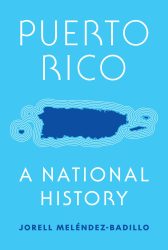
Puerto Rico: A National History
Jorell Meléndez-Badillo. Puerto Rico: A National History. Princeton University Press, 2024.
Puerto Rico is a Spanish-speaking territory of the United States with a history shaped by conquest and resistance. For centuries, Puerto Ricans have crafted and negotiated complex ideas about nationhood. Jorell Meléndez-Badillo provides a new history of Puerto Rico that gives voice to the archipelago’s people while offering a lens through which to understand the political, economic, and social challenges confronting them today. In this masterful work of scholarship, Meléndez-Badillo sheds light on the vibrant cultures of the archipelago in the centuries before the arrival of Columbus, and captures the full sweep of Puerto Rico’s turbulent history in the centuries that followed, from the first indigenous insurrection against colonial rule in 1511—led by the powerful chieftain Agüeybaná II—to the establishment of the Commonwealth in 1952. He deftly portrays the contemporary period and the intertwined though unequal histories of the archipelago and the continental United States. Puerto Rico is an engaging, sometimes personal, and consistently surprising history of colonialism, revolt, and the creation of a national identity, offering new perspectives not only on Puerto Rico and the Caribbean but on the United States and the Atlantic world more broadly. Available in Spanish from our partners at Grupo Planeta
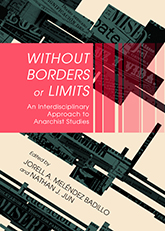
Without Borders or Limits: An Interdisciplinary Approach to Anarchist Studies
Jorell Meléndez-Badillo (Editor). Without Borders or Limits: An Interdisciplinary Approach to Anarchist Studies. Cambridge Scholars Publishers, 2013.
This volume of collected essays brings together conversations, papers, and debates from the Third Annual North American Anarchist Studies Network Conference in San Juan, Puerto Rico. Nathan Jun and Jorell A. Meléndez aspire to go beyond a simple collection of papers and instead aim to maintain a dialogue among different academic fields with the sole task of comprehending and re-thinking anarchist studies. With over twenty-one chapters written by a diverse range of activists, organizers, musicians, artists, poets, and academics, this book transgresses the apparent simplicity of the study of anarchism with a dynamic and interdisciplinary approach that crystallizes and emulates the heterogeneous nature of the anarchist ideal. From theory and philosophy to historical analyses, methodologies, and perspectives, from different manifestations in the arts, media, and culture to religion, ethics, and spirituality, from the intersectionality of animal liberation and queer struggles to contemporary praxis and organizing, the authors explore different topics from a critical perspective that is often lacking in their respective academic fields. This book is a must-buy for critical teachers, students, and activists interested in studying anarchism and the different ways in which we can transform our reality.
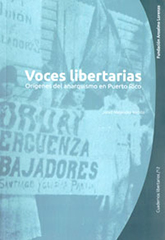
Voces libertarias: Los orígenes del anarquismo en Puerto Rico
Jorell Meléndez-Badillo. Voces Libertarias: Los orígenes Del Anarquismo En Puerto Rico. Secret Sailor Books, 2013; Fundación Anselmo Lorenzo, 2014; Editorial Akelarre, 2015, 2013.
Durante las dos primeras décadas del siglo XX, Puerto Rico será el escenario de una gama de cambios y transformaciones que afectarán a toda su fibra social, económica e ideológica. Es en este contexto de harta complejidad que comienzan a circular las ideas anarquistas dentro de las primeras organizaciones obreras en Puerto Rico. Su (re)producción y auge es producto de la participación de los obreros locales en varias redes trasnacionales de información y propaganda que los conectaban con nodos radicales alrededor del globo. Voces libertarias: Orígenes del anarquismo en Puerto Rico aspira a documentar expresiones anarquistas dentro del ascendente movimiento obrero puertorriqueño durante sus años formativos. Producto de una rígida investigación histórica el texto explora la producción periodística, cultural y organizativa de grupos de obreros radicales a principios del siglo XX. A través de sus páginas, el libro pretende crear una conversación transhistórica con aquellos individuos que intentaron (re)configurar las relaciones sociales y económicas que conformaban su realidad e imaginario social pero fueron tragados por el silencio histórico en el letargo de los tiempos.
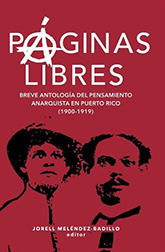
Páginas libres: breve antología del pensamiento anarquista en Puerto Rico
Jorell Meléndez-Badillo (Editor). Páginas Libres: Breve antología Del Pensamiento Anarquista En Puerto Rico. Editora Educación Emergente, 2021.
Páginas libres. Breve antología del pensamiento anarquista en Puerto Rico (1900-1919), compilado y editado con sensible cuidado por Jorell Meléndez-Badillo, suma hilos a una recuperación histórica imprescindible en nuestro país. Con el junte de textos de Venancio Cruz, Luisa Capetillo, Juan Vilar, Juan José López y Ángel María Dieppa esta nueva entrega de la serie Otra Universidad pone en circulación ideas, conexiones, aciertos y silencios de y sobre nuestrxs anarquistas. Así abona la genealogía de esta ignorada propuesta política en nuestro archipiélago y sus filiaciones tanto locales como internacionales. En cada una de estas Páginas libres… se respira la ilustración radical del anarquismo puertorriqueño, su apuesta por el libre pensamiento, su sospecha por las instituciones al uso y su aspiración insobornable por una mejor existencia para todxs. Para Juan Vilar, “La humanidad vive, porque sueña” y ese soñar se concreta en acciones por la vida. Abre este libro, camina a su lado, ponlo en circulación libre y déjate inspirar por sus luminosos sueños. Son posibles.
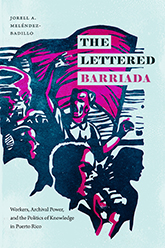
The Lettered Barriada: Workers, Archival Power, and the Politics of Knowledge in Puerto Rico
Jorell Meléndez-Badillo. The Lettered Barriada: Workers, Archival Power, and the Politics of Knowledge in Puerto Rico. Duke University Press, 2021.
In The Lettered Barriada, Jorell A. Meléndez-Badillo tells the story of how a cluster of self-educated workers burst into Puerto Rico’s world of letters and navigated the colonial polity that emerged out of the 1898 US occupation. They did so by asserting themselves as citizens, producers of their own historical narratives, and learned minds. Disregarded by most of Puerto Rico’s intellectual elite, these workers engaged in dialogue with international peers and imagined themselves as part of a global community. They also entered the world of politics through the creation of the Socialist Party, which became an electoral force in the first half of the twentieth century. Meléndez-Badillo shows how these workers produced, negotiated, and deployed powerful discourses that eventually shaped Puerto Rico’s national mythology. By following these ragtag intellectuals as they became politicians and statesmen, Meléndez-Badillo also demonstrates how they engaged in racial and gender silencing, epistemic violence, and historical erasures in the fringes of society. Ultimately, The Lettered Barriada is about the politics of knowledge production and the tensions between working-class intellectuals and the state. Duke University Press Scholars of Color First Book Award recipient
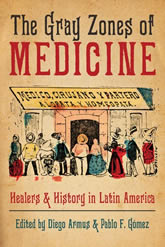
The Gray Zones of Medicine: Healers and History in Latin America
Pablo F. Gómez (Editor), and Diego Armus (Editor). The Gray Zones of Medicine: Healers and History in Latin America. University of Pittsburgh Press, 2021.
Health practitioners working in gray zones, or between official and unofficial medicines, played a fundamental role in shaping Latin America from the colonial period onward. The Gray Zones of Medicine offers a human, relatable, complex examination of the history of health and healing in Latin America across five centuries. Contributors uncover how biographical narratives of individual actors—outside those of hegemonic biomedical knowledge, careers of successful doctors, public health initiatives, and research and medical institutions—can provide a unique window into larger social, cultural, political, and economic historical changes and continuities in the region. They reveal the power of such stories to illuminate intricacies and resilient features of the history of health and disease, and they demonstrate the importance of escaping analytical constraints posed by binary frameworks of legality/illegality, learned/popular, and orthodoxy/heterodoxy when writing about the past. Through an accessible and story-like format, this book unlocks the potential of historical narratives of healings to understand and give nuance to processes too frequently articulated through intellectual medical histories or the lenses of empires, nation-states, and their institutions.
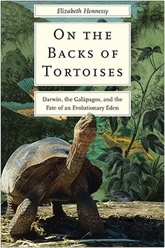
On the Backs of Tortoises: Darwin, the Galapagos, and the Fate of an Evolutionary Eden
Elizabeth Hennessy. On the Backs of Tortoises: Darwin, the Galapagos, and the Fate of an Evolutionary Eden. Yale University Press, 2019.
An insightful exploration of the iconic Galápagos tortoises, and how their fate is inextricably linked to our own in a rapidly changing world The Galápagos archipelago is often viewed as a last foothold of pristine nature. For sixty years, conservationists have worked to restore this evolutionary Eden after centuries of exploitation at the hands of pirates, whalers, and island settlers. This book tells the story of the islands’ namesakes—the giant tortoises—as coveted food sources, objects of natural history, and famous icons of conservation and tourism. By doing so, it brings into stark relief the paradoxical, and impossible, goal of conserving species by trying to restore a past state of prehistoric evolution. The tortoises, Elizabeth Hennessy demonstrates, are not prehistoric, but rather microcosms whose stories show how deeply human and nonhuman life are entangled. In a world where evolution is thoroughly shaped by global history, Hennessy puts forward a vision for conservation based on reckoning with the past, rather than trying to erase it.
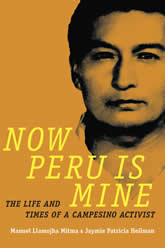
Now Peru is Mine: The Life and Times of a Campesino Activist
Manuel Llamojha Mitma, and Jaymie Patricia Heilman. Now Peru Is Mine: The Life and Times of a Campesino Activist. Duke University Press, 2016.
Born in 1921, Manuel Llamojha Mitma became one of Peru’s most creative and inspiring indigenous political activists. Now Peru Is Mine combines extensive oral history interviews with archival research to chronicle his struggles for indigenous land rights and political inclusion as well as his fight against anti-Indian racism. His compelling story—framed by Jaymie Patricia Heilman’s historical contextualization—covers nearly eight decades, from the poverty of his youth and teaching himself to read, to becoming an internationally known activist. Llamojha also recounts his life’s tragedies, such as being forced to flee his home and the disappearance of his son during the war between the Shining Path and the government. His life gives insight into many key developments in Peru’s tumultuous twentieth-century history, among them urbanization, poverty, racism, agrarian reform, political organizing, the demise of the hacienda system, and the Shining Path. The centrality of his embrace of his campesino identity forces a rethinking of how indigenous identity works inside Peru, while the implications of his activism broaden our understanding of political mobilization in Cold War Latin America.
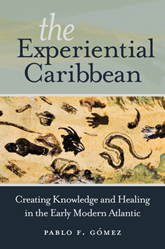
The Experiential Caribbean: Creating Knowledge and Healing in the Early Modern Atlantic
Pablo F. Gómez. The Experiential Caribbean: Creating Knowledge and Healing in the Early Modern Atlantic. University of North Carolina Press, 2018.
Opening a window on a dynamic realm far beyond imperial courts, anatomical theaters, and learned societies, Pablo F. Gómez examines the strategies that Caribbean people used to create authoritative, experientially based knowledge about the human body and the natural world during the long seventeenth century. Gómez treats the early modern intellectual culture of these mostly black and free Caribbean communities on its own merits and not only as it relates to well-known frameworks for the study of science and medicine. Drawing on an array of governmental and ecclesiastical sources—notably Inquisition records—Gómez highlights more than one hundred black ritual practitioners regarded as masters of healing practices and as social and spiritual leaders. He shows how they developed evidence-based healing principles based on sensorial experience rather than on dogma. He elucidates how they nourished ideas about the universality of human bodies, which contributed to the rise of empirical testing of disease origins and cures. Both colonial authorities and Caribbean people of all conditions viewed this experiential knowledge as powerful and competitive. In some ways, it served to respond to the ills of slavery. Even more crucial, however, it demonstrates how the black Atlantic helped creatively to fashion the early modern world.

Neither Peace nor Freedom: The Cultural Cold War in Latin America
Patrick Iber. Neither Peace nor Freedom: The Cultural Cold War in Latin America. Harvard University Press, 2015.
During the Cold War, left-wing Latin American artists, writers, and scholars worked as diplomats, advised rulers, opposed dictators, and even led nations. Their competing visions of social democracy and their pursuit of justice, peace, and freedom led them to organizations sponsored by the governments of the Cold War powers: the Soviet-backed World Peace Council, the U.S.-supported Congress for Cultural Freedom, and, after the 1959 Cuban Revolution, the homegrown Casa de las Américas. Neither Peace nor Freedom delves into the entwined histories of these organizations and the aspirations and dilemmas of intellectuals who participated in them, from Diego Rivera and Pablo Neruda to Gabriel Garcia Marquez and Jorge Luis Borges. Patrick Iber corrects the view that such individuals were merely pawns of the competing superpowers. Movements for democracy and social justice sprung up among pro-Communist and anti-Communist factions, and Casa de las Américas promoted a brand of revolutionary nationalism that was beholden to neither the Soviet Union nor the United States. But ultimately, intellectuals from Latin America could not break free from the Cold War’s rigid binaries. With the Soviet Union demanding fealty from Latin American communists, the United States zealously supporting their repression, and Fidel Castro pushing for regional armed revolution, advocates of social democracy found little room to promote their ideals without compromising them. Cold War politics had offered utopian dreams, but intellectuals could get neither the peace nor the freedom they sought.

Domingos Álvares, African Healing, and the Intellectual History of the Atlantic World
James Sweet. Domingos Álvares, African Healing, and the Intellectual History of the Atlantic World. Chapel Hill, NC: University of North Carolina Press, 2011.
Between 1730 and 1750, powerful healer and vodun priest Domingos Álvares traversed the colonial Atlantic world like few Africans of his time–from Africa to South America to Europe–addressing the profound alienation of warfare, capitalism, and the African slave trade through the language of health and healing. In Domingos Álvares, African Healing, and the Intellectual History of the Atlantic World, James H. Sweet finds dramatic means for unfolding a history of the eighteenth-century Atlantic world in which healing, religion, kinship, and political subversion were intimately connected.

The African Diaspora and the Disciplines
James Sweet, and Tejumola Olaniyan (Co-editor). The African Diaspora and the Disciplines. Indiana University Press, 2010.
Focusing on the problems and conflicts of doing African diaspora research from various disciplinary perspectives, these essays situate, describe, and reflect on the current practice of diaspora scholarship. Tejumola Olaniyan, James H. Sweet, and the international group of contributors assembled here seek to enlarge understanding of how the diaspora is conceived and explore possibilities for the future of its study. With the aim of initiating interdisciplinary dialogue on the practice of African diaspora studies, they emphasize learning from new perspectives that take advantage of intersections between disciplines. Ultimately, they advocate a fuller sense of what it means to study the African diaspora in a truly global way.

Recreating Africa: Culture, Kinship, and Religion in the African-Portuguese World, 1441-1770
James Sweet. Recreating Africa: Culture, Kinship, and Religion in the African-Portuguese World, 1441-1770. Chapel Hill, NC: University of North Carolina Press, 2003.
Exploring the cultural lives of African slaves in the early colonial Portuguese world, with an emphasis on the more than one million Central Africans who survived the journey to Brazil, James Sweet lifts a curtain on their lives as Africans rather than as incipient Brazilians. Focusing first on the cultures of Central Africa from which the slaves came–Ndembu, Imbangala, Kongo, and others–Sweet identifies specific cultural rites and beliefs that survived their transplantation to the African-Portuguese diaspora, arguing that they did not give way to immediate creolization in the New World but remained distinctly African for some time. Slaves transferred many cultural practices from their homelands to Brazil, including kinship structures, divination rituals, judicial ordeals, ritual burials, dietary restrictions, and secret societies. Sweet demonstrates that the structures of many of these practices remained constant during this early period, although the meanings of the rituals were often transformed as slaves coped with their new environment and status. Religious rituals in particular became potent forms of protest against the institution of slavery and its hardships. In addition, Sweet examines how certain African beliefs and customs challenged and ultimately influenced Brazilian Catholicism. Sweet’s analysis sheds new light on African culture in Brazil’s slave society while also enriching our understanding of the complex process of creolization and cultural survival.