
Biography
Biography
Broad interests in the physical sciences (and their analogues and contexts) before 1700. Primary research interests focus on late medieval natural philosophy and astronomy, with special attention to the Viennese tradition and most specifically, of late, the work of Johannes Regiomontanus. Additional related interests: science and the medieval university, science and early printing, and Piero della Francesca.
Education
Ph.D., Harvard University, History of Science, 1983
A.M., Harvard University, History of Science, 1978
M.A., University of Notre Dame, History and Philosophy of Science, 1975
B.A., Goshen College, Physics, 1971
Books
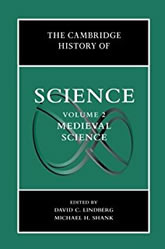
The Cambridge History of Science, Volume 2 Medieval Science
David C. Lindberg (Co-editor), and Michael H. Shank (Co-editor). The Cambridge History of Science, Volume 2 Medieval Science. Vol. 2: Medieval Science, Cambridge University Press, 2013.
This volume in the highly respected Cambridge History of Science series is devoted to the history of science in the Middle Ages from the North Atlantic to the Indus Valley. Medieval science was once universally dismissed as non-existent – and sometimes it still is. This volume reveals the diversity of goals, contexts, and accomplishments in the study of nature during the Middle Ages. Organized by topic and culture, its essays by distinguished scholars offer the most comprehensive and up-to-date history of medieval science currently available. Intended to provide a balanced and inclusive treatment of the medieval world, contributors consider scientific learning and advancement in the cultures associated with the Arabic, Greek, Latin, and Hebrew languages. Scientists, historians, and other curious readers will all gain a new appreciation for the study of nature during an era that is often misunderstood.
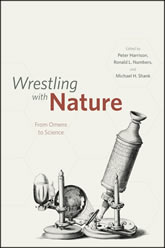
Wrestling with Nature: From Omens to Science
Peter Harrison (Co-editor), and Michael H. Shank (Co-editor). Wrestling With Nature: From Omens to Science. University of Chicago Press, 2011.
When and where did science begin? Historians have offered different answers to these questions, some pointing to Babylonian observational astronomy, some to the speculations of natural philosophers of ancient Greece. Others have opted for early modern Europe, which saw the triumph of Copernicanism and the birth of experimental science, while yet another view is that the appearance of science was postponed until the nineteenth century. Rather than posit a modern definition of science and search for evidence of it in the past, the contributors to Wrestling with Nature examine how students of nature themselves, in various cultures and periods of history, have understood and represented their work. The aim of each chapter is to explain the content, goals, methods, practices, and institutions associated with the investigation of nature and to articulate the strengths, limitations, and boundaries of these efforts from the perspective of the researchers themselves. With contributions from experts representing different historical periods and different disciplinary specializations, this volume offers a fresh perspective on the history of science and on what it meant, in other times and places, to wrestle with nature.
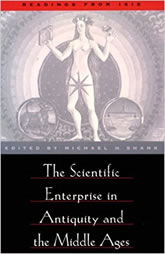
The Scientific Enterprise in Antiquity and Middle Ages: Readings from Isis
Michael H. Shank (Editor). The Scientific Enterprise in Antiquity and Middle Ages: Readings from Isis. University of Chicago Press, 1996.
This stimulating collection of twenty-two articles is intended not only to explore a range of scientific topics but to engage readers in historiographical debates and methodological issues that surround the study of ancient and medieval science. A convenient sampling of classic and contemporary scholarship, it will appeal to students and specialists alike. Contributors include Francesca Rochberg, David Pingree, G. E. R. Lloyd, Heinrich von Staden, Martin Bernal, Alexander Jones, Bernard Goldstein, Alan Bowen, Owsei Temkin, David Lindberg, Steven McCluskey, Linda Voigts, Edward Grant, Bernard Goldstein, Victor Roberts, Lynn Thorndike, Helen Lemay, William Newman, A. Mark Smith, Nancy Siraisi, Michael McVaugh, and Brian P. Copenhaver.
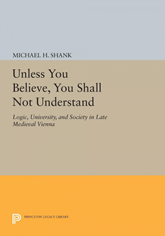
Unless You Believe, You Shall Not Understand: Logic, University, and Society in Late Medieval Vienna
Michael H. Shank. Unless You Believe, You Shall Not Understand: Logic, University, and Society in Late Medieval Vienna. Princeton University Press, 1988.
Founded in 1365, not long after the Great Plague ravaged Europe, the University of Vienna was revitalized in 1384 by prominent theologians displaced from Paris–among them Henry of Langenstein. Beginning with the 1384 revival, Michael Shank explores the history of the university and its ties with European intellectual life and the city of Vienna. In so doing he links the abstract discussions of university theologians with the burning of John Hus and Jerome of Prague at the Council of Constance (1415-16) and the destruction of the Jewish community of Lower Austria (1421). Like most other scholars of the period, Henry of Langenstein (d. 1397) at one time believed that Aristotle’s syllogistic was universally valid even in Trinitarian theology. In touch with the vibrant Jewish community in Vienna, Langenstein had high hopes of converting its members by logical argument. When he failed in his purpose, he lost his confidence in Aristotle’s syllogistic as a universal tool of apologetics and handmaiden to Trinitarian theology. (“Unless you believe, you shall not understand,” he quoted from Isaiah, in order to express his change of opinion.) During the next generation, the intellectual climate at the university changed from academic openness to increasing rigidity, and theologians turned from argument to persecution. First published in 1988.
Selected Publications
- “Regiomontanus and Astronomical Controversy in the Background of Copernicus,” in Rivka Feldhay and Jamil Ragep, eds., Before Copernicus: The Cultures and Contexts of Scientific Learning in the Fifteenth Century (Montreal: McGill-Queen’s University Press, 2017), pp. 79-109, 232-43.
- “The Almagest, Politics, and Apocalypticism in the Conflict between George of Trebizond and Cardinal Bessarion,” Almagest 8.2 (2017), pp. 49-83.
- “Naturalist Tendencies in Late-Medieval Science,” in Peter Harrison and Jon H. Roberts, eds., Science without God? Rethinking the History of Scientific Naturalism [Ian Ramsey Centre Studies in Science and Religion] (Oxford: Oxford University Press, 2018), pp. 37-57.
- “Regiomontanus versus George of Trebizond on Planetary Order, Distances, and Orbs (Almagest 9.1)” in David Juste, Benno van Dalen, and Dag Nikolaus Hasse, and Charles Burnett, eds., Ptolemy’s Science of the Stars in the Middle Ages (Turnhout: Brepols, 2020), pp. 345-426.